


LM139 One Shot Multivibrator/Timer
#LM139
#monostable
#multivibrator
#timer
#pulse generator
#one shot
#fixed pulse
#timing circuit
#electronics
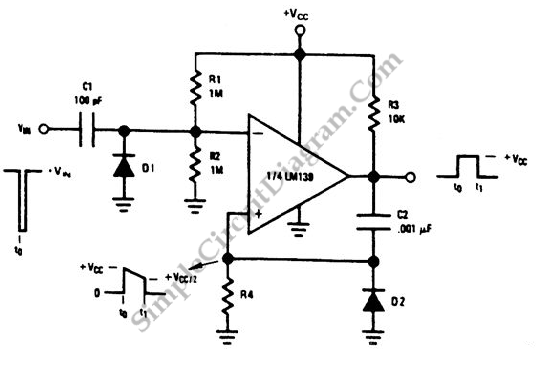
Description: A one-shot multivibrator circuit, commonly referred to as a monostable multivibrator or timer, is designed to generate a pulse strobe of fixed duration in response to an input trigger.
The one-shot multivibrator is a fundamental circuit used in various electronic applications for pulse generation. It operates in a single stable state and transitions to a temporary state when triggered. The primary components of a typical one-shot multivibrator include a timing resistor, a timing capacitor, and a logic gate or a flip-flop configuration.
When a trigger signal is applied to the circuit, it causes the output to switch from its stable low state to a high state for a predetermined period, defined by the RC time constant, which is the product of the resistance (R) and capacitance (C) values used in the timing network. The output then returns to its stable low state after the time period elapses, regardless of the duration of the input trigger.
In practical applications, one-shot multivibrators are utilized in timer circuits, pulse-width modulation, and as delay elements in digital systems. The design can be implemented using discrete components such as resistors, capacitors, and operational amplifiers, or it can be integrated into microcontroller-based systems where software can dictate the timing parameters.
The reliability and precision of the pulse generated by a one-shot multivibrator make it a valuable component in synchronous systems, where timing is critical for the coordinated operation of various electronic devices.One shot multivibrator circuit is also known as monostable multivibrator or timer. The function of such circuit is simply produce a pulse strobe with a fixed..
The one-shot multivibrator is a fundamental circuit used in various electronic applications for pulse generation. It operates in a single stable state and transitions to a temporary state when triggered. The primary components of a typical one-shot multivibrator include a timing resistor, a timing capacitor, and a logic gate or a flip-flop configuration.
When a trigger signal is applied to the circuit, it causes the output to switch from its stable low state to a high state for a predetermined period, defined by the RC time constant, which is the product of the resistance (R) and capacitance (C) values used in the timing network. The output then returns to its stable low state after the time period elapses, regardless of the duration of the input trigger.
In practical applications, one-shot multivibrators are utilized in timer circuits, pulse-width modulation, and as delay elements in digital systems. The design can be implemented using discrete components such as resistors, capacitors, and operational amplifiers, or it can be integrated into microcontroller-based systems where software can dictate the timing parameters.
The reliability and precision of the pulse generated by a one-shot multivibrator make it a valuable component in synchronous systems, where timing is critical for the coordinated operation of various electronic devices.One shot multivibrator circuit is also known as monostable multivibrator or timer. The function of such circuit is simply produce a pulse strobe with a fixed..
Repeating Timer 5
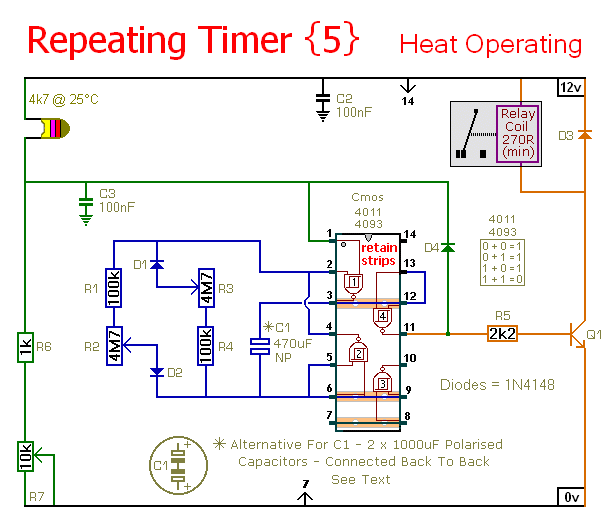
This timer circuit operates only when the temperature exceeds a predetermined level. An alternative version, known as Repeating Timer No. 6, functions while the temperature is below this preset level. The resistor R7 is used to set the temperature threshold....
Airplane Flight Timer
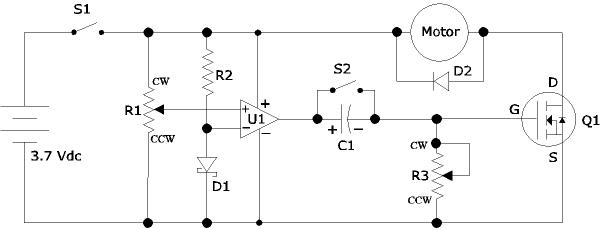
The following circuit illustrates an Airplane Flight Timer Circuit Diagram. Features include switches in the closed position and battery voltage maintained at a safe level.
The Airplane Flight Timer Circuit is designed to provide a reliable timing mechanism for monitoring flight...
Dual Precision Monostable Logic circuit (CD4538BC)
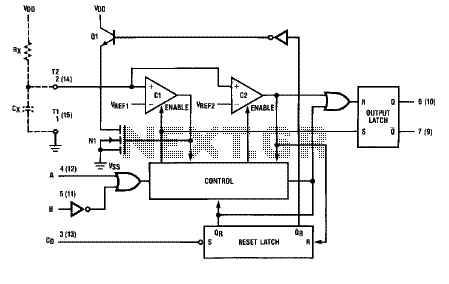
The logic diagram of the CD4538BC Dual Precision Monostable is shown in the following schematic diagram. This IC is a dual, precision monostable multivibrator with independent trigger and controls, according to the datasheet. This CD4538BC IC features a wide supply...
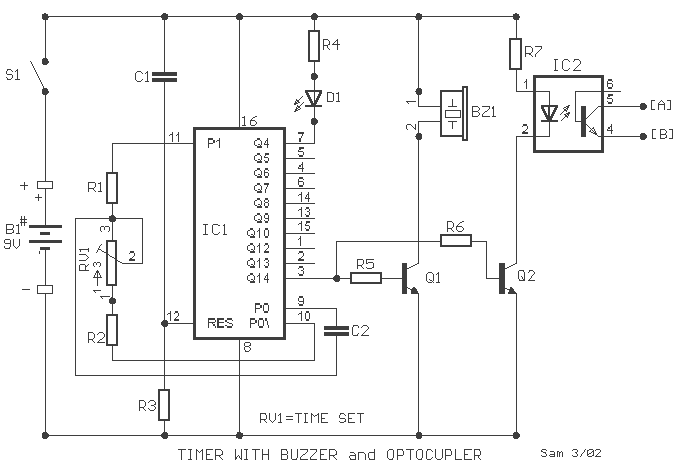
Timer Circuit with optocoupler
A small circuit that can find a lot of applications for measuring time. It has the capability to inform with a sound signal from the BZ1. At the same time, there exists the possibility to drive an external circuit via...

Multivibrator
A multivibrator is an electronic circuit that implements various simple two-state systems, such as oscillators, timers, and flip-flops. The most common type is the astable multivibrator, which continuously oscillates between two states, generating a square wave. Another type is the...
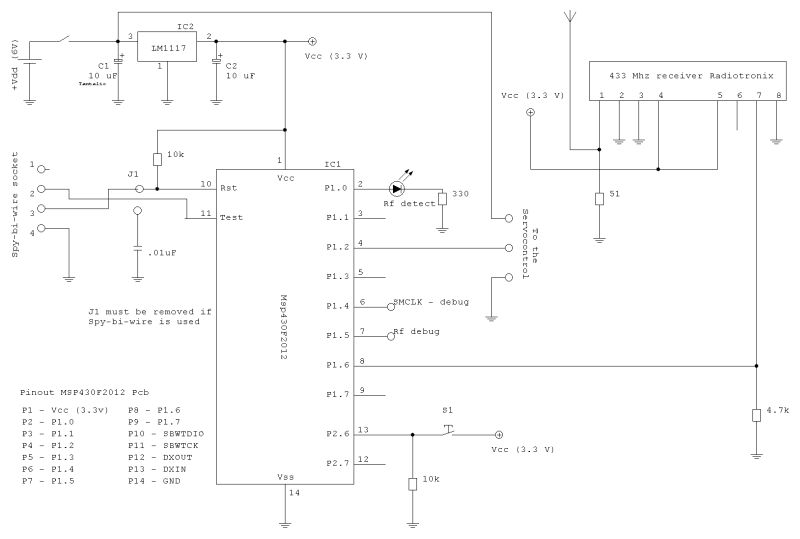
Boba Fett project movement
The timer generates a basic period (for instance, 20 ms), and with certain associated variables, it is possible to activate an I/O pin to produce a signal. By utilizing an 8-bit variable, the generated frequency can be divided into "chunks"...
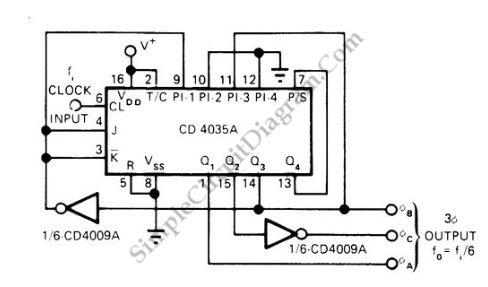
Pulse Generator Produces 3-Phase Output
This is a schematic diagram of a three-phase pulse generator circuit. This circuit produces a three-phase overlapped output similar to a three-phase AC power line.
The three-phase pulse generator circuit is designed to create three-phase output signals that are phase-shifted by...
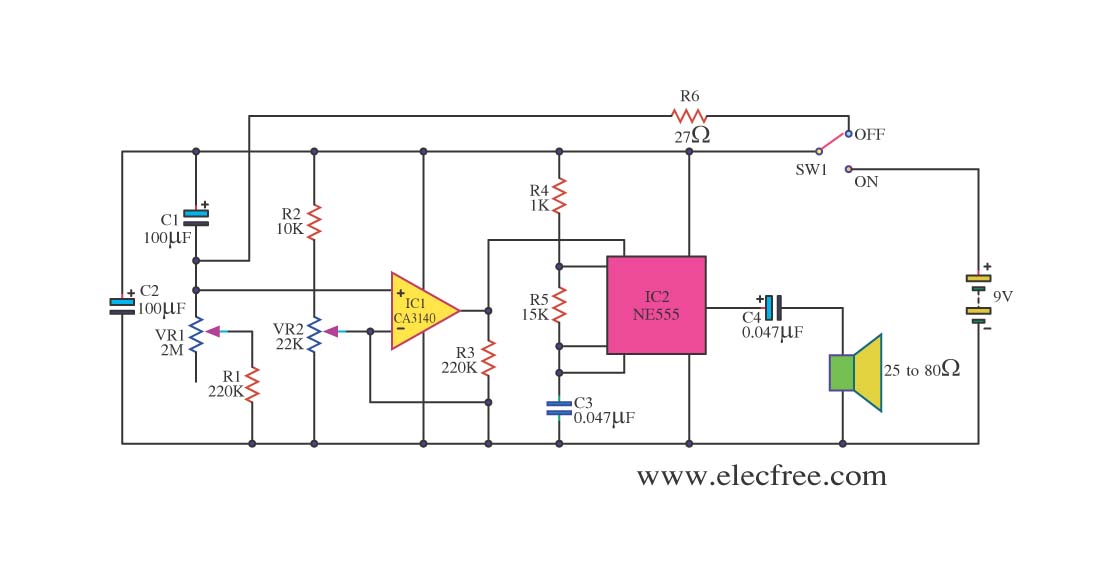
Simple Timer by CA3140 + NE555
This circuit sets the time using a simple model that can accurately maintain the time over extended periods. It employs the CA3140 integrated circuit for its functionality.
The circuit utilizes the CA3140 operational amplifier, which is known for its high precision...
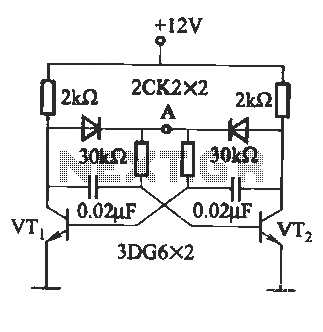
Improved multivibrator circuit
The circuit illustrated in Figure (A) consists of resistors R1 and R2 with values ranging from 15 to 18 kΩ, and capacitors C1 and C2 with capacitance values between 0.01 µF and 10 µF. Figure (B) depicts the oscillation frequency,...