


Timer with alarm circuit
#4060 IC
#oscillator
#timer circuit
#alarm circuit
#frequency stability
#pulse generation
#simple timer
#electronic timer
#clock circuit
#timing circuit
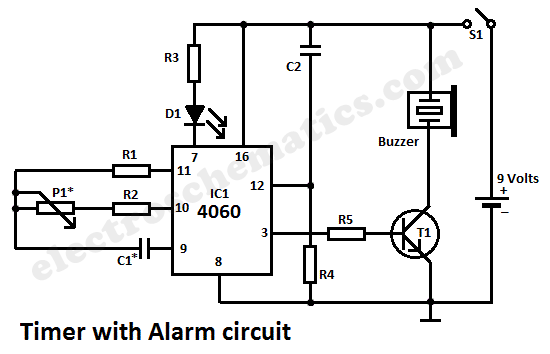
Description: This simple alarm timer circuit is constructed using a 4060 IC, which features an integrated oscillator known for its good stability and relatively wide frequency range.
The 4060 integrated circuit (IC) serves as the core component of this alarm timer circuit. It combines a high-stability oscillator with a binary counter, making it suitable for timing applications. The oscillator's frequency can be adjusted by selecting appropriate external resistors and capacitors connected to the IC. This flexibility allows the user to set the desired time interval for the alarm function.
The circuit typically operates in the following manner: when powered, the 4060 generates a clock signal at its output pin, which is then fed into a series of flip-flops that divide the frequency. The output from these flip-flops can be configured to trigger an alarm or indicator when the count reaches a predetermined value.
An additional feature of the circuit may include a reset mechanism, which can be implemented using a push-button switch. This allows the user to reset the timer and start the counting process anew. The output can be connected to various types of alarms, such as a buzzer or LED, to signal when the timer has elapsed.
To ensure proper operation, it is essential to provide the correct power supply voltage to the 4060 IC, typically in the range of 3V to 15V, depending on the specific variant used. The design can be further enhanced by incorporating a power-saving feature, such as a low-power mode, which can be activated when the timer is not in use.
In summary, this simple alarm timer circuit utilizing the 4060 IC provides a reliable and adjustable timing solution, suitable for various applications, including reminders, countdowns, and alarm systems.This simple alarm timer circuit is made with 4060 which has an integrated oscillator with a good stability with a relatively wide frequency range. In the c.
The 4060 integrated circuit (IC) serves as the core component of this alarm timer circuit. It combines a high-stability oscillator with a binary counter, making it suitable for timing applications. The oscillator's frequency can be adjusted by selecting appropriate external resistors and capacitors connected to the IC. This flexibility allows the user to set the desired time interval for the alarm function.
The circuit typically operates in the following manner: when powered, the 4060 generates a clock signal at its output pin, which is then fed into a series of flip-flops that divide the frequency. The output from these flip-flops can be configured to trigger an alarm or indicator when the count reaches a predetermined value.
An additional feature of the circuit may include a reset mechanism, which can be implemented using a push-button switch. This allows the user to reset the timer and start the counting process anew. The output can be connected to various types of alarms, such as a buzzer or LED, to signal when the timer has elapsed.
To ensure proper operation, it is essential to provide the correct power supply voltage to the 4060 IC, typically in the range of 3V to 15V, depending on the specific variant used. The design can be further enhanced by incorporating a power-saving feature, such as a low-power mode, which can be activated when the timer is not in use.
In summary, this simple alarm timer circuit utilizing the 4060 IC provides a reliable and adjustable timing solution, suitable for various applications, including reminders, countdowns, and alarm systems.This simple alarm timer circuit is made with 4060 which has an integrated oscillator with a good stability with a relatively wide frequency range. In the c.

Induction high pressure alarm circuit
It utilizes the KD153 type "ding-dong" music integrated circuit (IC) to produce a "ding-dong" sound alarm. The reference number is 221611, and it is related to a refrigerator door alarm circuit.
The KD153 integrated circuit is designed specifically for generating melodic...
Electronic Organ Circuit
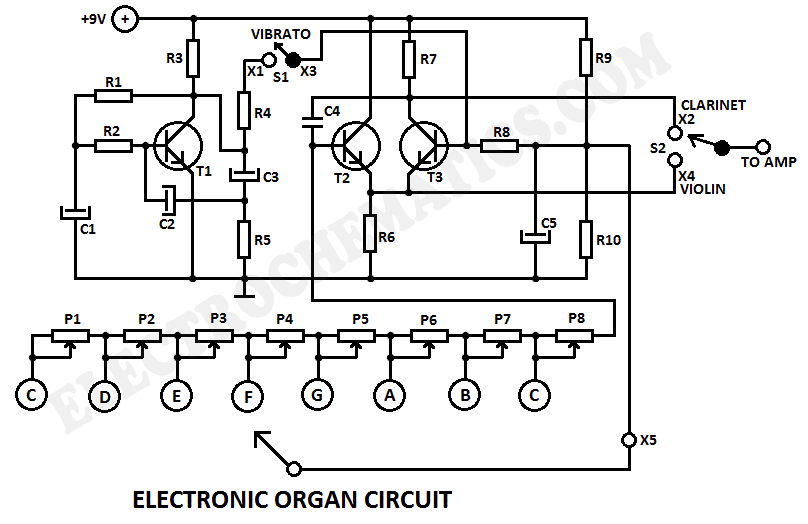
This electronic organ circuit is straightforward to construct and primarily consists of an emitter-coupled oscillator formed by transistors T2 and T3. A square wave voltage can be obtained from the collector of T3 (X2), which imparts a clarinet-like quality to...
Auto Flash Alarm - Staircase_Control
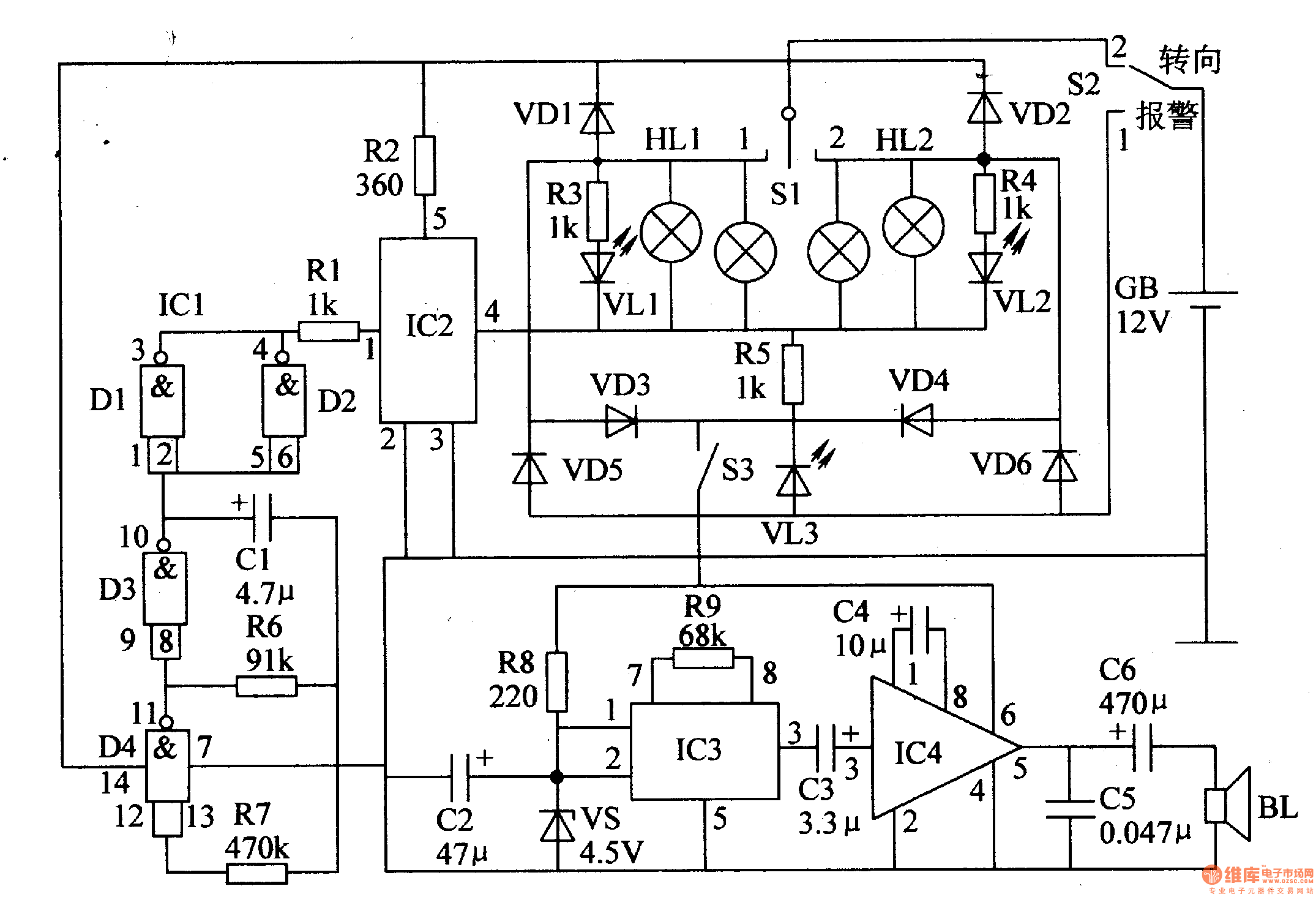
The circuit comprises a low-frequency oscillator, an electronic switch circuit, a control circuit, a photoelectric display circuit, and a music alarm circuit. The low-frequency oscillator is constructed using an integrated circuit (IC) with internal NAND gates and external resistor-capacitor (RC)...
simple electronic organ
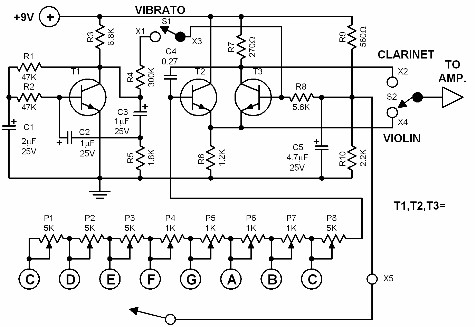
This electronic organ is simple to construct and can provide hours of enjoyment, particularly for children. The circuit is fundamentally an emitter-coupled oscillator consisting of transistors T2 and T3. A square wave voltage can be sampled from the collector of...
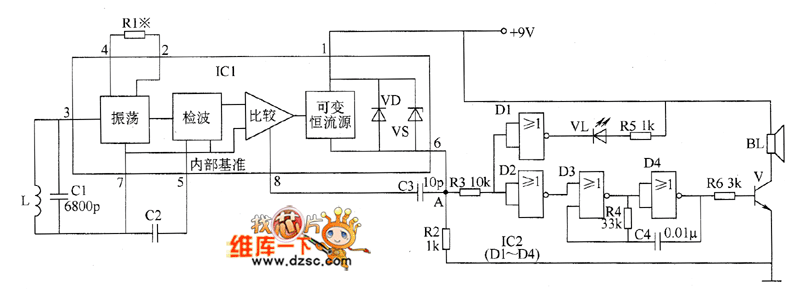
Metal detector circuit diagram 5
The metal detector circuit comprises an oscillator and a sound-light alarm circuit. The oscillator circuit includes an inductor (L), a capacitor (C1), a sensor switch integrated circuit (IC1) that integrates the oscillator, detector, comparator circuit, and peripheral components. The sound-light...
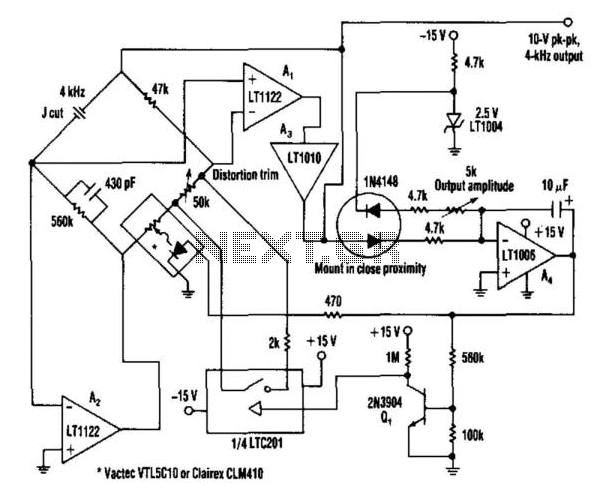
Very Low Distortion Oscillator
This oscillator utilizes a bridge circuit with an optoisolator functioning as a gain-control device. The resultant distortion can be maintained at 9 ppm (0.0009%) with appropriate adjustments.
The oscillator circuit described operates using a bridge configuration, which is a common approach...
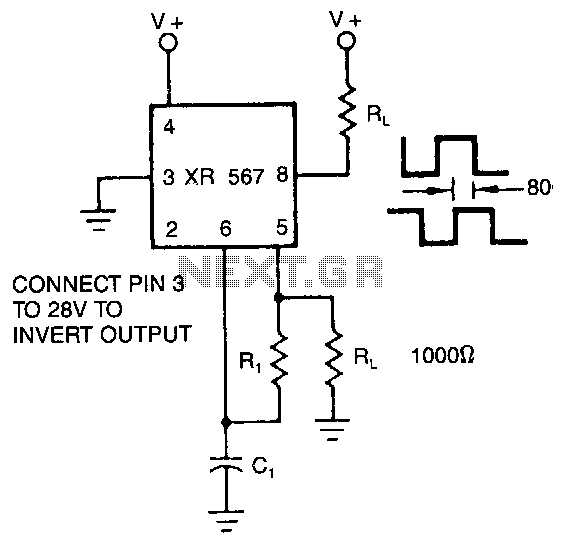
Quadrature-outputs-oscillator
The XR-567 operates as a precision oscillator, providing two distinct square-wave outputs at pins 5 and 8, which are nearly in quadrature phase with one another. Due to the internal biasing configuration, the typical phase shift between the two outputs...
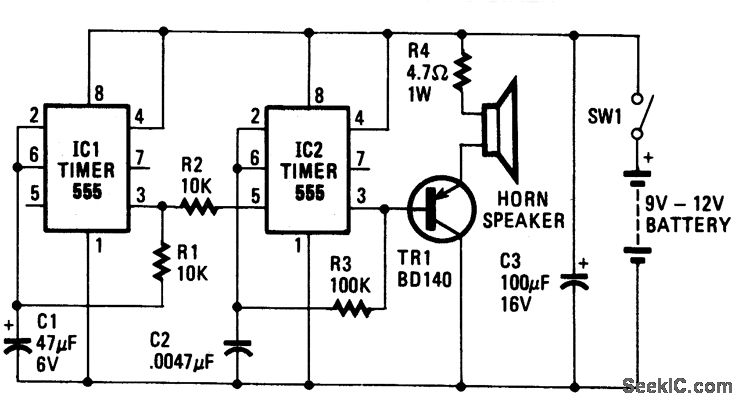
HEE HAW ELECTRONIC SIREN
The oscillator based on IC2 generates sound, with its output linked to the base of TR1, which amplifies the signal to drive the speaker. Resistor R4 is included to limit the current through TR1 to a safe level. The oscillation...
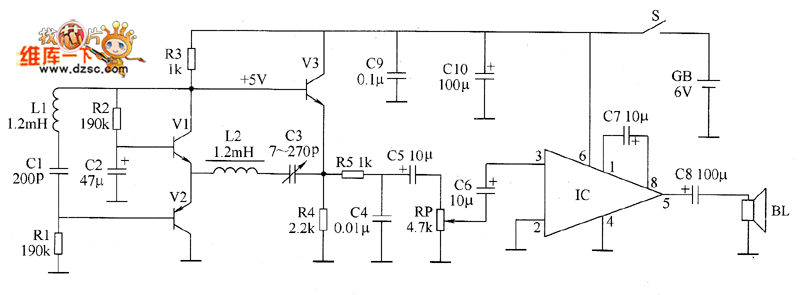
Metal detector circuit diagram 3
The metal detector consists of a probe oscillator, a reference oscillator, an audio amplifier, and various other components, as illustrated in the schematic. The probe oscillator is made up of transistors V1 and V2, a detection coil L1, a capacitor...