


Time Controlled Power-Save Mode
#synchronous buck converter
#power-save mode
#low-power
#efficiency
#portable applications
#voltage regulation
#DC-DC converter
#power management
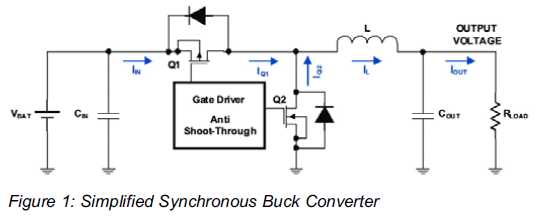
Description: Increased Flexibility for Low-Power Synchronous Buck Converters. Contemporary synchronous buck converters designed for portable applications offer a power-save mode operation to sustain high efficiency throughout the entire range of operation.
Modern low-power synchronous buck converters are essential components in portable electronic devices, where efficiency and battery life are critical. These converters are designed to step down voltage while maintaining high efficiency, which is particularly important in battery-operated applications. The implementation of a power-save mode enhances their operational flexibility, allowing the converters to adjust their performance based on the load conditions.
In power-save mode, the synchronous buck converter reduces its switching frequency and adjusts the on-time and off-time of the switching elements to minimize power loss. This mode is particularly beneficial during periods of low load, as it helps to maintain efficiency by decreasing the quiescent current and reducing switching losses. The converter can seamlessly transition between normal operation and power-save mode, ensuring that it meets the demands of varying load conditions without compromising performance.
Additionally, the design of these converters often includes features such as adaptive voltage positioning, which helps to optimize output voltage regulation under different load scenarios. This further enhances the efficiency and performance of the buck converter across a range of applications, from consumer electronics to industrial devices.
The integration of control algorithms within the converter's circuitry allows for real-time adjustments to the switching strategy, further improving efficiency. The ability to maintain high efficiency over the entire load range is critical for extending battery life in portable applications, making modern synchronous buck converters a vital component in the design of energy-efficient electronic systems.More Flexibility For Low-Power Synchronous Buck Converters Modern synchronous buck converters for portable applications provide so called power-save mode operation to maintain high efficiency over the entire..
Modern low-power synchronous buck converters are essential components in portable electronic devices, where efficiency and battery life are critical. These converters are designed to step down voltage while maintaining high efficiency, which is particularly important in battery-operated applications. The implementation of a power-save mode enhances their operational flexibility, allowing the converters to adjust their performance based on the load conditions.
In power-save mode, the synchronous buck converter reduces its switching frequency and adjusts the on-time and off-time of the switching elements to minimize power loss. This mode is particularly beneficial during periods of low load, as it helps to maintain efficiency by decreasing the quiescent current and reducing switching losses. The converter can seamlessly transition between normal operation and power-save mode, ensuring that it meets the demands of varying load conditions without compromising performance.
Additionally, the design of these converters often includes features such as adaptive voltage positioning, which helps to optimize output voltage regulation under different load scenarios. This further enhances the efficiency and performance of the buck converter across a range of applications, from consumer electronics to industrial devices.
The integration of control algorithms within the converter's circuitry allows for real-time adjustments to the switching strategy, further improving efficiency. The ability to maintain high efficiency over the entire load range is critical for extending battery life in portable applications, making modern synchronous buck converters a vital component in the design of energy-efficient electronic systems.More Flexibility For Low-Power Synchronous Buck Converters Modern synchronous buck converters for portable applications provide so called power-save mode operation to maintain high efficiency over the entire..
Voltage Regulators
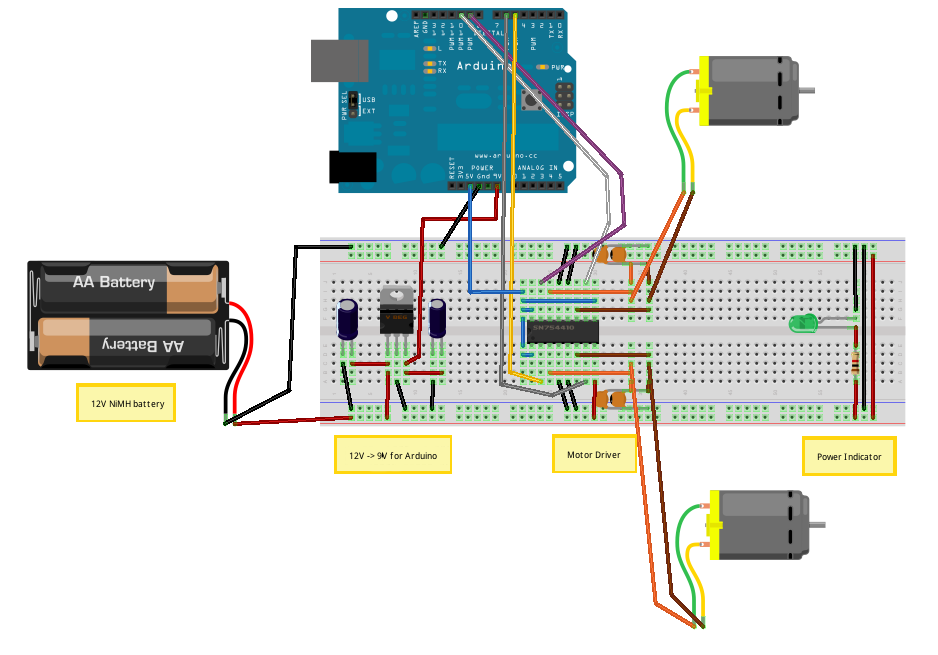
Until Willow Garage was acquired, there was work as a Web Robotics Engineer. This title reflects a role as a full-stack engineer focused on real-time, distributed robot control. Notable projects include an XML-RPC server and client for Node.js, a deprecated...
Power Supply 0-30V / 0-2A
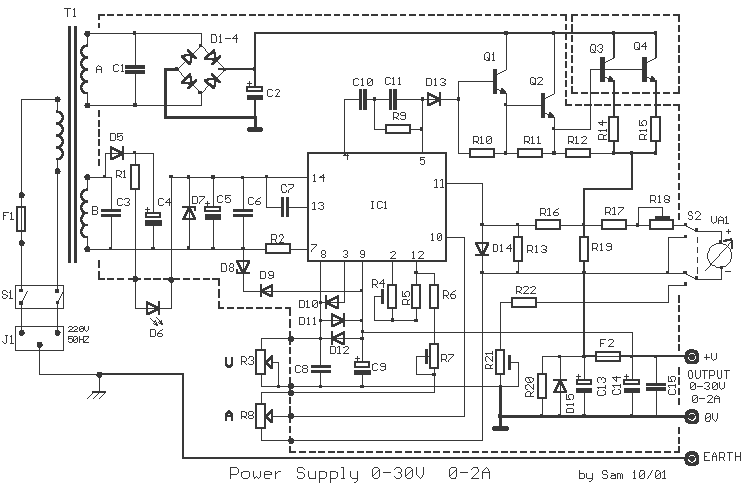
The basic requirements for a laboratory power supply are to provide the necessary voltages and currents with low output resistance, low noise, minimal ripple, and good stabilization. These requirements are addressed within the circuit design. Many power supplies incorporate electronic...
A user friendly boost DC DC converter topology
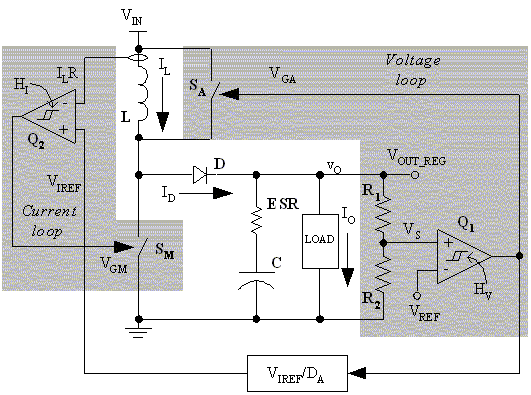
In battery-powered applications such as cell phones, PDAs, and digital cameras, an integrated DC-DC converter circuit solution provides multiple advantages regarding cost, size, and design complexity. A significant challenge in achieving a fully integrated solution is designing the frequency compensation...
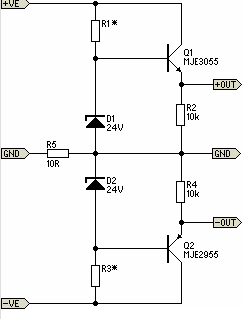
Simple Pre-Regulator
There will be many occasions when it is beneficial to utilize the P05 supply module sourced from a higher voltage supply. For instance, this could be advantageous when integrating balanced inputs.
The P05 supply module is designed to facilitate the conversion...
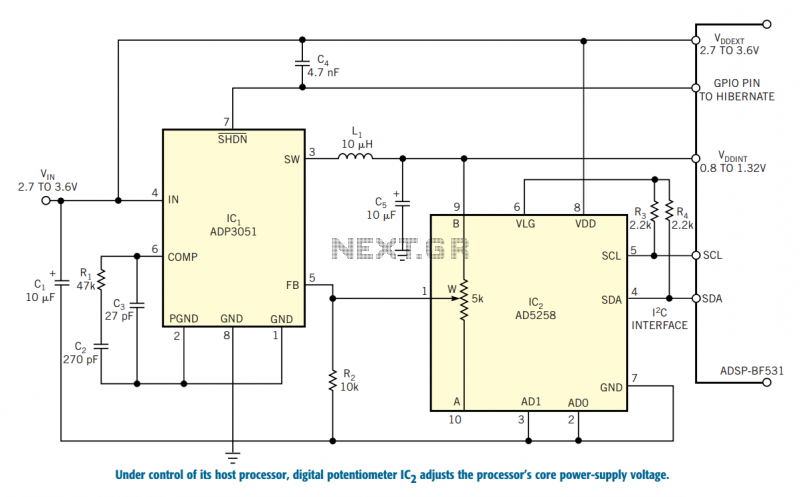
Control a processor`s power supply in real time
In battery-powered applications in which power management is key, a microprocessor may adjust its core voltage corresponding to an increase or a decrease in clock speed, allowing full processing power when necessary but not wasting excess power when idle. The...
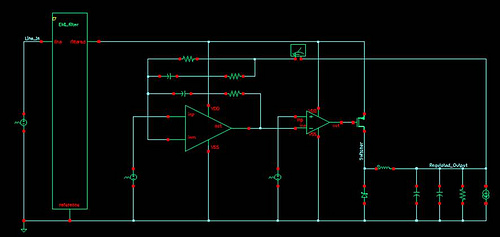
periodic steady state analysis for dc to dc converters
Connect with Cadence technologists and peers in the Cadence Community. Stay informed about technology trends, news, and opinions through blogs, forums, and social networking.
The Cadence Community serves as a collaborative platform for professionals in the electronics design automation (EDA) field....
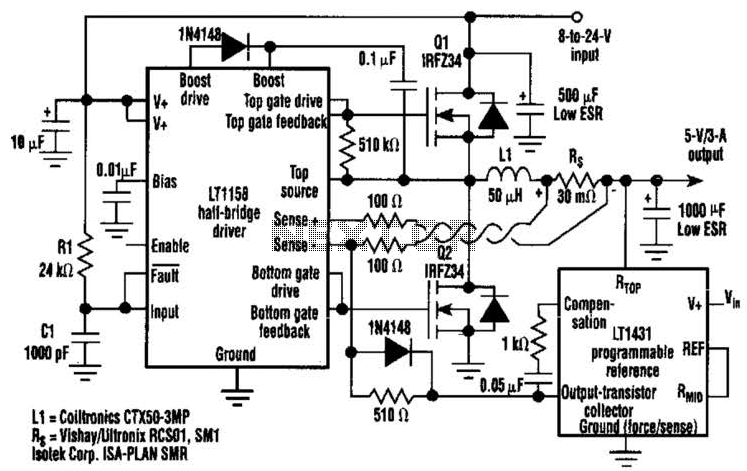
3A Dc-Dc Converter Needs No Heatsink Circuit
This regulator achieves 90% efficiency with a 12-V input and a 5-V output. It utilizes the LT1158 and LT1431 components from Linear Technology, Inc. High efficiency is accomplished by synchronously switching two power MOSFETs in a step-down switching regulator. The...
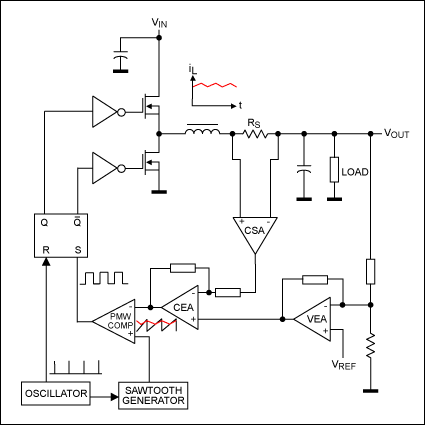
DC-DC Controllers Use Average-Current-Mode Control for Infotainment Applications
As high-performance microprocessors require increased power in automotive multimedia and telematics, commonly referred to as infotainment products, several well-known issues arise, including noise susceptibility, electromagnetic interference (EMI), and loop compensation, among others. Average current-mode control (ACMC) assists in mitigating these...
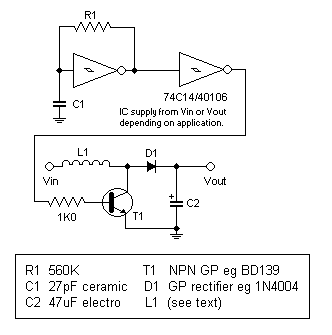
DC-DC converter to step up input voltage
This circuit is a simple design that outputs a voltage higher than the input. It can be used to power 12V or 9V devices from a 6V system or to operate 6V devices from a 1.5V battery. The circuit utilizes...