


Variable Frequency Switch Mode Regulator
#switch mode regulator
#TL497
#voltage regulation
#power supply
#efficiency
#5V output
#7.5-15V input
#switching regulator
#DC-DC converter
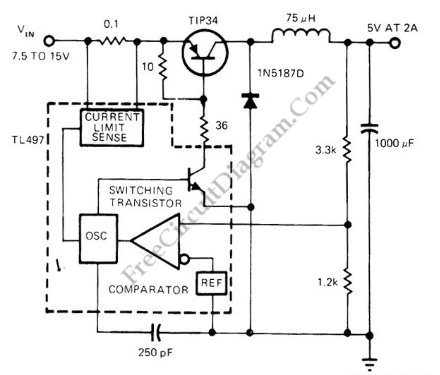
Description: Switching voltage regulator utilizing the TL497 integrated circuit, achieving up to 75% efficiency. The output voltage is 5V, while the input voltage ranges from 7.5V to 15V.
The TL497 is a versatile integrated circuit designed for use in switching voltage regulator applications. It operates by converting a higher input voltage to a lower output voltage, specifically providing a stable 5V output. The input voltage range of 7.5V to 15V allows for flexibility in various power supply scenarios, making it suitable for battery-operated devices or power supply systems requiring a regulated output.
The efficiency of up to 75% indicates that a significant portion of the input power is converted into usable output power, minimizing energy loss in the form of heat. This characteristic is particularly important in applications where thermal management is critical, as it reduces the need for extensive heat dissipation solutions.
In terms of circuit configuration, the TL497 typically operates in a feedback loop, where it continuously monitors the output voltage and adjusts the duty cycle of the switching element (usually a transistor) to maintain the desired output voltage. This feedback mechanism is crucial for achieving regulation and stability in the output voltage, even with variations in input voltage or load conditions.
The circuit design may include additional components such as inductors, capacitors, and diodes to form a complete switching power supply. The inductor stores energy when the switch is closed and releases it to the output when the switch is open, while capacitors help smooth the output voltage and filter out noise. A Schottky diode is often used in the output stage to provide a fast recovery time and minimize voltage drop.
Overall, the TL497-based switching voltage regulator is an efficient solution for applications requiring a reliable 5V output from a variable input voltage, providing a compact and effective means of power regulation.Switch mode/switching voltage regulator with TL497 integrated circuit, up to 75% efficiency, output: 5V, input: 7.5-15V.
The TL497 is a versatile integrated circuit designed for use in switching voltage regulator applications. It operates by converting a higher input voltage to a lower output voltage, specifically providing a stable 5V output. The input voltage range of 7.5V to 15V allows for flexibility in various power supply scenarios, making it suitable for battery-operated devices or power supply systems requiring a regulated output.
The efficiency of up to 75% indicates that a significant portion of the input power is converted into usable output power, minimizing energy loss in the form of heat. This characteristic is particularly important in applications where thermal management is critical, as it reduces the need for extensive heat dissipation solutions.
In terms of circuit configuration, the TL497 typically operates in a feedback loop, where it continuously monitors the output voltage and adjusts the duty cycle of the switching element (usually a transistor) to maintain the desired output voltage. This feedback mechanism is crucial for achieving regulation and stability in the output voltage, even with variations in input voltage or load conditions.
The circuit design may include additional components such as inductors, capacitors, and diodes to form a complete switching power supply. The inductor stores energy when the switch is closed and releases it to the output when the switch is open, while capacitors help smooth the output voltage and filter out noise. A Schottky diode is often used in the output stage to provide a fast recovery time and minimize voltage drop.
Overall, the TL497-based switching voltage regulator is an efficient solution for applications requiring a reliable 5V output from a variable input voltage, providing a compact and effective means of power regulation.Switch mode/switching voltage regulator with TL497 integrated circuit, up to 75% efficiency, output: 5V, input: 7.5-15V.
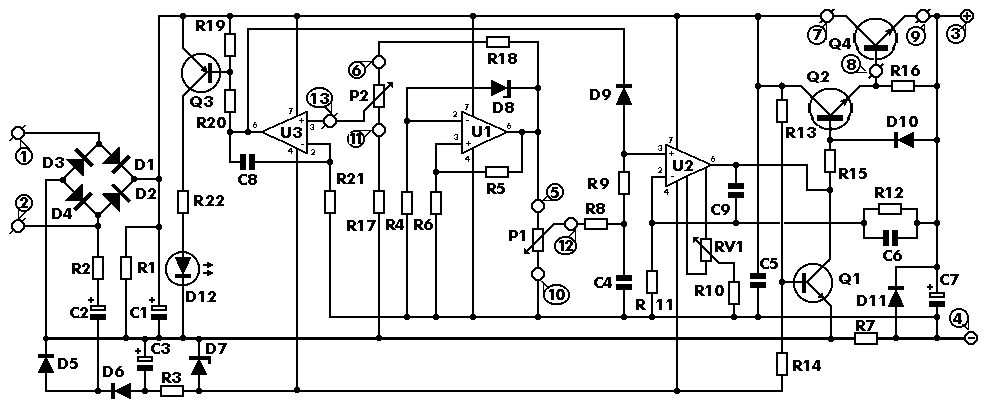
0-30 VDC Stabilized Power Supply with Current Control 0.002-3 A
The circuit begins with a step-down mains transformer featuring a secondary winding rated at 24 V/3 A, which connects across the input points at pins 1 and 2. The quality of the output supply is directly related to the transformer's...
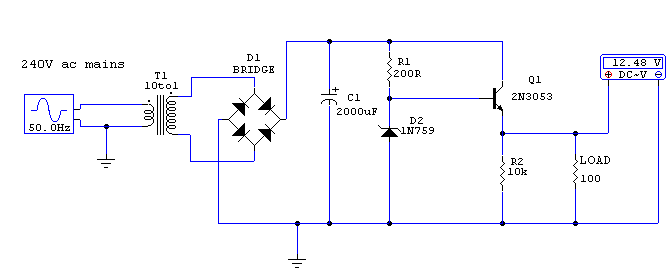
Regulated 12 Volt Supply
This circuit utilizes a 13-volt zener diode (D2) for voltage regulation. Approximately 0.7 volts are dropped across the base-emitter junction of the transistors, resulting in a higher current output of 12.3 volts. The circuit is capable of supplying loads up...
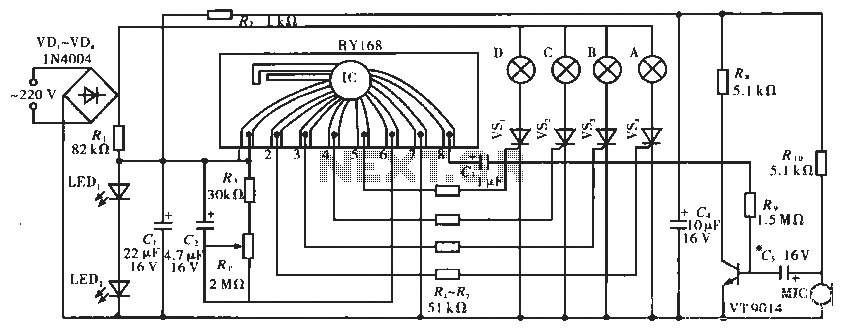
Lighting controller circuit
The circuit operates with a controller that includes a power supply circuit, a control circuit, and an audio amplifier, which are three distinct components. The power circuit comprises diodes VD1 to VD4, resistor R1, capacitor C1, LED1, LED2, and additional...
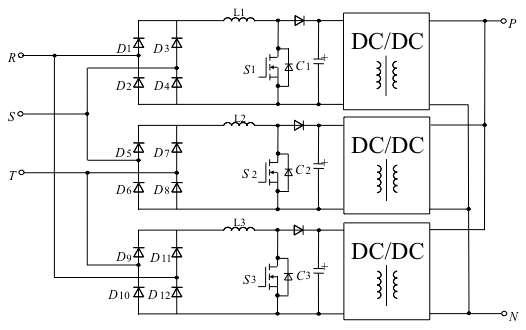
PFC Switching Power Supply
The following circuit illustrates a Power Factor Correction (PFC) Switching Power Supply Circuit Diagram. Features include suitability for 1U (1.75-inch) form factor and minimization of input harmonics.
The PFC Switching Power Supply Circuit is designed to enhance the efficiency of power...
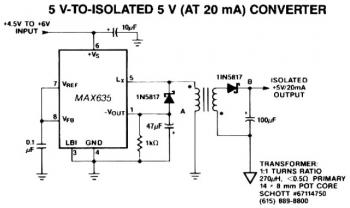
5v to isolated 5v converter circuit
A negative output voltage DC to DC converter generates a -5V output at pin A. To achieve -5V at point A, the primary of the transformer must fly back to a diode drop more negative than -5V. If the transformer...
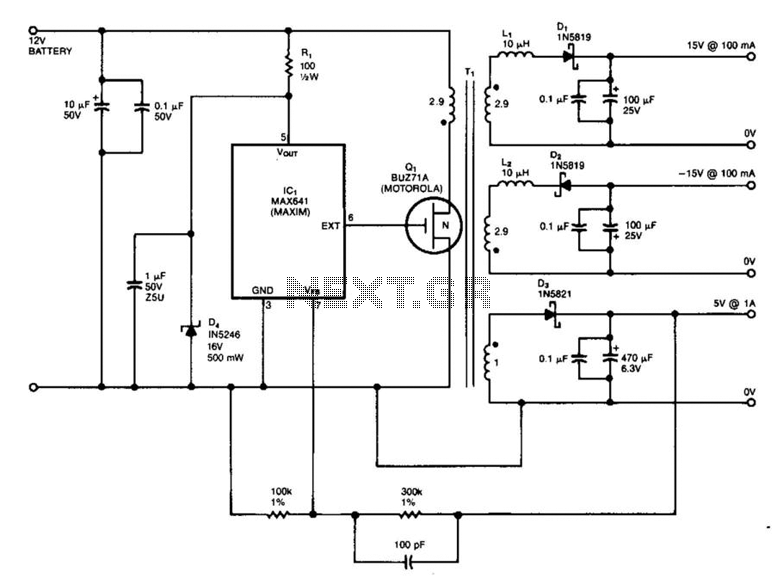
15V And 5V Car Battery Supply
IC1 is a switching regulator that generates a 45-kHz signal to drive the gate of MOSFET Q1. Diodes D1, D2, and D3 are Schottky diodes. The 5-V output is monitored as a reference; feedback to the chip disables the gate...
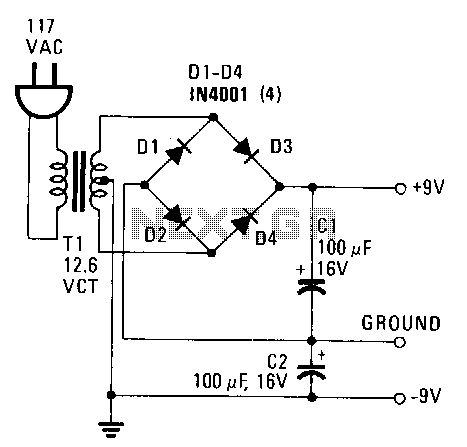
Simple-power-supply
This power supply provides both +9 V and -9 V outputs to replace two 9-V batteries. The rectifier circuit consists of two separate full-wave rectifiers, each connected to the secondary winding of the transformer. The first full-wave rectifier, made up...
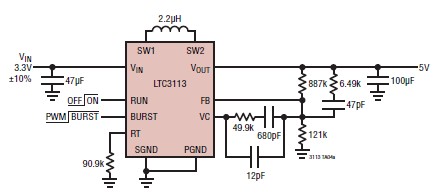
5 volts 3A Dc DC converter circuit design project using LTC3113 IC
The LTC3113 fixed frequency buck-boost DC-DC converter can be utilized to design various power supply circuits that operate with input voltages that are above, below, or equal to the output voltage. The topology integrated into the IC ensures low noise...
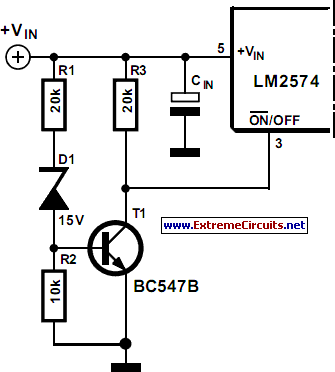
Soft Start For Switching Power Supply
A switching power supply that has an output voltage significantly lower than its input voltage exhibits a unique characteristic: the current drawn from the supply is less than the output current. However, the input power (UI) is, naturally, greater than...