


TC35I use wireless data transmission and GSM communication module circuit design schematics
#TC35I
#GSM
#wireless communication
#data transmission
#motor vehicle
#base station
#RF
#telecommunication
#module
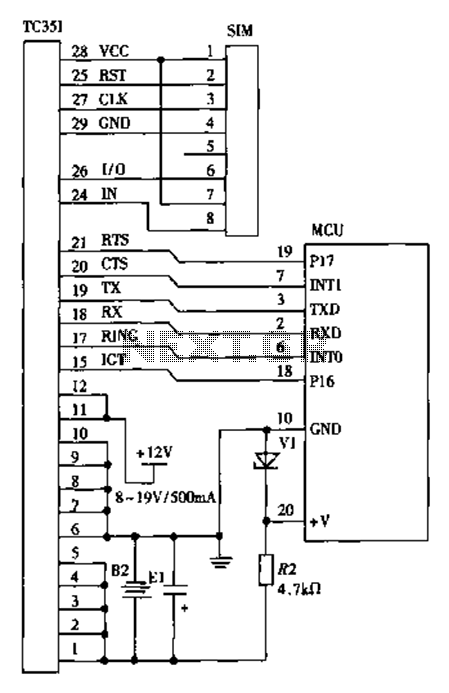
Description: The design of a wireless data communication circuit is primarily intended for motor vehicles and fixed base station systems to facilitate close-range wireless data exchange. The circuit is based on the core chip nRF401 and its associated components. The nRF401 is a dual-channel, high-performance, low-power wireless communication chip that operates at frequencies of 433.93/434.33 MHz, with a supply voltage of 3.3V and a maximum communication speed of 20 kbps. It can interface directly with microcontrollers via serial asynchronous communication for data transmission and reception without the need for data encoding. The TxD-side data input (DIN) and RXD data output (DOUT) terminals connect to the microcontroller. This circuit is designed for a communication speed of 19.2 kbps. Additionally, there is a microprocessor interface circuit TC35I, from which all SIEMENS instructions can be downloaded from the website. A low-cost AT89C4051 single chip is used for the car users' mobile payment system, powered by 3.3V, while the base station utilizes a high-speed, high-performance single-chip 77E58-40 for complete wireless data communication and authentication. Vehicle recognition is handled by an independent processing unit.
The wireless data communication circuit serves as an essential component in modern automotive and fixed base station applications, enabling efficient data transfer between vehicles and infrastructure. The nRF401 chip is a critical element in this design, offering robust performance in a compact form factor. Its dual-channel capability allows simultaneous data transmission and reception, enhancing the overall communication efficiency.
The operating frequency range of 433.93/434.33 MHz is particularly suitable for short-range communication, minimizing interference from other devices operating in the same band. The choice of a 3.3V power supply ensures compatibility with a wide range of microcontrollers and other digital circuits, facilitating easy integration into existing systems.
The maximum communication speed of 20 kbps provides sufficient bandwidth for various applications, including telemetry data transmission and control signals for automotive systems. The design's focus on a communication speed of 19.2 kbps ensures reliable data exchange while maintaining low power consumption, which is critical for battery-operated devices.
The direct connection between the TxD and RxD terminals of the nRF401 and the microcontroller simplifies the circuit design, reducing the need for additional encoding or decoding circuitry. This feature not only streamlines the overall design but also enhances the reliability of data transmission.
The integration of the TC35I microprocessor interface circuit allows for advanced functionalities, such as the downloading of necessary firmware and instructions from the SIEMENS website, ensuring that the system remains up-to-date with the latest features and security protocols.
The use of the AT89C4051 single chip for mobile payment systems highlights the circuit's versatility, enabling secure transactions within the vehicle environment. The 77E58-40 chip at the base station provides high-speed communication capabilities, ensuring that data is processed swiftly and accurately, which is vital for real-time applications.
Vehicle recognition is facilitated by an independent processing unit, which complements the wireless communication circuit by providing additional functionality, such as identifying vehicles for access control or automated toll collection. This comprehensive approach to wireless data communication in automotive applications illustrates the circuit's potential to enhance operational efficiency and user experience in modern transportation systems.Design of wireless data communication circuit Wireless data communication circuit is mainly responsible for the motor vehicle and fixed base station system for close wireless d ata exchange tasks. From the core chip nRF401 and its subsidiary components. nRF401 is a dual-channel, high-performance, low-power wireless communication dedicated chip, operating frequency is 433.93/434.33MHz. operating voltage of 3.3v, the maximum communication speed of 20kbps, you can contact directly with the microcontroller serial, asynchronous communication, to achieve data transmission and reception.
No need to encode data. TxD-side data input DIN and SCM phase, RXD data output terminal DOUT terminal in contact with the microcontroller. In this circuit, designed for communication speed 19.2 kbps. Circuit shown in FIG. And a microprocessor interface circuit TC35I TC35I All SIEMENS instructions can be downloaded from the website.
Car users mobile payment system by the low cost of AT89C4051 single chip, the power supply 3.3V, the base station by a high-speed, high-performance single-chip 77E58-40 complete wireless data communication and authentication. CCD Vehicle Recognition completed by another independent processing units.
The wireless data communication circuit serves as an essential component in modern automotive and fixed base station applications, enabling efficient data transfer between vehicles and infrastructure. The nRF401 chip is a critical element in this design, offering robust performance in a compact form factor. Its dual-channel capability allows simultaneous data transmission and reception, enhancing the overall communication efficiency.
The operating frequency range of 433.93/434.33 MHz is particularly suitable for short-range communication, minimizing interference from other devices operating in the same band. The choice of a 3.3V power supply ensures compatibility with a wide range of microcontrollers and other digital circuits, facilitating easy integration into existing systems.
The maximum communication speed of 20 kbps provides sufficient bandwidth for various applications, including telemetry data transmission and control signals for automotive systems. The design's focus on a communication speed of 19.2 kbps ensures reliable data exchange while maintaining low power consumption, which is critical for battery-operated devices.
The direct connection between the TxD and RxD terminals of the nRF401 and the microcontroller simplifies the circuit design, reducing the need for additional encoding or decoding circuitry. This feature not only streamlines the overall design but also enhances the reliability of data transmission.
The integration of the TC35I microprocessor interface circuit allows for advanced functionalities, such as the downloading of necessary firmware and instructions from the SIEMENS website, ensuring that the system remains up-to-date with the latest features and security protocols.
The use of the AT89C4051 single chip for mobile payment systems highlights the circuit's versatility, enabling secure transactions within the vehicle environment. The 77E58-40 chip at the base station provides high-speed communication capabilities, ensuring that data is processed swiftly and accurately, which is vital for real-time applications.
Vehicle recognition is facilitated by an independent processing unit, which complements the wireless communication circuit by providing additional functionality, such as identifying vehicles for access control or automated toll collection. This comprehensive approach to wireless data communication in automotive applications illustrates the circuit's potential to enhance operational efficiency and user experience in modern transportation systems.Design of wireless data communication circuit Wireless data communication circuit is mainly responsible for the motor vehicle and fixed base station system for close wireless d ata exchange tasks. From the core chip nRF401 and its subsidiary components. nRF401 is a dual-channel, high-performance, low-power wireless communication dedicated chip, operating frequency is 433.93/434.33MHz. operating voltage of 3.3v, the maximum communication speed of 20kbps, you can contact directly with the microcontroller serial, asynchronous communication, to achieve data transmission and reception.
No need to encode data. TxD-side data input DIN and SCM phase, RXD data output terminal DOUT terminal in contact with the microcontroller. In this circuit, designed for communication speed 19.2 kbps. Circuit shown in FIG. And a microprocessor interface circuit TC35I TC35I All SIEMENS instructions can be downloaded from the website.
Car users mobile payment system by the low cost of AT89C4051 single chip, the power supply 3.3V, the base station by a high-speed, high-performance single-chip 77E58-40 complete wireless data communication and authentication. CCD Vehicle Recognition completed by another independent processing units.
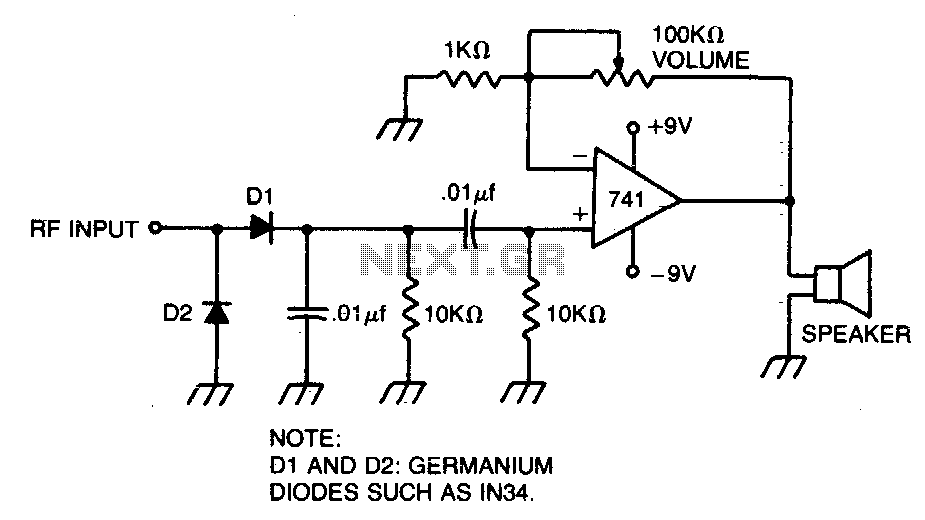
Modulation monitor
A broad-tuned receiver demodulates the RF signal picked up by a loosely coupled wire placed near the transmitting antenna.
The broad-tuned receiver operates by utilizing a loosely coupled wire antenna, which is strategically positioned in proximity to the transmitting antenna. This...
RF-Radio Frequency 6
This circuit is designed to attenuate signal frequency, with a customizable range from 1 to 40 dB. For UHF band usage, it should be enclosed within a shielded frame, and capacitors C1 to C3 should be appropriately selected. The connection...
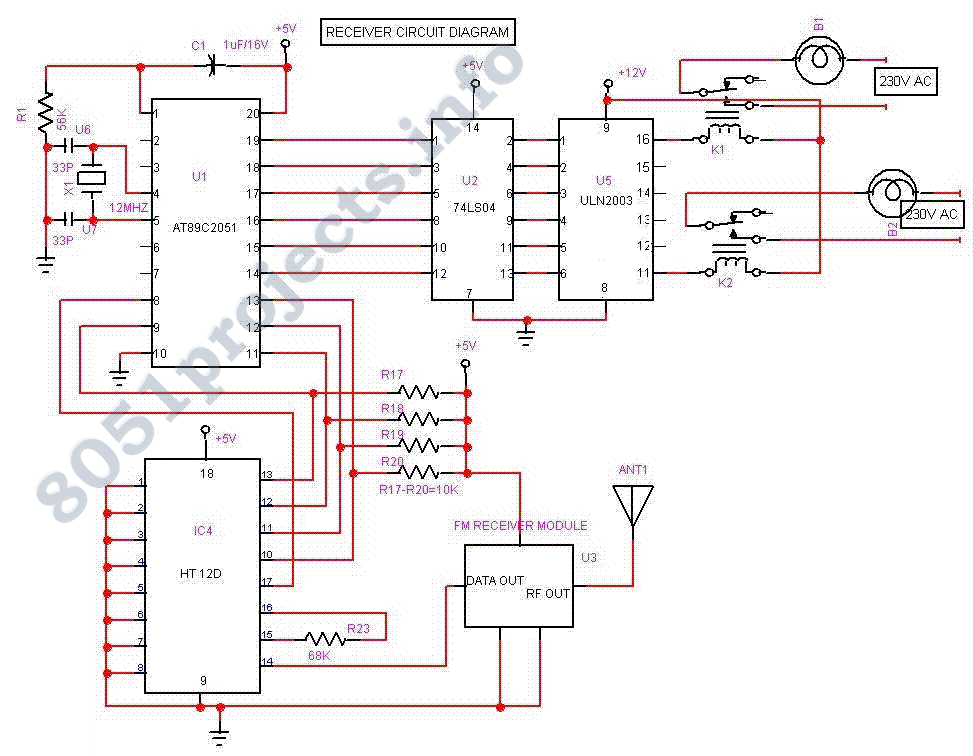
RF Remote control
The Project Long Range Remote Control can be used to remotely control a number of Electrical or Electronic Gadgets connected to it. Unlike Infra Red remote control, this Project employs FM transmission and Reception, and hence it can be used...
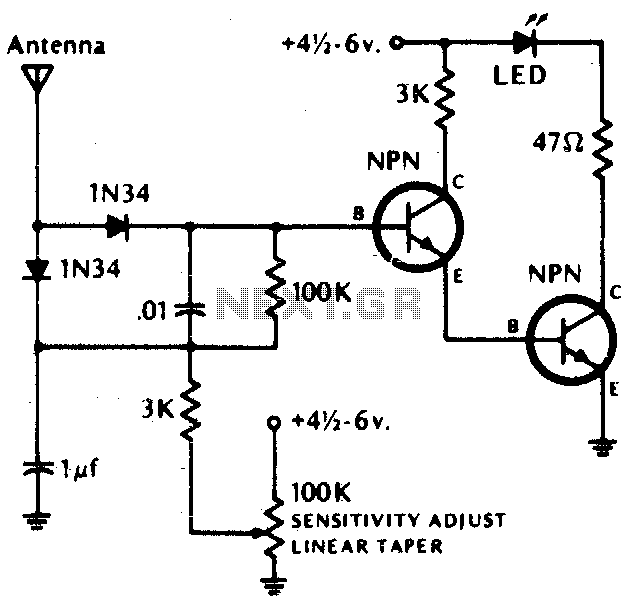
Adjustable-sensitivity field-strength indicator
The LED illuminates when the RF field exceeds the pre-set field strength level. Germanium diodes are recommended. Additional information: Transistors (NPN) include 2N2222, 2N3393, 2N3904, or equivalent.
The circuit described is a simple RF field strength indicator that utilizes an LED...
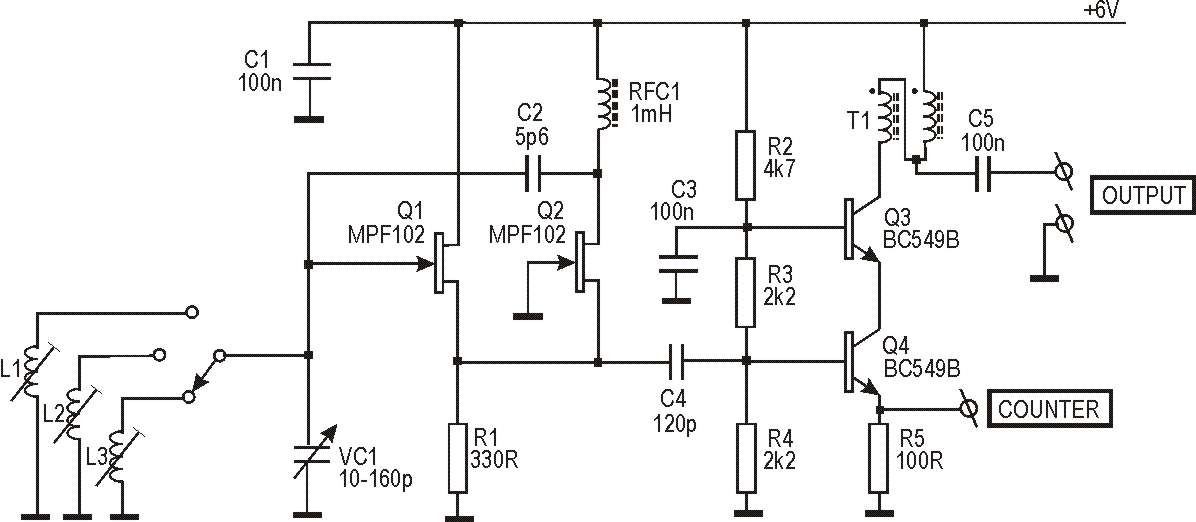
Simple RF Signal Generator
This circuit originated from work on two antenna analyzers, which are detailed elsewhere on this site. Both instruments incorporate an RF signal generator that serves as the signal source for driving the impedance bridge and detectors used to measure impedance....
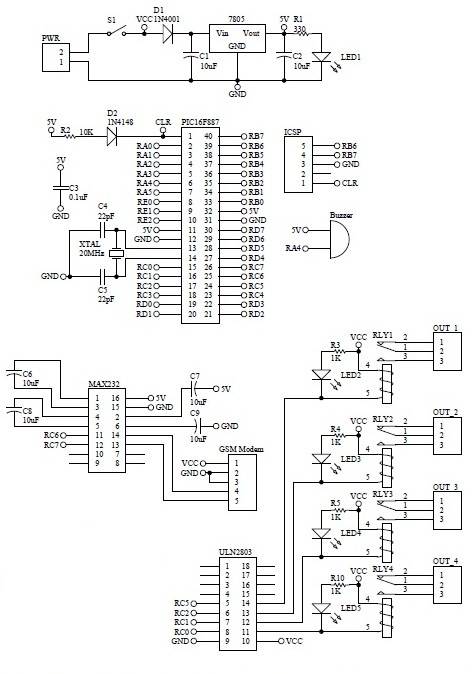
Programmable Control For Home Safety via GSM Remote
How to turn on equipment by sending SMS `1111` to switch it ON and switch off the equipment by sending SMS `0000`. The GSM switch will receive instructions for either load 1 (L1), load 2 (L2), load 3 (L3), or...
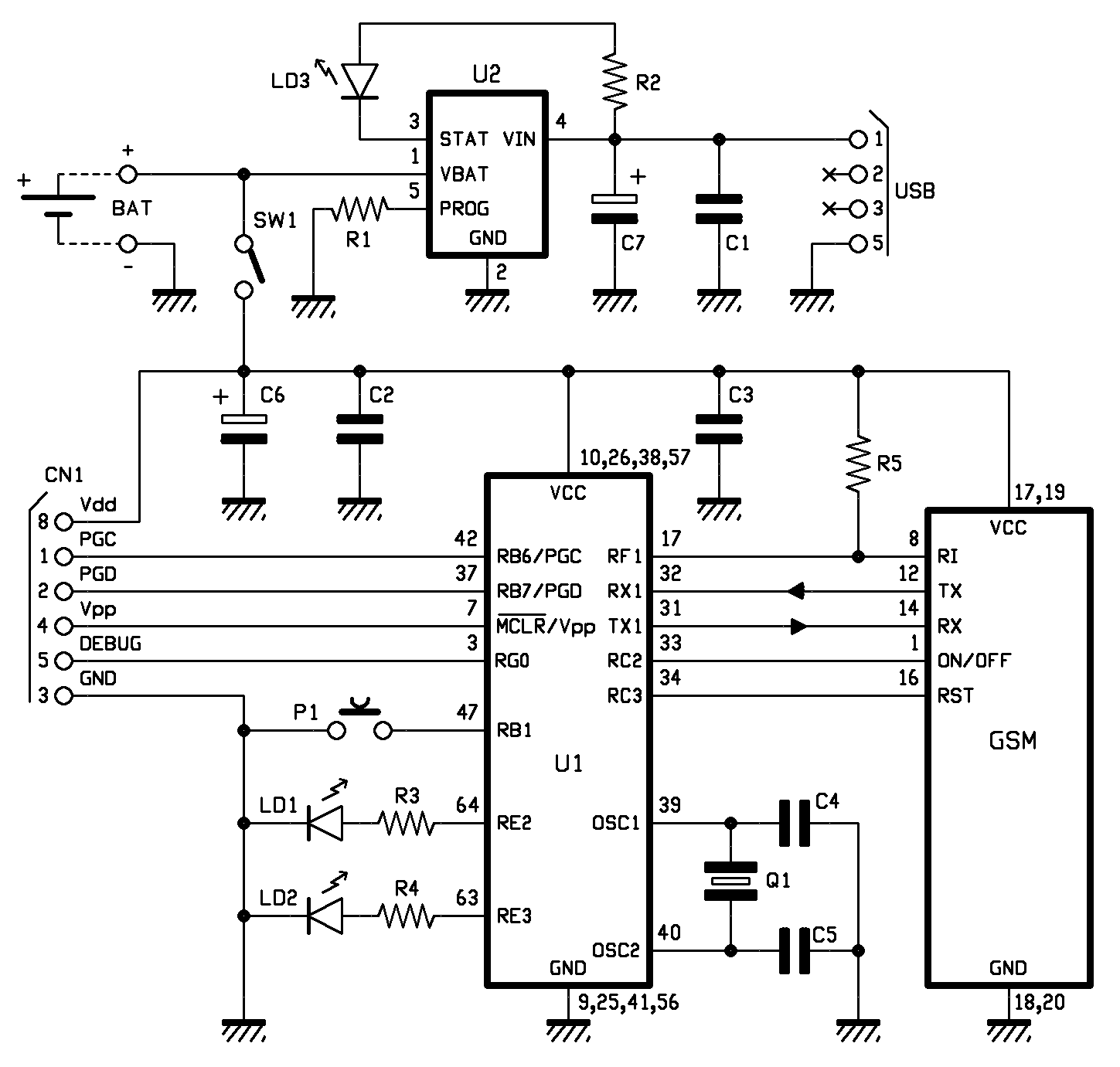
Mini GSM localizer without GPS
A localizer that does not utilize GPS technology has been developed using the cost-effective SimCom SIM900 module. In previous discussions, the GSM section was presented, and now the complete localization system is introduced. This system allows for object localization without...
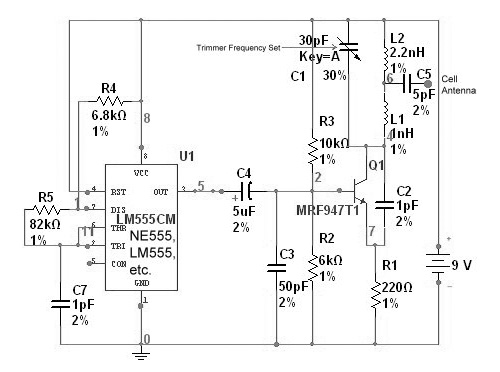
radio station blocker circuit
This device functions as a reversal of a radio station, sending a null signal to a selected frequency to eliminate the actual broadcast. The radio transmitter operates at a loss of 10,000W; therefore, this circuit is intended for use only...
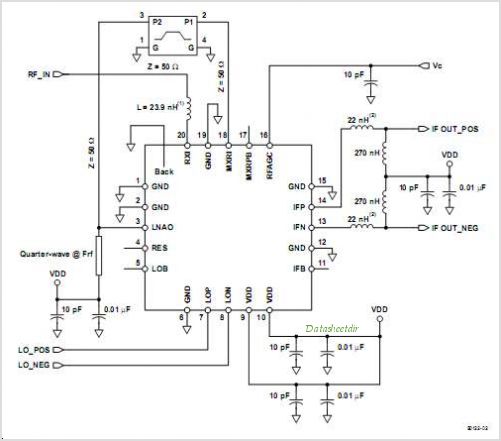
TRF1115 RF Down-Converter
The TRF1400 VHF/UHF RZ ASK remote control receiver is specifically designed for RZ ASK (return-to-zero amplitude-shift keyed) communications systems operating in the 200-MHz to 450-MHz band. This device is targeted for use in automotive and home security systems, garage door...