


Selective Preamplifier For Infrared Photodiode Circuit
#infrared
#photodiode
#preamplifier
#frequency selection
#tuned circuit
#51 kHz
#signal conditioning
#sensor interface

Description: The circuit utilizes a tuned circuit for frequency selection, designed to operate at approximately 51 kHz. The 2N3565 transistor amplifies the output generated by the tuned circuit.
The described circuit operates on the principle of resonance, where the tuned circuit is typically composed of an inductor and a capacitor. At the specified frequency of 51 kHz, the circuit is designed to selectively amplify signals that match this frequency while attenuating others. The choice of components, including the inductor and capacitor values, is critical to achieving the desired resonant frequency.
The 2N3565 is a high-frequency NPN transistor that is well-suited for this application due to its ability to operate effectively in the RF range. It is commonly used in amplification stages of radio frequency circuits. When the tuned circuit receives an input signal at or near 51 kHz, it resonates, producing a voltage that is fed into the base of the 2N3565.
The transistor then amplifies this voltage, providing a higher power output that can be utilized for further processing or transmission. Proper biasing of the transistor is essential to ensure it operates in the active region, allowing for linear amplification of the input signal. Additionally, the circuit may include resistors and capacitors for stability and to set the gain of the amplifier.
Overall, this circuit configuration is typical in applications such as radio receivers, where selective frequency amplification is required to isolate desired signals from a range of frequencies. The circuit uses a tuned circuit to achieve frequency selection. Values are for operation at about 51 kHz. The 2N3565 amplifies the output developed by the tuned circuit.
The described circuit operates on the principle of resonance, where the tuned circuit is typically composed of an inductor and a capacitor. At the specified frequency of 51 kHz, the circuit is designed to selectively amplify signals that match this frequency while attenuating others. The choice of components, including the inductor and capacitor values, is critical to achieving the desired resonant frequency.
The 2N3565 is a high-frequency NPN transistor that is well-suited for this application due to its ability to operate effectively in the RF range. It is commonly used in amplification stages of radio frequency circuits. When the tuned circuit receives an input signal at or near 51 kHz, it resonates, producing a voltage that is fed into the base of the 2N3565.
The transistor then amplifies this voltage, providing a higher power output that can be utilized for further processing or transmission. Proper biasing of the transistor is essential to ensure it operates in the active region, allowing for linear amplification of the input signal. Additionally, the circuit may include resistors and capacitors for stability and to set the gain of the amplifier.
Overall, this circuit configuration is typical in applications such as radio receivers, where selective frequency amplification is required to isolate desired signals from a range of frequencies. The circuit uses a tuned circuit to achieve frequency selection. Values are for operation at about 51 kHz. The 2N3565 amplifies the output developed by the tuned circuit.
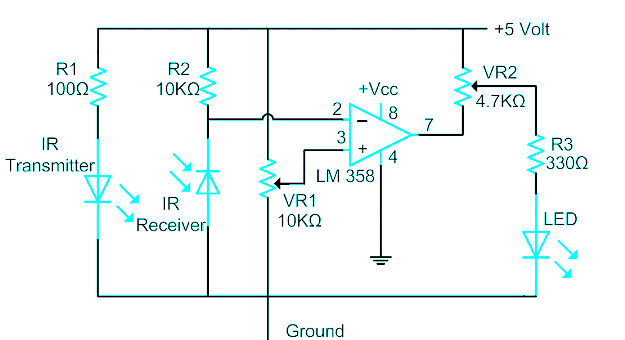
infrared ir sensor
This circuit is one of the most basic and popular sensor modules. In electronics, this sensor is analogous to human visual senses and can be used.
The described sensor module serves as a fundamental component in various electronic applications, emulating the...
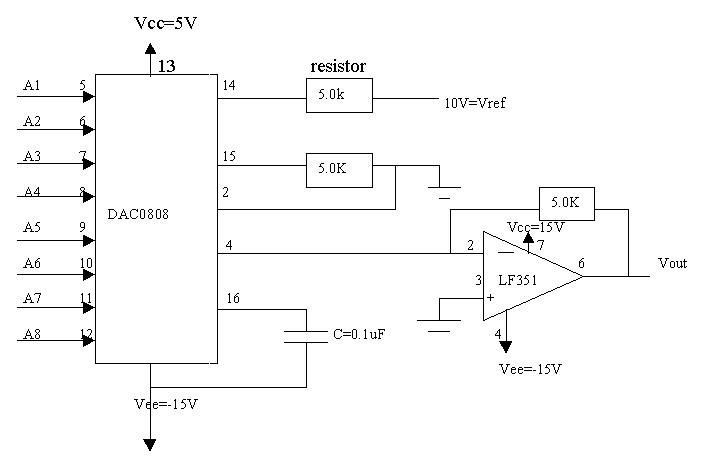
Signal Conditioners Information
Signal conditioning involves a series of operations applied to a signal to make it compatible for interfacing with other devices or systems. Signal conditioners are the devices that execute this operation, featuring both an input and an output. Typically, the...
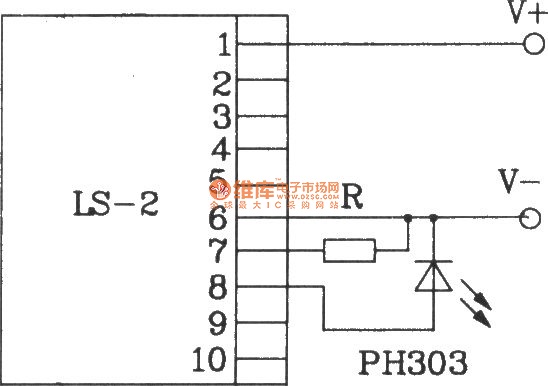
Direct infrared remote control switch circuit diagram composed of LS-2
The LS-2 remote control switch infrared sensor module is similar to the LS-18 but functions as a reflector. The LS-2 pin diagram and internal block diagram provide insights into its electrical parameters. The operating voltage for the LS-2 remote control...
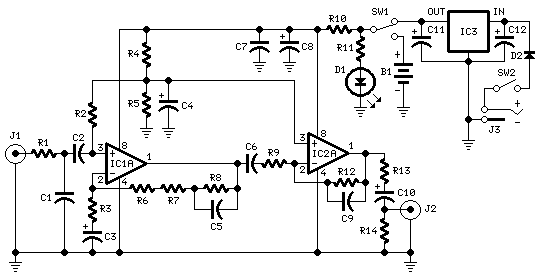
Portable Phone Preamplifier
This assembly is designed for amateurs who possess a collection of vinyl records and wish to convert them into a digital format on a personal computer. Alternatively, they may want to enjoy an old, cherished LP collection through their modern...
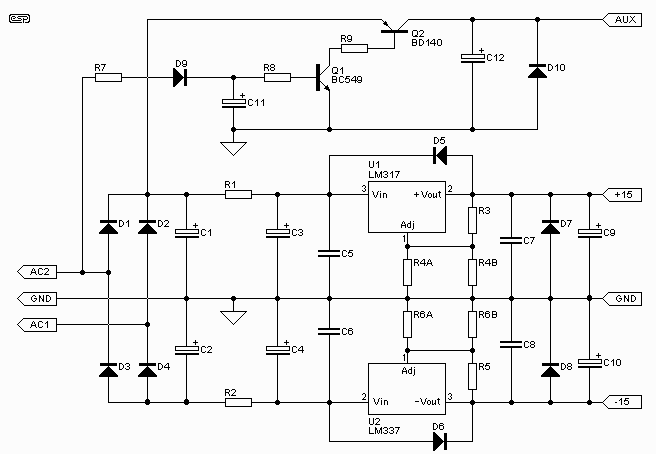
Power Supply for Preamplifiers (Revision A)
The original version of P05 has been around for a very long time now (around 4 years), and there are some worthwhile reasons for the updates. Although the performance of the original was not lacking in any way, I decided...
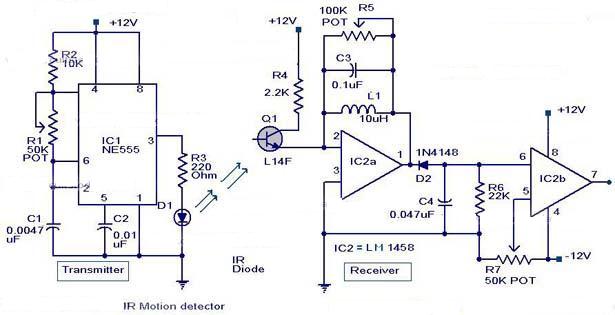
infrared motion detector
The circuit diagram depicts an infrared motion detector designed to detect intrusions. Infrared rays reflected from a stationary object exhibit one phase, while rays reflected from a moving object display a different phase. This principle is utilized for motion detection....
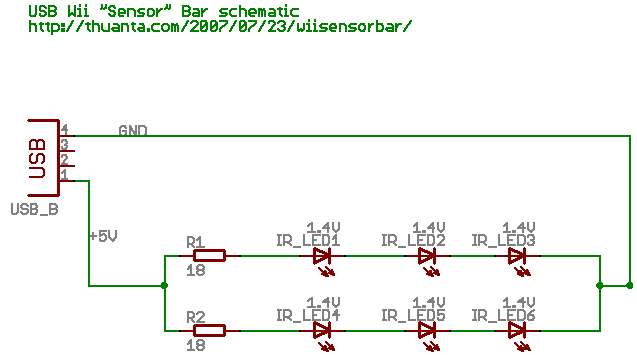
Circuit Diagram Of Wii ߀?Sensor߀ Bar Project
The following circuit illustrates the Wii "Sensor" Bar Project Circuit Diagram. Features include a series of infrared LEDs positioned at both ends of the bar, which emit infrared light.
The Wii Sensor Bar is a crucial component for the Wii gaming...
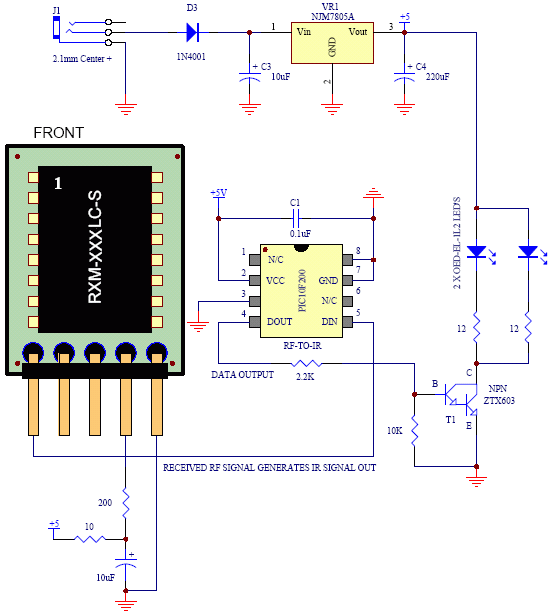
Transmit Infrared Signals Through Walls
Instructions for utilizing an existing infrared transmitter from any room within the house. The concept is straightforward and operates more effectively than anticipated. This project proves to be quite useful, allowing control over devices from virtually anywhere. For instance, stereo...

ir sensors
The infrared emitter-detector circuit is highly beneficial for constructing a line-following robot or a robot capable of basic object or obstacle detection. Infrared emitter-detector pairs are relatively straightforward to implement, although they require a certain level of testing and calibration...