


Giving a false speed reading
#jammer
#doppler shift
#speed reading
#radar
#security
#signal interference
#electronic countermeasure
#speed trap
Description: The Scorpion jammers operate by sending back a constantly varying Doppler shift instead of a fixed Doppler shift corresponding to a specific speed. Some units may not display readings, while others show continuously changing data. Other devices have transmitted a speed, but they do not function on the same principle. The ECM 5446 transmits a powerful tone-modulated signal to deceive radar into showing a speed. It is speculated that if ATR or DSR guns could differentiate between the strongest and fastest targets, they would display the actual speed of the fastest target and the desired speed of the most powerful target, provided that the actual Doppler shift signal can be overpowered. The Scorpion jammer detects the actual frequency and sends back shifting signals around that frequency; however, it is limited to jamming only three out of twelve commonly used Ka frequencies. Additionally, varactor-tuned Gunn oscillators for Ka frequencies are costly and lack the range to be tuned across a 2.6 GHz bandwidth, necessitating multiple oscillators, which would require significant space and investment. The Scorpion is believed to utilize three oscillators, one for each frequency. The fundamental concept involves tone-modulating a Gunn oscillator at the required Doppler shift, potentially using a varactor or the power supply. Experiments have been conducted with K-band Gunn oscillators, which are compact. However, the required power levels exceed 10mW. There is a question of whether amplifiers can be used at high frequencies to reduce antenna size. For the intended application, a circuit must be implemented before the variable resistor to account for the actual pre-shift frequency, likely necessitating a radar detector to identify the specific frequency. There is an interest in developing a comprehensive plan for a jammer, including a parts list for educational purposes. Acquiring antennas and sufficiently powerful Gunn oscillators poses a challenge, especially with the need for 180-degree coverage. The K-band Gunn oscillators found are small and mechanically tuned with a screw.
The operation of the Scorpion jammers relies on sophisticated signal manipulation techniques to effectively counter radar detection systems. The jammers achieve this by generating a variable Doppler shift, which can confuse radar systems that rely on consistent frequency returns to calculate speed. The ECM 5446 exemplifies this approach by emitting a tone-modulated signal, which can mislead radar into indicating a false speed.
The challenge of jamming multiple Ka-band frequencies is compounded by the limitations of available technology. While the Scorpion jammer can effectively jam three frequencies, the cost and complexity of varactor-tuned Gunn oscillators hinder broader effectiveness. These oscillators must be designed to operate over a 2.6 GHz bandwidth, and the need for multiple units to cover different frequencies increases both the physical footprint and financial investment required for such a system.
In practical applications, the design of a jammer must account for the ability to differentiate between various radar signals. The concept of using a radar detector to identify the pre-shift frequency is critical, as it allows the jammer to tailor its output more precisely to the radar's operational parameters. This would involve a sophisticated circuit design that integrates frequency detection and modulation capabilities.
Furthermore, the design considerations extend to the physical aspects of the jammer, including antenna size and coverage. The requirement for 180-degree coverage presents significant engineering challenges, necessitating careful planning of antenna placement and orientation. The potential use of amplifiers at high frequencies could be explored to mitigate the size constraints of antennas, allowing for more compact designs without sacrificing performance.
In conclusion, the development of a comprehensive jammer system involves a multi-faceted approach that integrates advanced signal processing, frequency detection, and careful consideration of hardware limitations. A detailed parts list and sourcing options would be essential for anyone looking to build such a system, emphasizing the need for thorough research and planning in the design phase.This is basically how the Scorpion jammers work except that instead of sending back a shifted doppler corresponding to a certain speed, they send back a constantly varying doppler shift where some units won`t display a reading while others display constantly changing readings. There have been other units that send back a speed, but they didn`t work on the same principle. The ECM 5446 sent back a very powerful tone-modulated signal in order to fool the radar into displaying a speed. I thought that if the ATR or DSR guns could distinguish betweenn the strongest and fastest targets that it would simply show your actual speed in the fastest target and show your desired speed in the most powerful target, if in fact you could overpower your actual doppler shift signal.
If the Scorpion jammer works by detecting the actual frequency and then firing back shifting signals around that frequency why can it only jam 3 of the commonly used 12 Ka frequencies I thought that if the ATR or DSR guns could distinguish betweenn the strongest and fastest targets that it would simply show your actual speed in the fastest target and show your desired speed in the most powerful target, if in fact you could overpower your actual doppler shift signal. If the Scorpion jammer works by detecting the actual frequency and then firing back shifting signals around that frequency why can it only jam 3 of the commonly used 12 Ka frequencies For another, varactor tuned Gunn oscillators for Ka are expensive, and they don`t have the range to be tuned over a 2.
6 GHz wide band. You would need multiple oscillators, that would be a lot of space and $$$. I would bet that the Scorpion uses three, one for each freq. No, but the general concept is simple. Just tone-modulate a gunn oscillator at the required doppler shift. Use a varactor if it has one, or use the power supply. I`ve built some units and experimented with this, see my post in this thread: I found a couple K band gunn oscillators on ebay and they were tiny things. Honestly, I have no clue what these things really are and how they do what the do. From what I`ve seen it looks like 10mW isn`t even close to what you`ll need. Is it possible to use some kind of amplifier at this high of frequencies so an antenna doesn`t have to be as big as your car Also, for the application we`re looking for, there would have to be some circuit that tapped in before the variable resistor to take into account the actual pre-shift frequency.
This would have to be some kind of radar detector that could determind the specific frequency. Correct I`d like to be able to possibly put together a nice plan for a jammer and a parts list (and where to get them from) for educational purposes only. Getting the antennas and the powerful enough gunn oscillators would be difficult. You would have to have 180 degrees coverage with antennas, I can`t imagine how that would be done. I found a couple K band gunn oscillators on ebay and they were tiny things. Honestly, I have no clue what these things really are and how they do what the do. Yep, for these just power and ground. These are mechanically tuned with a screw. More
The operation of the Scorpion jammers relies on sophisticated signal manipulation techniques to effectively counter radar detection systems. The jammers achieve this by generating a variable Doppler shift, which can confuse radar systems that rely on consistent frequency returns to calculate speed. The ECM 5446 exemplifies this approach by emitting a tone-modulated signal, which can mislead radar into indicating a false speed.
The challenge of jamming multiple Ka-band frequencies is compounded by the limitations of available technology. While the Scorpion jammer can effectively jam three frequencies, the cost and complexity of varactor-tuned Gunn oscillators hinder broader effectiveness. These oscillators must be designed to operate over a 2.6 GHz bandwidth, and the need for multiple units to cover different frequencies increases both the physical footprint and financial investment required for such a system.
In practical applications, the design of a jammer must account for the ability to differentiate between various radar signals. The concept of using a radar detector to identify the pre-shift frequency is critical, as it allows the jammer to tailor its output more precisely to the radar's operational parameters. This would involve a sophisticated circuit design that integrates frequency detection and modulation capabilities.
Furthermore, the design considerations extend to the physical aspects of the jammer, including antenna size and coverage. The requirement for 180-degree coverage presents significant engineering challenges, necessitating careful planning of antenna placement and orientation. The potential use of amplifiers at high frequencies could be explored to mitigate the size constraints of antennas, allowing for more compact designs without sacrificing performance.
In conclusion, the development of a comprehensive jammer system involves a multi-faceted approach that integrates advanced signal processing, frequency detection, and careful consideration of hardware limitations. A detailed parts list and sourcing options would be essential for anyone looking to build such a system, emphasizing the need for thorough research and planning in the design phase.This is basically how the Scorpion jammers work except that instead of sending back a shifted doppler corresponding to a certain speed, they send back a constantly varying doppler shift where some units won`t display a reading while others display constantly changing readings. There have been other units that send back a speed, but they didn`t work on the same principle. The ECM 5446 sent back a very powerful tone-modulated signal in order to fool the radar into displaying a speed. I thought that if the ATR or DSR guns could distinguish betweenn the strongest and fastest targets that it would simply show your actual speed in the fastest target and show your desired speed in the most powerful target, if in fact you could overpower your actual doppler shift signal.
If the Scorpion jammer works by detecting the actual frequency and then firing back shifting signals around that frequency why can it only jam 3 of the commonly used 12 Ka frequencies I thought that if the ATR or DSR guns could distinguish betweenn the strongest and fastest targets that it would simply show your actual speed in the fastest target and show your desired speed in the most powerful target, if in fact you could overpower your actual doppler shift signal. If the Scorpion jammer works by detecting the actual frequency and then firing back shifting signals around that frequency why can it only jam 3 of the commonly used 12 Ka frequencies For another, varactor tuned Gunn oscillators for Ka are expensive, and they don`t have the range to be tuned over a 2.
6 GHz wide band. You would need multiple oscillators, that would be a lot of space and $$$. I would bet that the Scorpion uses three, one for each freq. No, but the general concept is simple. Just tone-modulate a gunn oscillator at the required doppler shift. Use a varactor if it has one, or use the power supply. I`ve built some units and experimented with this, see my post in this thread: I found a couple K band gunn oscillators on ebay and they were tiny things. Honestly, I have no clue what these things really are and how they do what the do. From what I`ve seen it looks like 10mW isn`t even close to what you`ll need. Is it possible to use some kind of amplifier at this high of frequencies so an antenna doesn`t have to be as big as your car Also, for the application we`re looking for, there would have to be some circuit that tapped in before the variable resistor to take into account the actual pre-shift frequency.
This would have to be some kind of radar detector that could determind the specific frequency. Correct I`d like to be able to possibly put together a nice plan for a jammer and a parts list (and where to get them from) for educational purposes only. Getting the antennas and the powerful enough gunn oscillators would be difficult. You would have to have 180 degrees coverage with antennas, I can`t imagine how that would be done. I found a couple K band gunn oscillators on ebay and they were tiny things. Honestly, I have no clue what these things really are and how they do what the do. Yep, for these just power and ground. These are mechanically tuned with a screw. More
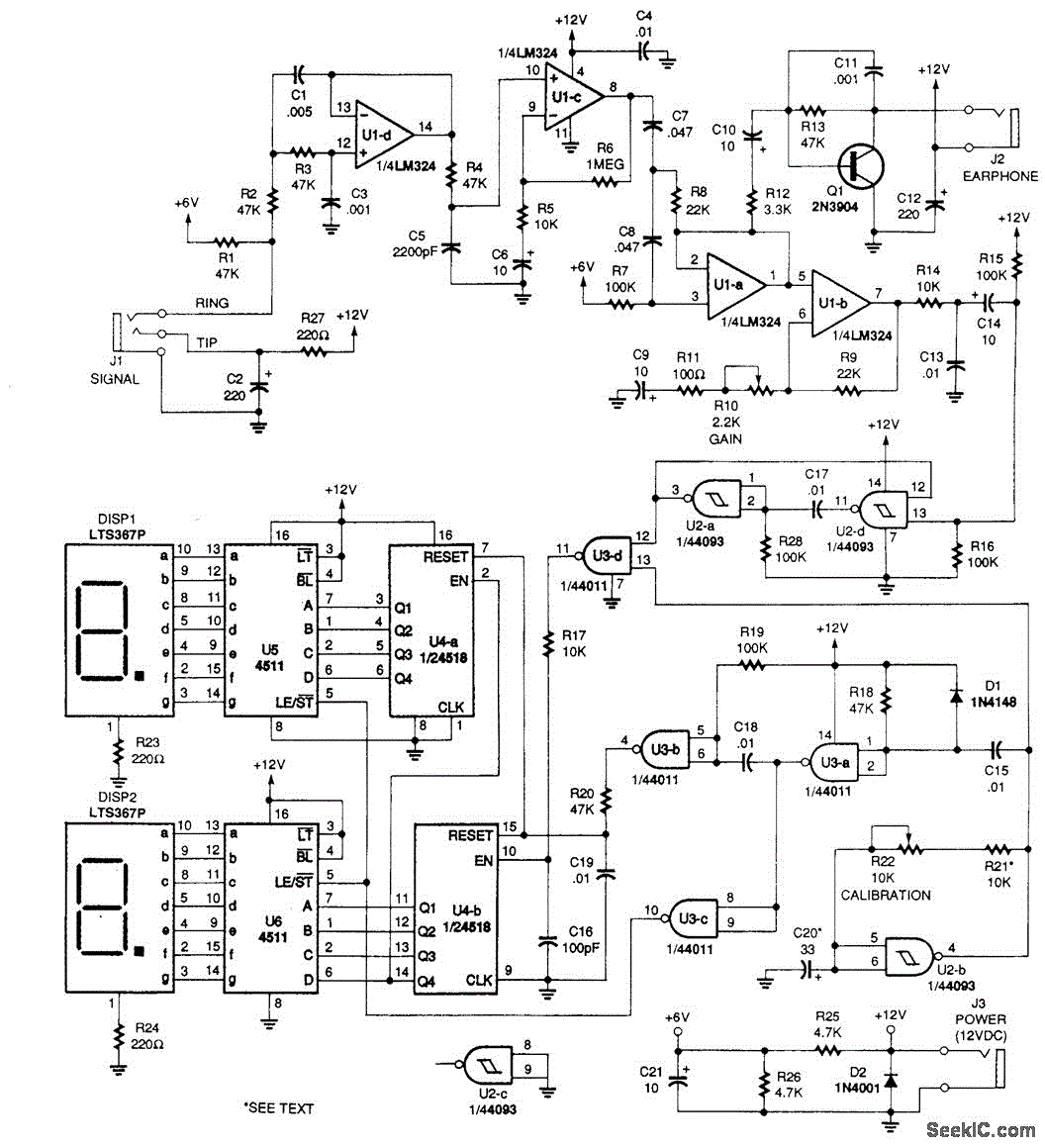
DISPLAY BOARD FOR RADAR GUN
This circuit receives a Doppler signal from a radar, amplifies and limits it, and then feeds the frequency into a counter (U4) and a display circuit (DISP1, DISP2, U5, U6). The calibration of the counter is determined by the clock...
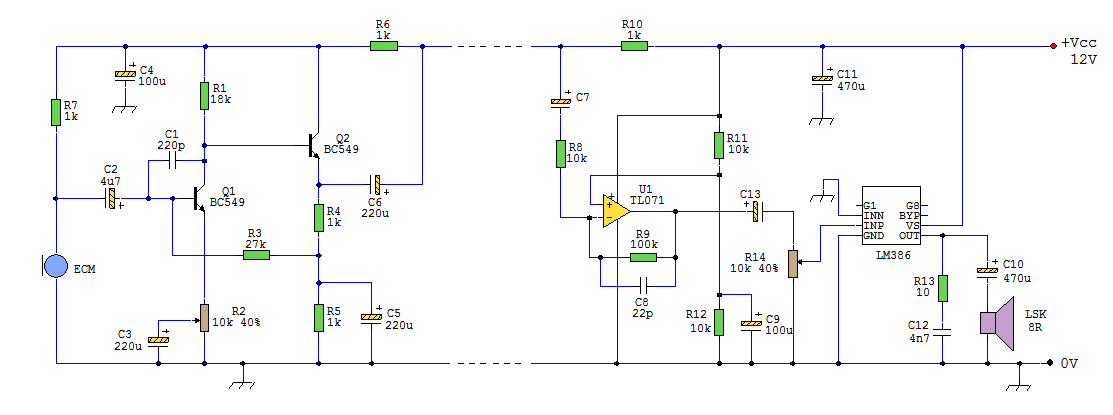
Security Monitor
This circuit can be utilized in a garden setting to detect unusual sounds or wildlife noises. It can also monitor sounds around a car parked in a remote location. The cable used for the setup can either be visible or...
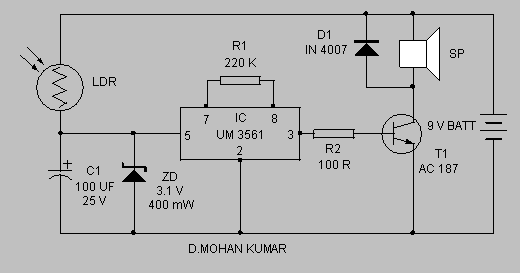
Electronic Locker Guard
Protect your locker or briefcase from theft using this pocket-sized gadget. It emits a loud police siren to attract attention. The circuit utilizes a single integrated circuit (IC).
This circuit is designed to provide a compact and effective security solution for...
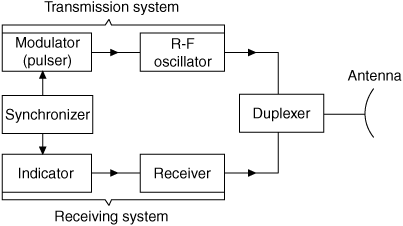
radar
Radar is a method used to detect distant objects and determine their position, velocity, or other characteristics through the analysis of very high frequency signals.
Radar systems operate by transmitting electromagnetic waves, typically in the microwave range, which are reflected off...

Midnight Security Light Circuit Schematic
Most thefts occur after midnight when individuals enter the second phase of sleep known as 'paradoxical sleep.' Here is an energy-saving circuit that causes...
An energy-saving circuit designed for security applications can be particularly beneficial during the late-night hours when individuals...
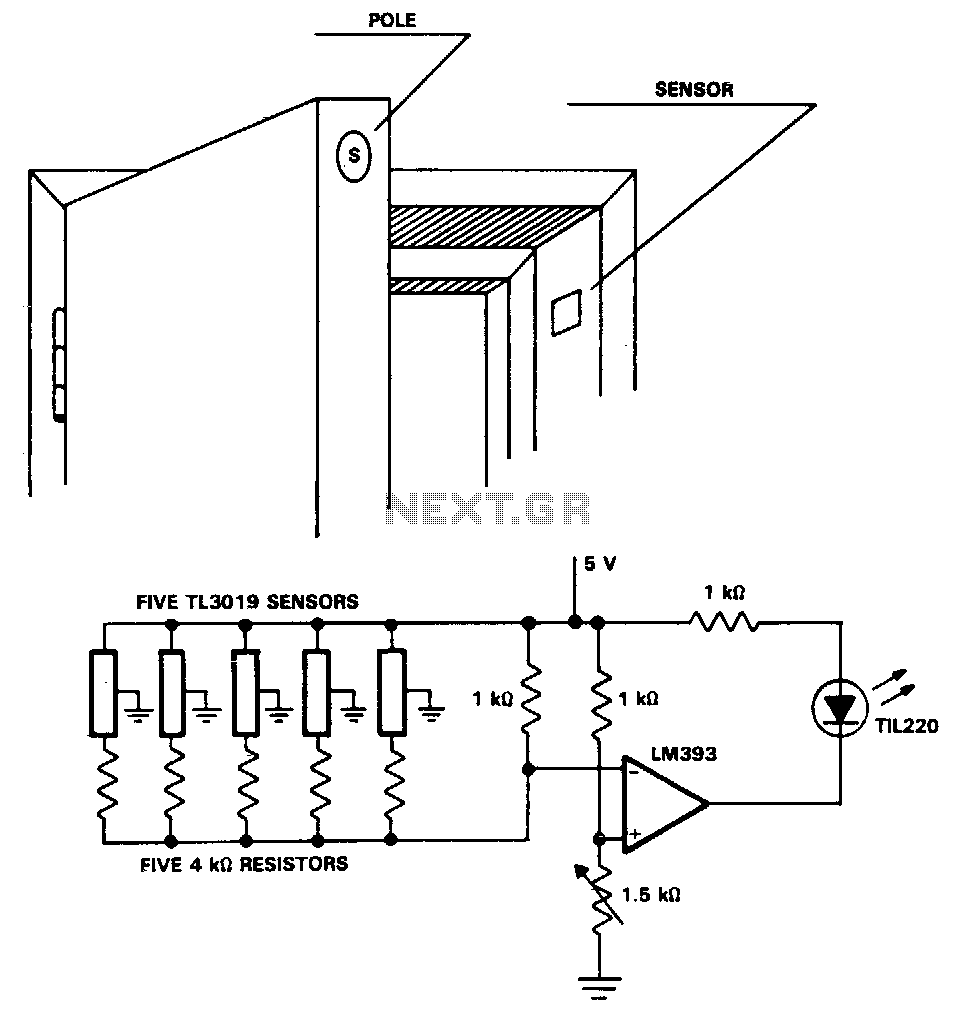
Security-door-ajar-alarm
The TL3019 device activates, or goes low, when a south pole of a magnet approaches the chip face. In this example, there are five doors, each equipped with a magnet embedded in its edge, with the south pole facing outward....
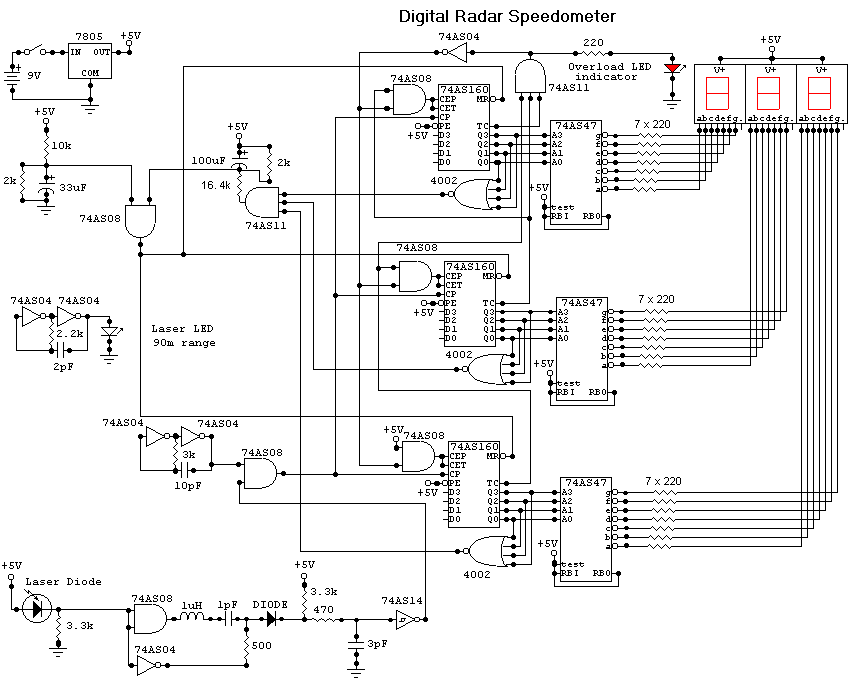
Digital Radar Speedometer
This circuit is a Digital Radar Speedometer. It allows the evaluation of the speed of any moving object, particularly cars and other vehicles. The speed is measured in kilometers per hour (KPH) and is displayed using a three-digit format. This...
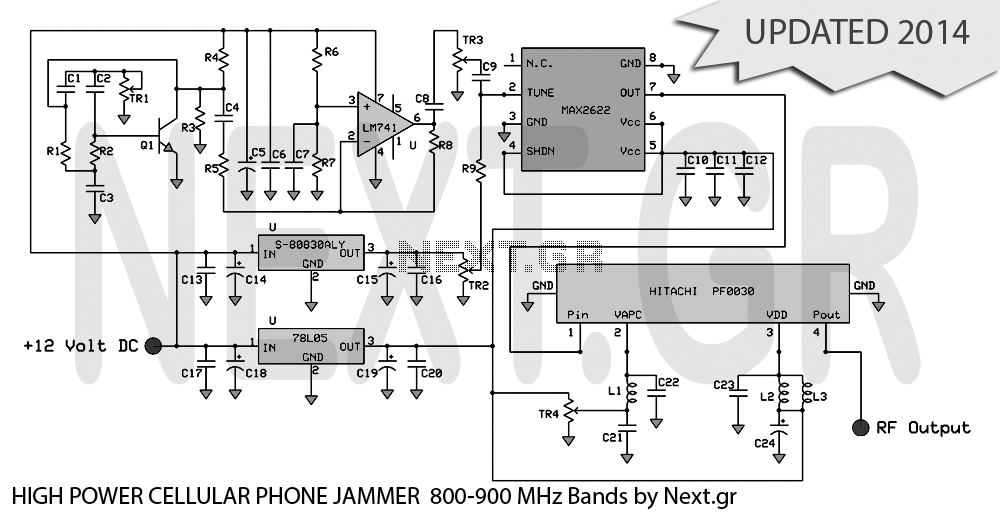
High power mobile phone Jammer circuit
UPDATED 2014 This project presents the original high-power mobile phone jammer circuit, with all updates posted here. Caution is advised regarding the use of this device, as it is illegal. The purpose of sharing this circuit is solely for educational...
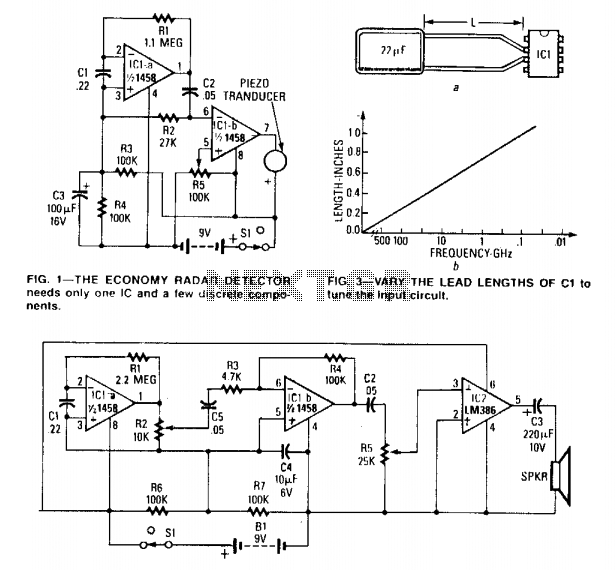
Radar signal detector
The circuit can be tuned to respond to signals between 50 MHz and 500 GHz. The economy model is illustrated in Figure 1, while the deluxe model is depicted in Figure 2. The first operational amplifier (op-amp) in each circuit...