


Mini Operated Voice Relay Schematic
#voice operated relay
#VOX
#off delay
#Silicon Chip
#release time constant
#light switch
#audio control
#relay circuit
#adjustable delay
#sound activation
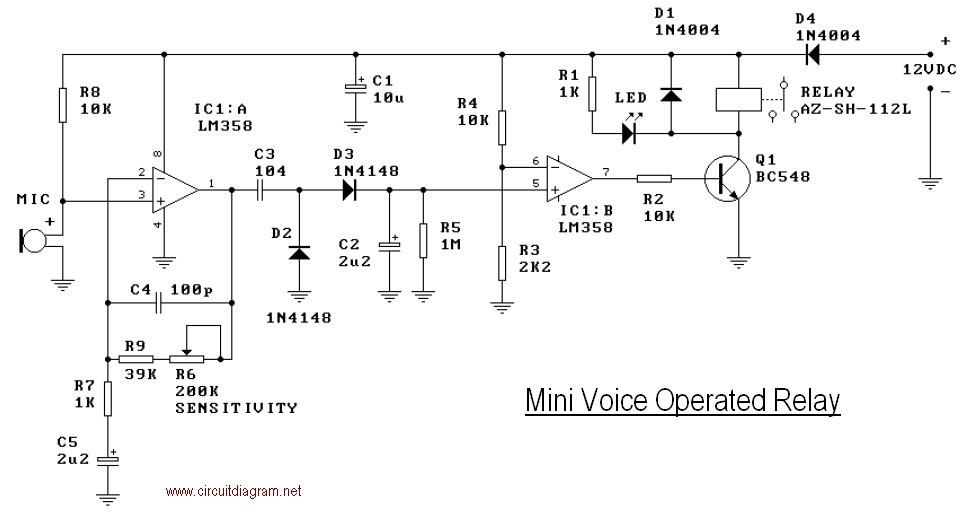
Description: This mini-VOX voice-operated relay is based on a circuit published in Silicon Chip, September 1994, page 31. The off-delay time can be adjusted by varying resistors R3 and R4. Reducing R3 will result in a longer release time. It is possible to change the release time constant (C2 and R5) to approximately 30 seconds, allowing the VOX to function as a light switch with this delay before turning off. To achieve this, increase C2 to around 10µF and R3 to 3.3MΩ. For easier adjustments, a potentiometer or trimpot can be used to vary the resistor value. Additional space on the PCB may be required for this modification, but it will facilitate easier adjustments. The kit for this circuit is available at kitsrus.com and electronickits.com.
This mini-VOX voice-operated relay circuit provides a flexible solution for controlling devices based on voice activation. The core functionality is derived from a design that utilizes a microphone to detect sound levels, which then triggers a relay to operate connected devices. The relay's operation can be finely tuned through the resistors R3 and R4, allowing for precise control over the delay time before the relay disengages.
The adjustment of the release time is critical for applications such as lighting control, where a delay is desired to prevent the light from turning off immediately after the voice command ceases. By changing the capacitor C2 and resistor R5, the time constant can be extended to approximately 30 seconds, providing ample time for the user to leave the room or perform other tasks before the light turns off.
Using a potentiometer or trimpot instead of fixed resistors for R3 and R4 allows for easy on-site adjustments, enhancing the usability of the circuit. This feature is particularly advantageous in prototype or experimental setups where conditions may vary. It is important to note that increasing the capacitance of C2 to 10µF and adjusting R3 to 3.3MΩ will effectively achieve the desired delay without compromising the circuit's integrity.
The circuit layout should be carefully designed to accommodate the additional components required for the adjustable resistors. Sufficient space on the PCB will ensure that the modifications do not interfere with the overall functionality of the circuit. For those interested in building this circuit, kits are available from reputable sources such as kitsrus.com and electronickits.com, providing an accessible entry point for enthusiasts and professionals alike.This mini-VOX voice operated relay is based on a circuit published in Silicon Chip, 9/1994, p31. The off delay time may be adjusted by varying R3 and R4. Reducing R3 will result in a longer release time. You could change the release time constant (C2 & R5) to say 30 seconds and use the VOX as a light switch with this delay time before turn ing off. Increase C2 to say 10uF and R3 to 3M3. To make the easy adjustment, you may use potensiometer or trimpot to varying the value of resistor. You will need additional place on the PCB but it will easier for you to make some adjustment The kit of this circuit available at kitsrus. com anf electronickits. com, you may buy the circuit there.
This mini-VOX voice-operated relay circuit provides a flexible solution for controlling devices based on voice activation. The core functionality is derived from a design that utilizes a microphone to detect sound levels, which then triggers a relay to operate connected devices. The relay's operation can be finely tuned through the resistors R3 and R4, allowing for precise control over the delay time before the relay disengages.
The adjustment of the release time is critical for applications such as lighting control, where a delay is desired to prevent the light from turning off immediately after the voice command ceases. By changing the capacitor C2 and resistor R5, the time constant can be extended to approximately 30 seconds, providing ample time for the user to leave the room or perform other tasks before the light turns off.
Using a potentiometer or trimpot instead of fixed resistors for R3 and R4 allows for easy on-site adjustments, enhancing the usability of the circuit. This feature is particularly advantageous in prototype or experimental setups where conditions may vary. It is important to note that increasing the capacitance of C2 to 10µF and adjusting R3 to 3.3MΩ will effectively achieve the desired delay without compromising the circuit's integrity.
The circuit layout should be carefully designed to accommodate the additional components required for the adjustable resistors. Sufficient space on the PCB will ensure that the modifications do not interfere with the overall functionality of the circuit. For those interested in building this circuit, kits are available from reputable sources such as kitsrus.com and electronickits.com, providing an accessible entry point for enthusiasts and professionals alike.This mini-VOX voice operated relay is based on a circuit published in Silicon Chip, 9/1994, p31. The off delay time may be adjusted by varying R3 and R4. Reducing R3 will result in a longer release time. You could change the release time constant (C2 & R5) to say 30 seconds and use the VOX as a light switch with this delay time before turn ing off. Increase C2 to say 10uF and R3 to 3M3. To make the easy adjustment, you may use potensiometer or trimpot to varying the value of resistor. You will need additional place on the PCB but it will easier for you to make some adjustment The kit of this circuit available at kitsrus. com anf electronickits. com, you may buy the circuit there.
Door Light Switch
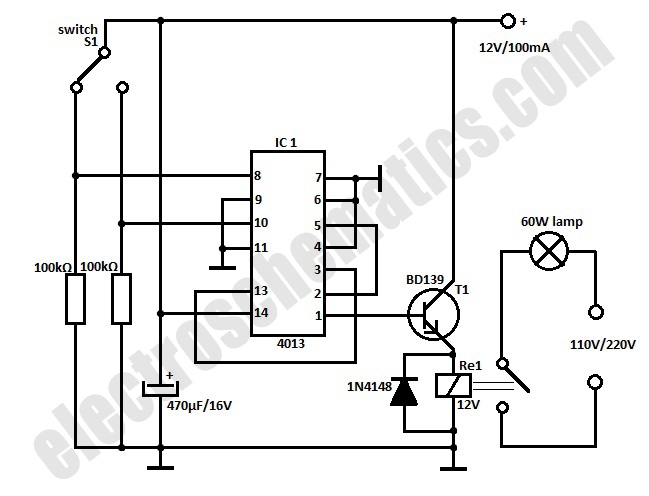
This automatic door light switch circuit activates a lamp when a door is opened and deactivates it when the door is closed again. The working principle of the circuit involves a sensor that detects the door's position.
The automatic door light...
VOX Circuit
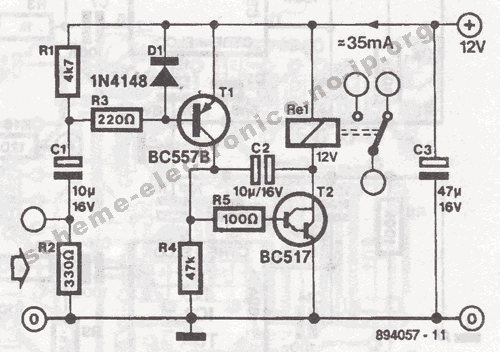
VOX is a voice-activated switch commonly used with microphones as an alternative to traditional push-button switches. The VOX can be connected to various audio equipment featuring an external speaker for coupling. The activation threshold is adjusted using the volume potentiometer...
Light Switch
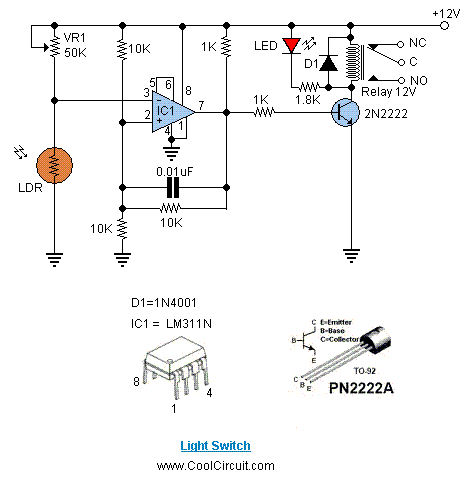
Light Switch. This is a light switch or light-activated relay circuit. The relay activates when the light-dependent resistor (LDR) is uncovered and deactivates when the LDR is covered. It is adjustable for sensitivity and includes an LED indicator.
This light-activated relay...

Quartz Controlled Bedroom Light Switch
This is a simple automatic light switch circuit designed for bedrooms. After construction, connect the input terminals of this circuit in parallel to the internal buzzer terminals of a quartz alarm clock. When the clock alarm is activated, the circuit...
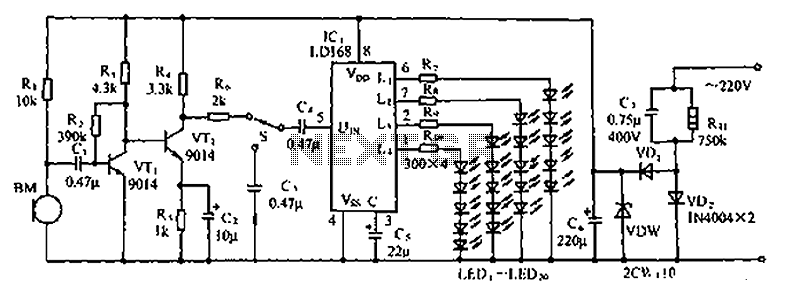
ld168 audio control circuit diagram of a voltage-controlled flash decoration
The circuit depicted in the figure involves the LD168, which functions as a sound level indicator for tape recorder speakers. It features four outputs capable of directly driving multiple light-emitting diodes. Additionally, the device can be activated by a thyristor...
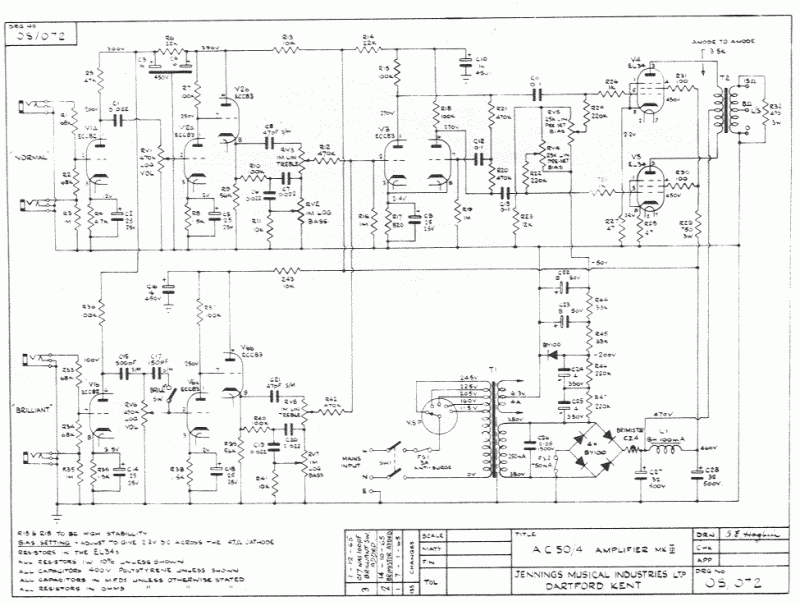
Vox AC 50/4 Amplifier
Cleaned Input: This is a simple Vox AC amplifier. The circuit is not very clear but is readable.
The circuit in question represents a basic Vox AC amplifier. The primary function of this circuit is to amplify the input audio signals,...
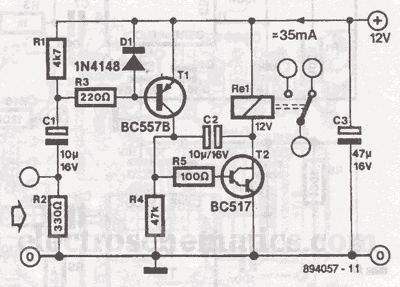
Simple VOX Circuit
VOX is a voice-controlled switch commonly used for microphones, serving as a replacement for the traditional switching button. The actuating threshold is adjusted through the volume potentiometer.
The VOX (Voice Operated Switch) circuit functions by detecting sound levels and activating a...