


simple bass treble tone control
#LM1036
#tone control
#bass
#treble
#volume control
#stereo
#audio systems
#car radio
#loudness compensation
#balance control
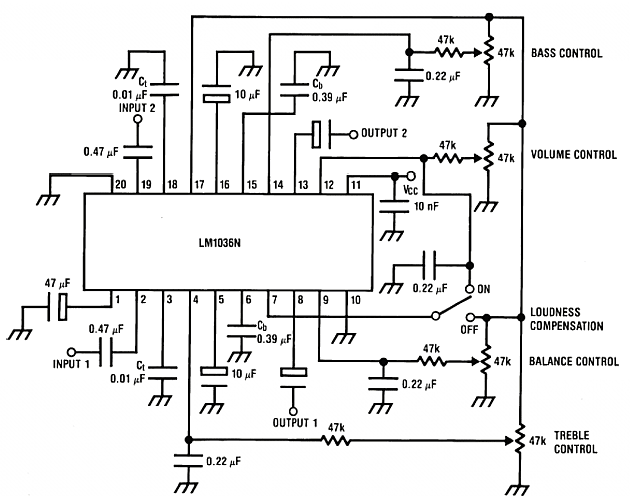
Description: The LM1036 is a DC-controlled circuit designed for adjusting tone (bass/treble), volume, and balance in stereo applications such as car radios, televisions, and audio systems. It features an additional control input that enables straightforward loudness compensation. Four control inputs allow for the manipulation of bass, treble, balance, and volume functions by applying DC voltages from a remote control system or, alternatively, from four potentiometers that can be biased using a Zener regulated supply available on the circuit.
The LM1036 integrates multiple functionalities essential for audio processing in consumer electronics. The device operates by accepting DC voltage levels that correspond to the desired adjustments in audio output. Each of the four control inputs—bass, treble, balance, and volume—can be connected to a remote control system or manually adjusted via potentiometers. This flexibility allows for user-friendly operation, catering to both automated and manual audio adjustments.
In terms of implementation, the circuit typically includes a Zener diode to provide a stable reference voltage for the potentiometers, ensuring consistent performance across various operating conditions. The tone control section employs a differential amplifier configuration that adjusts the audio signal's frequency response, allowing users to enhance or attenuate specific frequency ranges for optimal sound quality.
The volume control section utilizes a similar approach, where the audio signal's amplitude is adjusted based on the applied DC voltage. The balance control allows for the adjustment of audio levels between the left and right channels, ensuring a balanced stereo output, which is crucial for an immersive listening experience.
Additionally, the loudness compensation feature is particularly beneficial in scenarios where low listening levels may result in a perceived loss of bass and treble frequencies. By integrating this feature, the LM1036 ensures that audio quality remains consistent regardless of volume levels, making it an ideal choice for various audio applications.
Overall, the LM1036 is a versatile and effective solution for audio control in stereo systems, providing users with comprehensive control over their audio experience. Its design facilitates easy integration into existing systems, making it a valuable component for engineers and designers in the audio electronics field.The LM1036 is a DC controlled tone (bass/treble), volume and balance circuit for stereo applications in car radio, TV and audio systems. An additional control input allows loudness compensation to be simply effected. Four control inputs provide control of the bass, treble, balance and volume functions through application of DC voltages from a remo
te control system or, alternatively, from four potentiometers which may be biased from a zener regulated supply provided on the circuit.
The LM1036 integrates multiple functionalities essential for audio processing in consumer electronics. The device operates by accepting DC voltage levels that correspond to the desired adjustments in audio output. Each of the four control inputs—bass, treble, balance, and volume—can be connected to a remote control system or manually adjusted via potentiometers. This flexibility allows for user-friendly operation, catering to both automated and manual audio adjustments.
In terms of implementation, the circuit typically includes a Zener diode to provide a stable reference voltage for the potentiometers, ensuring consistent performance across various operating conditions. The tone control section employs a differential amplifier configuration that adjusts the audio signal's frequency response, allowing users to enhance or attenuate specific frequency ranges for optimal sound quality.
The volume control section utilizes a similar approach, where the audio signal's amplitude is adjusted based on the applied DC voltage. The balance control allows for the adjustment of audio levels between the left and right channels, ensuring a balanced stereo output, which is crucial for an immersive listening experience.
Additionally, the loudness compensation feature is particularly beneficial in scenarios where low listening levels may result in a perceived loss of bass and treble frequencies. By integrating this feature, the LM1036 ensures that audio quality remains consistent regardless of volume levels, making it an ideal choice for various audio applications.
Overall, the LM1036 is a versatile and effective solution for audio control in stereo systems, providing users with comprehensive control over their audio experience. Its design facilitates easy integration into existing systems, making it a valuable component for engineers and designers in the audio electronics field.The LM1036 is a DC controlled tone (bass/treble), volume and balance circuit for stereo applications in car radio, TV and audio systems. An additional control input allows loudness compensation to be simply effected. Four control inputs provide control of the bass, treble, balance and volume functions through application of DC voltages from a remo
te control system or, alternatively, from four potentiometers which may be biased from a zener regulated supply provided on the circuit.
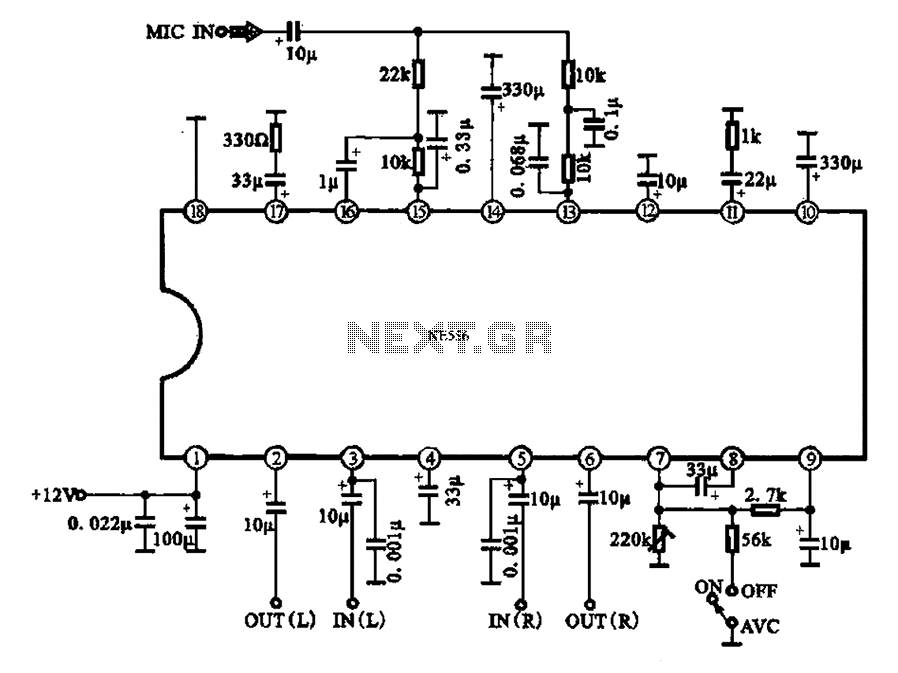
Automatic volume change with the ambient noise control circuit
Automatic volume adjustment with ambient noise control circuit. In car stereos and similar devices, the ambient noise level varies during high-speed and low-speed driving or while stationary, leading to different volume requirements. A fixed volume adjustment method may negatively impact...
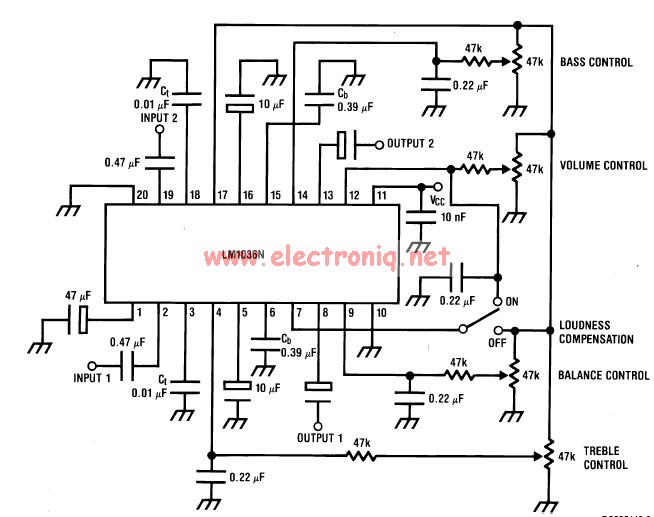
LM1036 volume controller equalizer electronic project
This volume controller equalizer electronic project is designed using the LM1036 DC tone volume controller, featuring a volume and balance circuit for stereo applications. The four control inputs of the LM1036 volume controller enable the control of bass, treble, balance,...
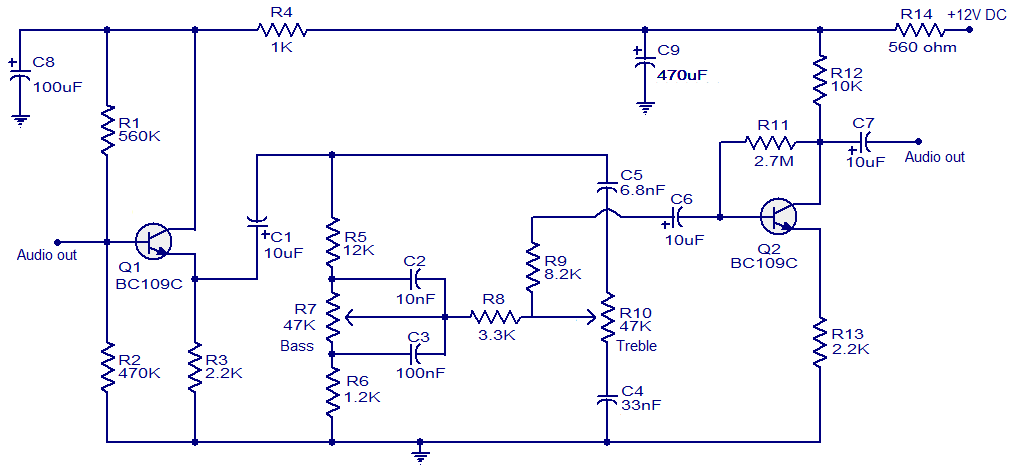
Baxendall tone control circuit
This simple tone control circuit is designed based on the renowned Baxendall tone control circuitry. The circuit can provide a maximum cut or boost of approximately 12 dB at both 10 kHz (treble) and 50 Hz (bass). Additionally, both bass...
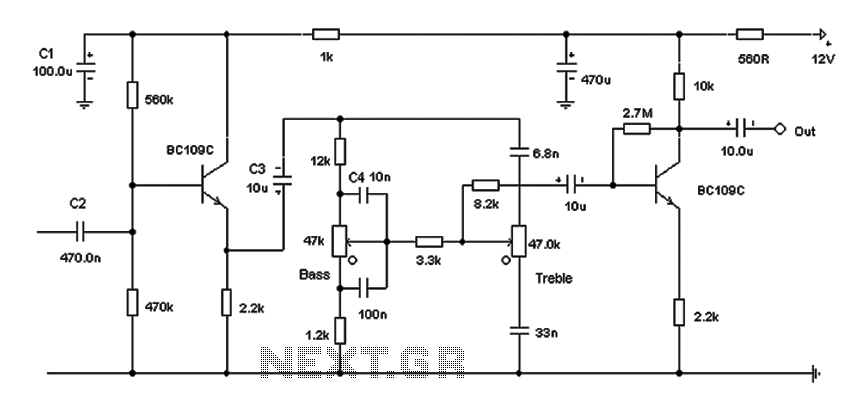
Volume control circuit
Based on the classic Baxendall tone control circuit, this design offers a maximum cut and boost of approximately 10 dB at 10 kHz and 50 Hz. Since the controls are passive, the final transistor provides a slight boost. The output...
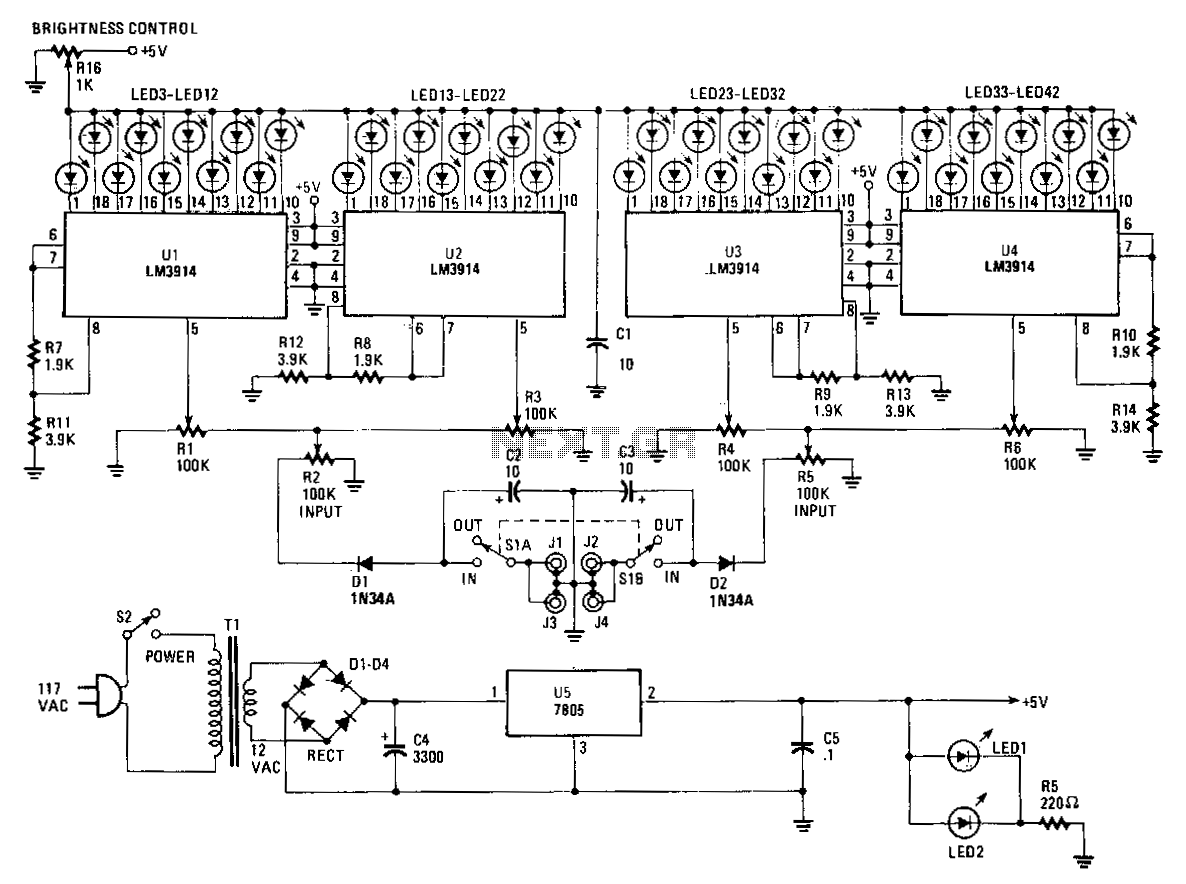
Stereo-power-meter
The Stereo Power Meter consists of two identical circuits and a power supply. Each circuit features two LM3914 display chips, which include 10 voltage comparators, a 10-step voltage divider, a reference voltage source, and a mode-select circuit that allows for...
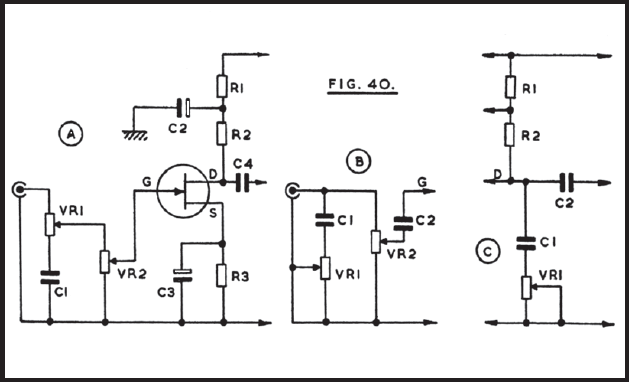
Tone Controls
The circuit operates from a 12V or similar power supply, with the option to adjust resistor R1 for higher voltage applications. There is significant flexibility in selecting values for components like capacitor C1. At point B, VR1 serves as a...

Bass circuit diagram
The circuit operates by processing an input signal through IC1-1 and a fourth-order low-pass filter, which provides a slope of 24 dB/octave with a cutoff frequency (fc) of 70 Hz and an amplification of 8.2 dB. The output from this...
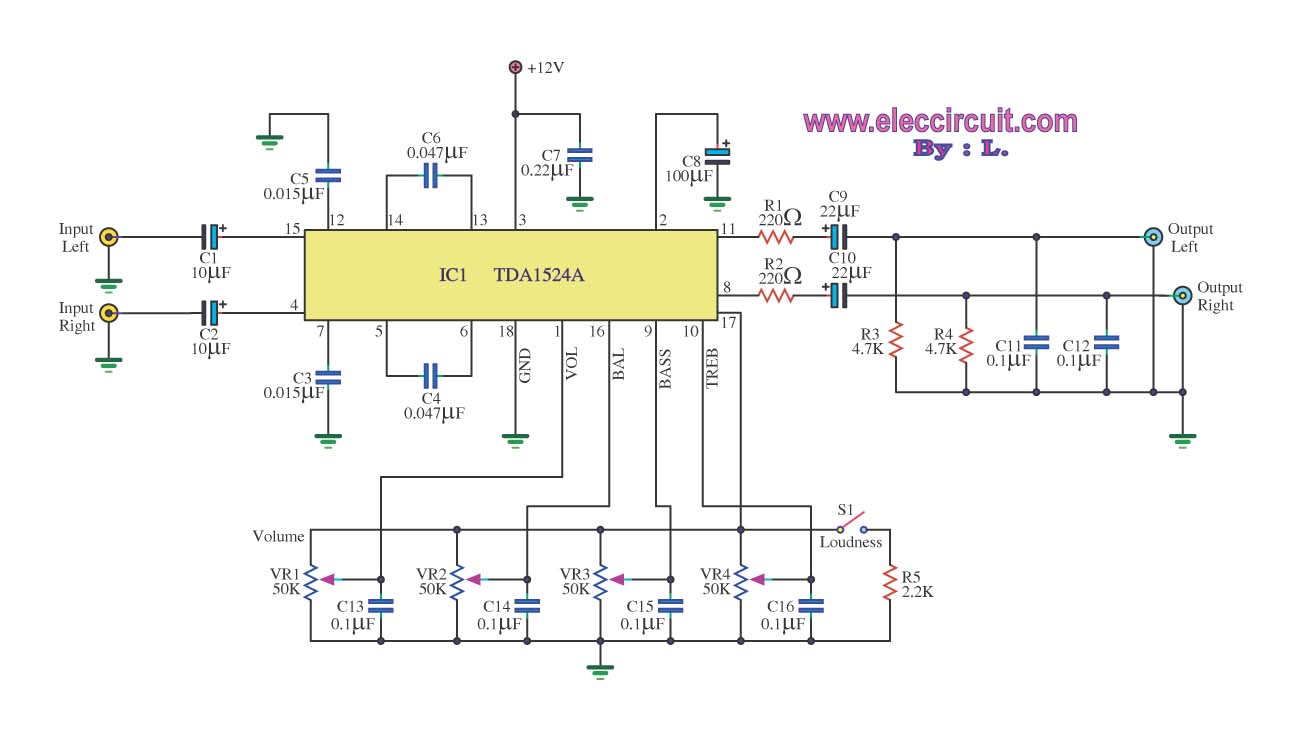
Stereo tone control circuit using IC TDA1524A
The stereo tone control circuit utilizes the integrated circuit TDA1524A. This IC serves as the central component in the design.
The TDA1524A is a versatile integrated circuit designed for audio applications, particularly in tone control systems. It features a dual-channel operation,...
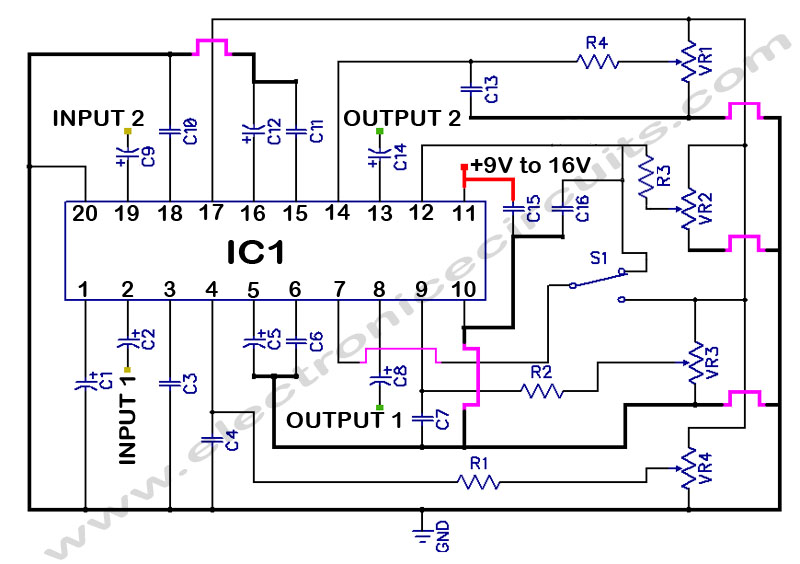
LM1036 Stereo Tone Controller Circuit
LM1036 Stereo Tone (Bass, Treble, Volume, Loudness, Balance) Controller Circuit. The LM1036 is a DC controlled tone (bass/treble), volume, and loudness controller designed for audio applications.
The LM1036 circuit serves as an integrated solution for controlling various aspects of audio signal...