


fog lamp sensor circuit
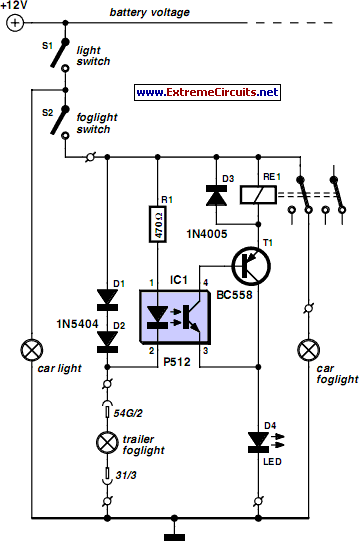
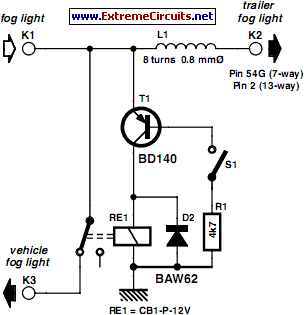
Description: For several years, a rear fog lamp has been mandatory for trailers and caravans to enhance visibility in foggy conditions. When this fog lamp is activated, the fog lamp of the towing vehicle must be turned off to prevent irritating reflections. To achieve this, a mechanical switch is integrated into the 13-way female connector to deactivate the fog lamp of the towing vehicle and activate the fog lamp of the trailer or caravan. For users with a 7-way connector, this switching can be implemented electronically using the circuit illustrated here. In this circuit, a type P521 optocoupler detects whether the fog lamp of the caravan or trailer is connected. If the fog lamp is turned on in the car, a current flows through the caravan fog lamp via diodes D1 and D2. This causes the LED in the optocoupler to illuminate, resulting in the photo-transistor conducting and energizing the relay via transistor T1. The relay then switches off the fog lamp of the car. For those with basic skills, this small circuit can be easily constructed on a small piece of perforated circuit board and installed near the rear lamp fitting of the towing vehicle.
The electronic circuit described facilitates the automatic control of fog lamps in towing scenarios, ensuring compliance with safety regulations while enhancing visibility. The core component of this system is the P521 optocoupler, which serves as an isolation device that detects the activation of the trailer or caravan fog lamp. When the fog lamp is energized, it allows current to flow through diodes D1 and D2, which are crucial for protecting the circuit and ensuring proper current routing.
The optocoupler's LED illuminates when current passes through, activating its internal photo-transistor. This action triggers transistor T1, which in turn energizes a relay. The relay serves as a switch that interrupts the power supply to the fog lamp of the towing vehicle, effectively turning it off. This process prevents the potential hazard of glare that could impair visibility for other drivers.
The circuit can be assembled on a perforated circuit board, making it accessible for individuals with basic electronics skills. The compact design allows for easy installation near the rear lamp fitting of the towing vehicle, ensuring that it does not interfere with the vehicle's normal operations. This solution not only adheres to legal requirements but also enhances overall road safety during adverse weather conditions. Proper implementation of this circuit can significantly improve the visibility of the trailer or caravan while minimizing distractions caused by the towing vehicle's fog lamp.For several years now, a rear fog lamp has been mandatory for trailers and caravans in order to improve visibility under foggy conditions. When this fog lamp is switched on, the fog lamp of the pulling vehicle must be switched of to avoid irritating reflections.
For this purpose, a mechanical switch is now built into the 13-way female connector in order to switch of the fog lamp of the pulling vehicle and switch on the fog lamp of the trailer or caravan. For anyone who uses a 7-way connector, this switching can also be implemented electronically with the aid of the circuit illustrated here.
Here a type P521 optocoupler detects whether the fog lamp of the caravan or trailer is connected. If the fog lamp is switched on in the car, a current flows through the caravan fog lamp via diodes D1 and D2. This causes the LED in the optocoupler to light up, with the result that the photo-transistor conducts and energies the relay via transistor T1.
The relay switches of the fog lamp of the car. For anyone who`s not all thumbs, this small circuit can easily be built on a small piece of perforated circuit board and then fitted somewhere close to the rear lamp fitting of the pulling vehicle.
The electronic circuit described facilitates the automatic control of fog lamps in towing scenarios, ensuring compliance with safety regulations while enhancing visibility. The core component of this system is the P521 optocoupler, which serves as an isolation device that detects the activation of the trailer or caravan fog lamp. When the fog lamp is energized, it allows current to flow through diodes D1 and D2, which are crucial for protecting the circuit and ensuring proper current routing.
The optocoupler's LED illuminates when current passes through, activating its internal photo-transistor. This action triggers transistor T1, which in turn energizes a relay. The relay serves as a switch that interrupts the power supply to the fog lamp of the towing vehicle, effectively turning it off. This process prevents the potential hazard of glare that could impair visibility for other drivers.
The circuit can be assembled on a perforated circuit board, making it accessible for individuals with basic electronics skills. The compact design allows for easy installation near the rear lamp fitting of the towing vehicle, ensuring that it does not interfere with the vehicle's normal operations. This solution not only adheres to legal requirements but also enhances overall road safety during adverse weather conditions. Proper implementation of this circuit can significantly improve the visibility of the trailer or caravan while minimizing distractions caused by the towing vehicle's fog lamp.For several years now, a rear fog lamp has been mandatory for trailers and caravans in order to improve visibility under foggy conditions. When this fog lamp is switched on, the fog lamp of the pulling vehicle must be switched of to avoid irritating reflections.
For this purpose, a mechanical switch is now built into the 13-way female connector in order to switch of the fog lamp of the pulling vehicle and switch on the fog lamp of the trailer or caravan. For anyone who uses a 7-way connector, this switching can also be implemented electronically with the aid of the circuit illustrated here.
Here a type P521 optocoupler detects whether the fog lamp of the caravan or trailer is connected. If the fog lamp is switched on in the car, a current flows through the caravan fog lamp via diodes D1 and D2. This causes the LED in the optocoupler to light up, with the result that the photo-transistor conducts and energies the relay via transistor T1.
The relay switches of the fog lamp of the car. For anyone who`s not all thumbs, this small circuit can easily be built on a small piece of perforated circuit board and then fitted somewhere close to the rear lamp fitting of the pulling vehicle.
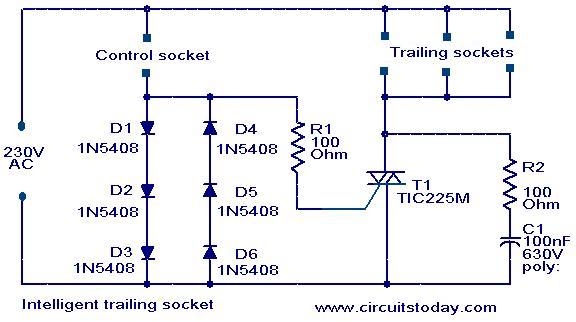
Intelligent trailing switch
This circuit is a straightforward yet effective design where devices connected to the trailing sockets will operate only when the device connected to the control socket is powered on. For instance, if a motor is connected to the control socket...

Rear Fog Lamp For Vintage Cars
According to current legislation in many countries, vintage cars must also be fitted with a fog lamp at the rear. In modern cars, there is a bit of circuitry involved in the integration of fog lamps.
Fog lamps are essential safety...
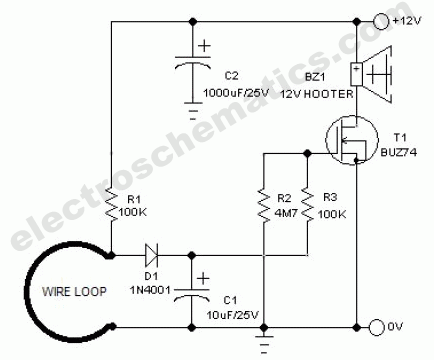
Wire Break Sensor Alarm Circuit Schematic
The circuit of a loop sensor-based simple security alarm is described here. The sensor loop consists of a short length of thin enamelled copper wire.
The loop sensor security alarm operates on the principle of detecting interruptions in the circuit formed...
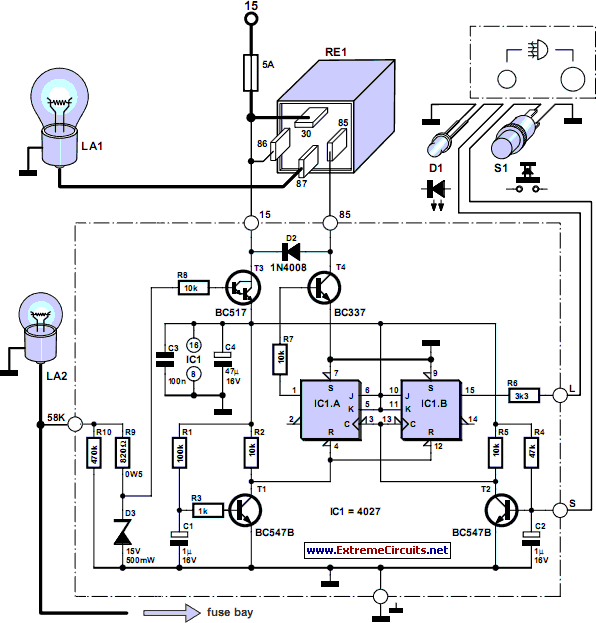
rear fog lamp for vintage cars
According to current legislation in many countries, vintage cars must also be fitted with a rear fog lamp. Modern vehicles incorporate circuitry associated with the fog lamp switch to prevent the fog lamp from activating when the lights are on,...
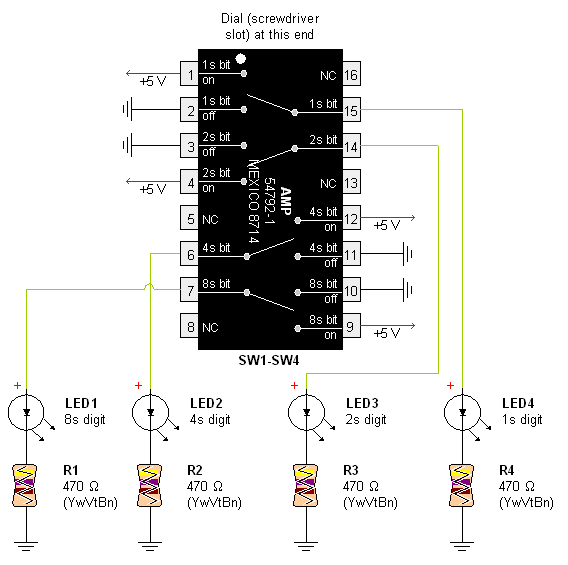
AMP Hexadecimal Rotary Switch
Pictures and a sample schematic (including pinouts) of an AMP hexadecimal (16-position) switch with a screw slot actuator.
The AMP hexadecimal switch is a 16-position rotary switch designed for applications requiring multiple selectable options. This switch features a screw slot actuator...
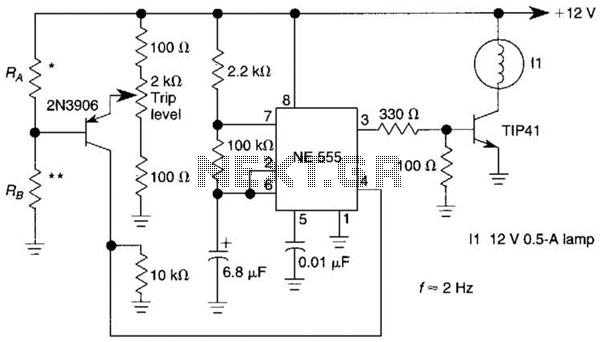
Sensor-Activated Relay Pulser Circuit
A sensor activates transistor Q1 to turn on the low-frequency 555 oscillator, which generates pulses to control LAMP II. The sensor may respond to variations in light or temperature. Either resistor RA or RB can function as the sensor, depending...
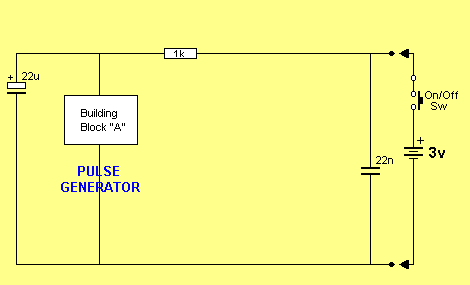
Mini Tracker
A grasshopper is a switch that can activate at any moment. A plastic piece is positioned between two switch contacts to keep them apart, connected to a cotton thread fixed to the floor. When the object is moved, the cotton...
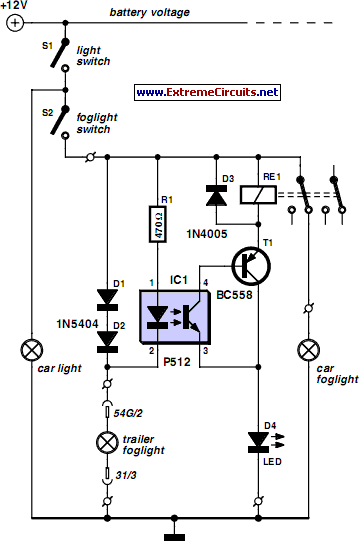
Fog Lamp Sensor Circuit
For several years, a rear fog lamp has been mandatory for trailers and caravans to improve visibility in foggy conditions. When this fog lamp is activated, the fog lamp of the towing vehicle must be turned off to prevent irritating...
Fog Lamp Switch Circuit
In many countries, it is now mandatory or at least recommended to have a rear fog light on a trailer. There is an additional requirement that when the trailer is connected to the vehicle, the rear fog light of the...