


Wide Band Fuel Mixture Display
#wideband
#fuel mixture
#oxygen sensor
#display
#automotive
#sensor controller
#DIY
#Jaycar
#TE-5301
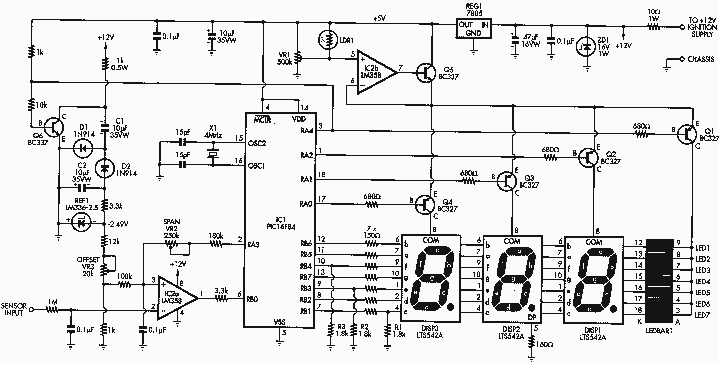
Description: This document is an introduction to the Wideband Fuel Mixture Display (FMD). We modified the original Silicon Chip Fuel Mixture Display (that used a narrowband sensor) for use as a display for the DIY-WB wideband oxygen sensor controller. After first publishing how to modify the Jaycar KC-5300, we got Jaycar to make up the kits for us and we called them the TE-5300 display. These units were quite successful but we wanted them to be easier to build, so we created the improved TE-5301 display.
The Wideband Fuel Mixture Display (FMD) serves as a critical component in monitoring and adjusting the air-fuel mixture in internal combustion engines. The TE-5301 display is an enhanced version of its predecessor, the TE-5300, designed to provide a more user-friendly assembly process while maintaining high accuracy in the measurement of the air-fuel ratio.
The circuit incorporates a wideband oxygen sensor, which is capable of providing a broader range of air-fuel mixture readings compared to narrowband sensors. This capability allows for more precise tuning of the engine, resulting in improved performance and efficiency. The schematic includes a microcontroller that processes the sensor signals, translating them into a readable format for the display module.
Power supply requirements for the TE-5301 are minimal, typically operating within a range of 9-12V DC, which can be sourced from the vehicle's electrical system. The display unit interfaces with the sensor through a dedicated analog input, ensuring that the voltage levels corresponding to the air-fuel ratio are accurately captured.
Additional components such as resistors, capacitors, and operational amplifiers are utilized to filter and condition the sensor signals before they are processed by the microcontroller. The output is presented on an LCD or LED display, providing real-time feedback to the user.
The TE-5301 is designed with modularity in mind, allowing for easy upgrades and modifications. This flexibility is particularly beneficial for DIY enthusiasts and automotive tuners who may wish to customize the display for specific applications or preferences.
In summary, the TE-5301 Wideband Fuel Mixture Display represents an evolution in fuel mixture monitoring technology, combining ease of assembly, accurate readings, and flexibility for the user, making it an essential tool for optimizing engine performance.This document is an introduction to the Wideband Fuel Mixture Display (FMD). We modified the original Silicon Chip Fuel Mixture Display (that used a narrowband sensor) for use as a display for the DIY-WB wideband oxygen sensor controller. After first publishing how to modify the Jaycar KC-5300, we got Jaycar to make up the kits for us and we called them the TE-5300 display.
These units were quite successful but we wanted them to be easier to build, so we created the improved TE-5301 display.
The Wideband Fuel Mixture Display (FMD) serves as a critical component in monitoring and adjusting the air-fuel mixture in internal combustion engines. The TE-5301 display is an enhanced version of its predecessor, the TE-5300, designed to provide a more user-friendly assembly process while maintaining high accuracy in the measurement of the air-fuel ratio.
The circuit incorporates a wideband oxygen sensor, which is capable of providing a broader range of air-fuel mixture readings compared to narrowband sensors. This capability allows for more precise tuning of the engine, resulting in improved performance and efficiency. The schematic includes a microcontroller that processes the sensor signals, translating them into a readable format for the display module.
Power supply requirements for the TE-5301 are minimal, typically operating within a range of 9-12V DC, which can be sourced from the vehicle's electrical system. The display unit interfaces with the sensor through a dedicated analog input, ensuring that the voltage levels corresponding to the air-fuel ratio are accurately captured.
Additional components such as resistors, capacitors, and operational amplifiers are utilized to filter and condition the sensor signals before they are processed by the microcontroller. The output is presented on an LCD or LED display, providing real-time feedback to the user.
The TE-5301 is designed with modularity in mind, allowing for easy upgrades and modifications. This flexibility is particularly beneficial for DIY enthusiasts and automotive tuners who may wish to customize the display for specific applications or preferences.
In summary, the TE-5301 Wideband Fuel Mixture Display represents an evolution in fuel mixture monitoring technology, combining ease of assembly, accurate readings, and flexibility for the user, making it an essential tool for optimizing engine performance.This document is an introduction to the Wideband Fuel Mixture Display (FMD). We modified the original Silicon Chip Fuel Mixture Display (that used a narrowband sensor) for use as a display for the DIY-WB wideband oxygen sensor controller. After first publishing how to modify the Jaycar KC-5300, we got Jaycar to make up the kits for us and we called them the TE-5300 display.
These units were quite successful but we wanted them to be easier to build, so we created the improved TE-5301 display.
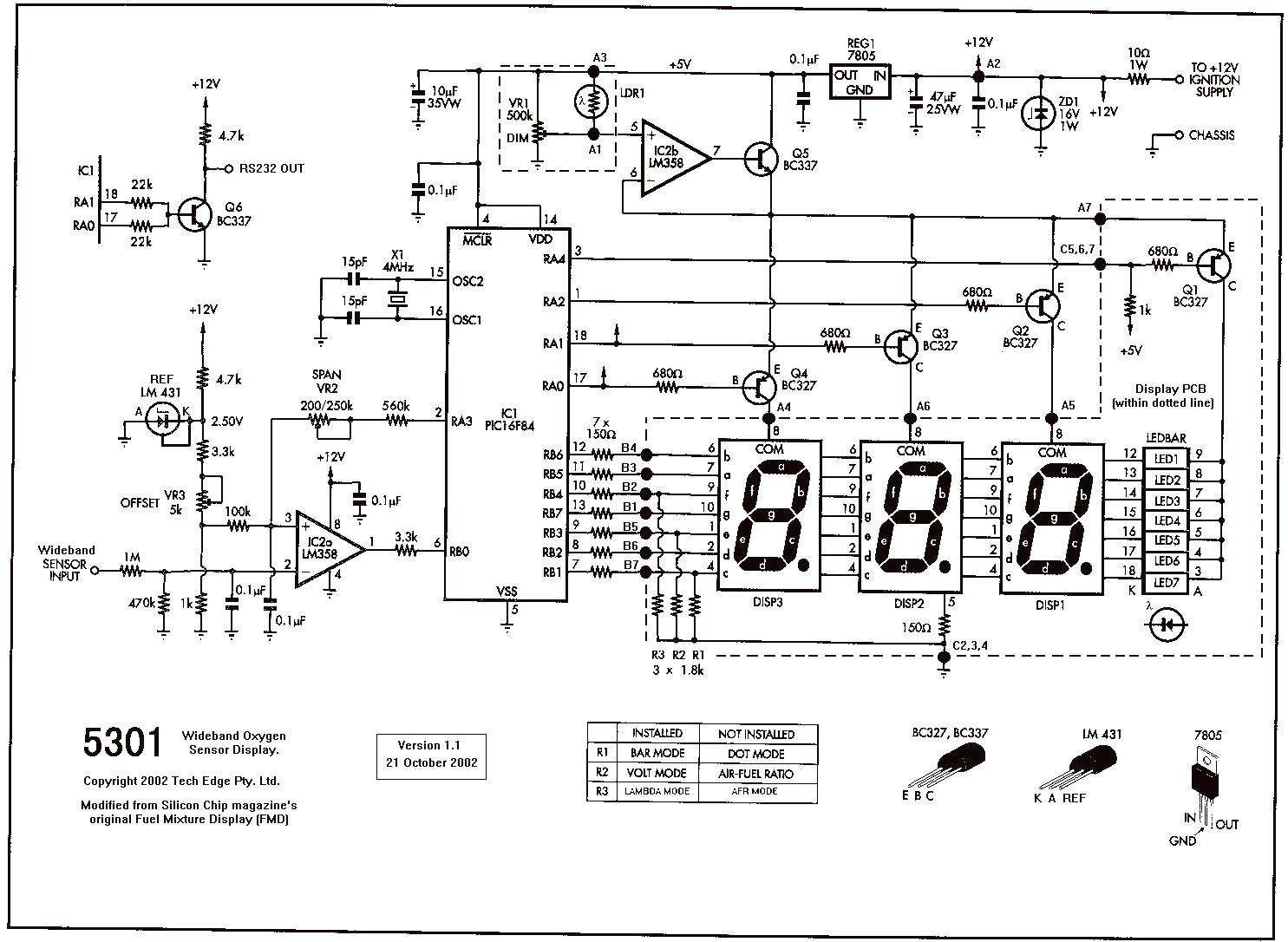
Wideband Display
This is the construction guide for the 5301 wideband fuel mixture display kit. The 5301 is the Tech Edge version (rather than the Jaycar version) of the modified Silicon Chip FMD design, and it features, compared to the original kit,...
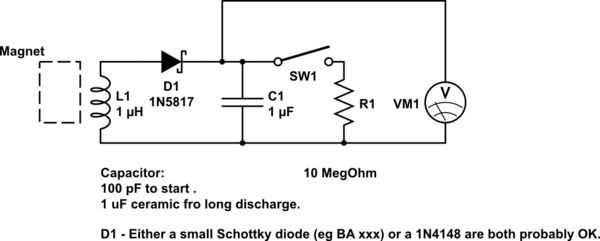
DIY kinetic energy harvester
A DIY kinetic energy harvester utilizing the electromagnetic method to generate electricity. The materials that will be used are currently known.
The project involves creating a kinetic energy harvester that converts mechanical energy from motion into electrical energy through electromagnetic induction....

Universal Wideband Amp
This kit is part of what is referred to as RF Tool Kits, specifically Electronic Building Blocks. A variety of these kits are available, with new ones being released periodically. The offerings can be explored and built in a homebrew...
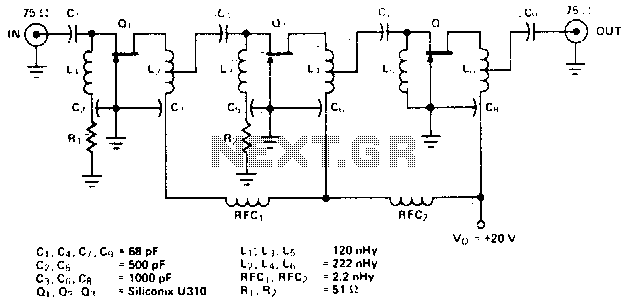
Wideband uhf amplifier with high-performance fets
The amplifier circuit is designed for a center frequency of 225 MHz, with a bandwidth of 50 MHz at 1 dB, low input voltage standing wave ratio (VSWR) in a 75-ohm system, and a gain of 24 dB. Three stages...
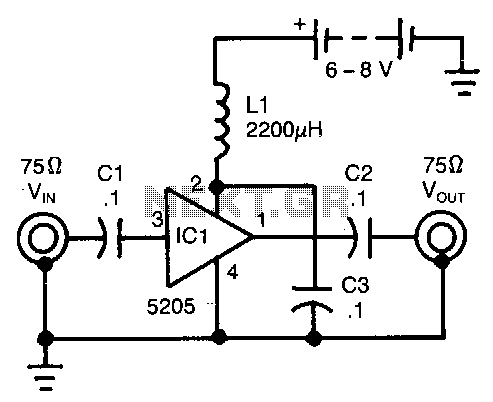
Miniature-wideband-amplifier
This wideband amplifier utilizes only five components. External signals are introduced to pin 3 of IC1 through an AC coupling capacitor, C1. After amplification, the enhanced signals from pin 1 of IC1 are transmitted to the output via capacitor C2....
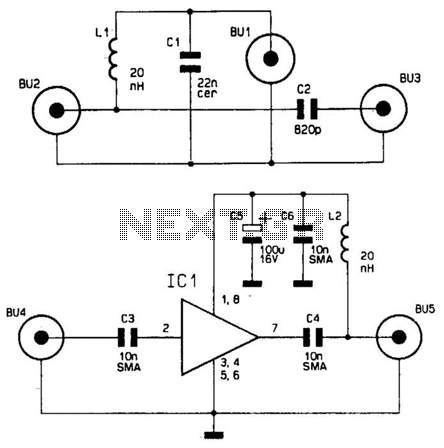
Wideband Antenna Preamplifier Circuit
This wideband antenna preamplifier has a gain of approximately 20 dB from 40 to 860 MHz, covering the entire VHF, FM, commercial, and UHF bands. A phantom power supply delivers DC power to the preamplifier through the coaxial cable connected...
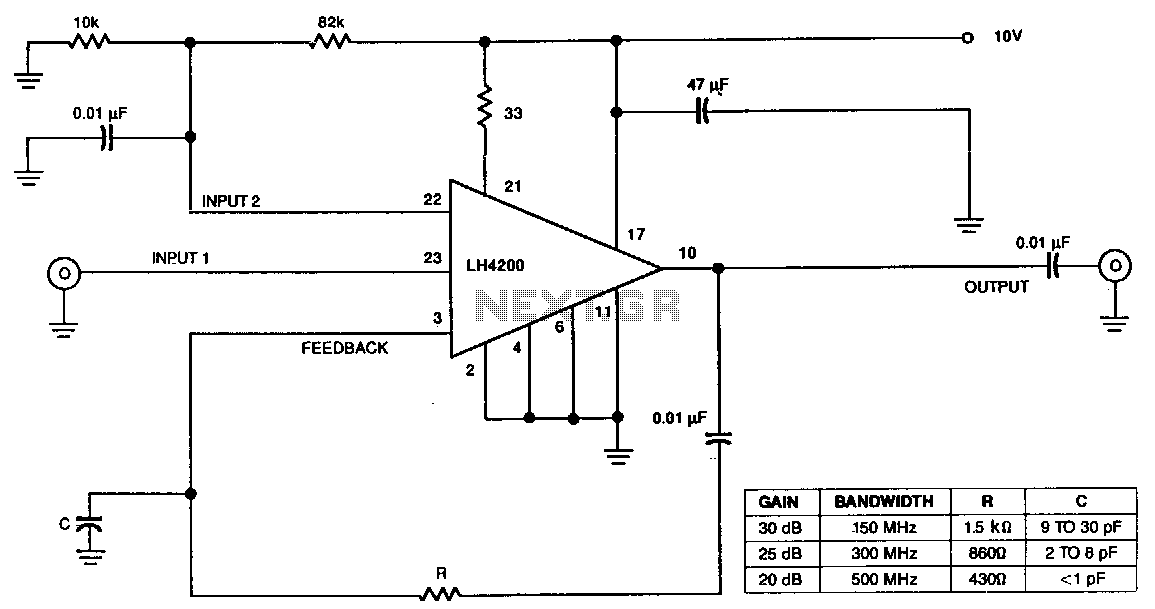
Wideband-500khz-1ghz-hybrid-amplifier
The amplifier's input stage features a dual-gate GaAs FET, which offers low input capacitance and high transconductance. The first input accepts the signal, while the second input regulates the amplifier's gain. Additionally, there is a third input for series feedback....
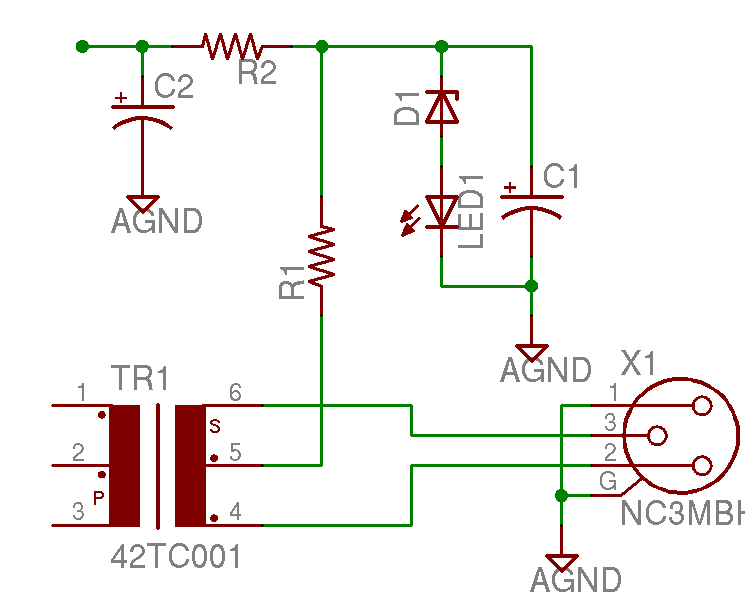
Help with a schematic please
A project is underway to construct the CountryHick DI as illustrated on DIYFactory, incorporating a few minor modifications. The final design aims to be a 1U unit with four inputs.
The CountryHick DI (Direct Injection) box is a crucial tool in...
Bubble display proof of concept
Some time ago, a captivating water display showcased by Jeep at conventions caught attention. The design appeared straightforward, prompting the decision to create a similar project. Instead of utilizing falling water, the concept involves using air bubbles that rise in...