


Lithium battery charger schematic circuit design using LTM8061 IC
#Lithium battery
#LTM8061
#charger circuit
#high efficiency
#Linear Technology
#battery monitoring
#fixed float voltage
#2A charger
#32V charger
#one-cell pack
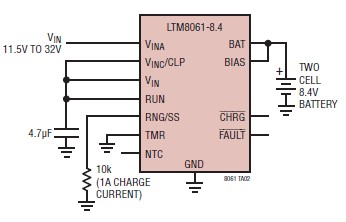
Description: A simple and efficient lithium battery charger and monitoring system can be designed using the LTM8061 integrated circuit from Linear Technology. The LTM8061 is a high-efficiency 32V, 2A module standalone lithium battery charger optimized for one- and two-cell packs, with fixed float voltage options of 4.1V, 4.2V, 8.2V, and 8.4V. It features a preconditioning function that trickle charges a depleted battery, and includes bad battery detection that signals and suspends charging if the battery does not respond to preconditioning. The LTM8061 can be configured to terminate charging when the charge current drops to one-tenth of the programmed maximum current or can utilize an internal timer for time-based termination. Upon termination of charging, the LTM8061 enters a low current standby mode. If the battery voltage decreases by 2.5% from the float voltage or if a new battery is inserted, the auto-restart feature initiates a new charge cycle. To design a charger using the LTM8061, it is necessary to select the appropriate chip and apply a few equations, particularly if a non-standard configuration is desired, such as limiting the input current.
The LTM8061 integrated circuit serves as a versatile solution for lithium battery charging applications, providing a compact and efficient means to manage battery health and charging cycles. The IC's ability to handle both one-cell and two-cell lithium battery packs makes it suitable for a variety of applications ranging from consumer electronics to industrial devices.
The preconditioning feature is particularly beneficial for maintaining battery longevity, as it allows for a gentle charging process for batteries that have been deeply discharged. This feature mitigates the risks associated with charging batteries that may have developed internal faults, enhancing the overall safety of the charging system.
For applications requiring precise control, the configurable charging termination mechanisms provide flexibility. The choice between current-based and timer-based termination allows designers to tailor the charging process to specific battery characteristics or application needs. The low current standby mode following charge termination is advantageous for energy conservation, reducing power consumption when the charger is not actively charging.
The auto-restart feature is critical for systems that may experience battery voltage drops due to load changes or battery insertion. This ensures that the battery is consistently maintained at its optimal charge level without manual intervention.
In terms of implementation, the selection of the LTM8061 requires careful consideration of the desired float voltage and the specific requirements of the battery being charged. Designers may need to calculate the necessary resistor values to set the float voltage accurately and ensure that the charging current is within safe limits for the battery’s specifications.
Overall, the LTM8061 integrated circuit provides a robust platform for developing lithium battery charging solutions, combining efficiency, safety, and flexibility into a single module.A very simple and efficiency Lithium battery charger and monitoring system, can be designed using the LTM8061 integrated circuit, designed by Linear Technology. The LTM8061 IC is a high efficiency 32V, 2A Module standalone Lithium battery charger optimized for one and two-cell packs, with fixed float voltage options: 4.
1V, 4. 2V, 8. 2V and 8. 4V . A precondition feature trickle charges a depleted battery, and bad battery detection provides a signal and suspends charging if a battery does not respond to preconditioning. The LTM8061 can be configured to terminate charging when charge current falls to one-tenth the programmed maximum current or to use an internal timer if a time based termination scheme is desired.
When charging is terminated, the LTM8061 enters a low current standby mode. If the battery voltage drops 2. 5% from the fl oat voltage, or if a new battery is inserted into a charging system, the auto-restart feature starts a new charge cycle. To design a charger using the LTM8061 IC, you`ll need just to select the right chip and apply few equations ( just in case if you don`t want the standard configuration, for example if you want to limit the input current ).
The LTM8061 integrated circuit serves as a versatile solution for lithium battery charging applications, providing a compact and efficient means to manage battery health and charging cycles. The IC's ability to handle both one-cell and two-cell lithium battery packs makes it suitable for a variety of applications ranging from consumer electronics to industrial devices.
The preconditioning feature is particularly beneficial for maintaining battery longevity, as it allows for a gentle charging process for batteries that have been deeply discharged. This feature mitigates the risks associated with charging batteries that may have developed internal faults, enhancing the overall safety of the charging system.
For applications requiring precise control, the configurable charging termination mechanisms provide flexibility. The choice between current-based and timer-based termination allows designers to tailor the charging process to specific battery characteristics or application needs. The low current standby mode following charge termination is advantageous for energy conservation, reducing power consumption when the charger is not actively charging.
The auto-restart feature is critical for systems that may experience battery voltage drops due to load changes or battery insertion. This ensures that the battery is consistently maintained at its optimal charge level without manual intervention.
In terms of implementation, the selection of the LTM8061 requires careful consideration of the desired float voltage and the specific requirements of the battery being charged. Designers may need to calculate the necessary resistor values to set the float voltage accurately and ensure that the charging current is within safe limits for the battery’s specifications.
Overall, the LTM8061 integrated circuit provides a robust platform for developing lithium battery charging solutions, combining efficiency, safety, and flexibility into a single module.A very simple and efficiency Lithium battery charger and monitoring system, can be designed using the LTM8061 integrated circuit, designed by Linear Technology. The LTM8061 IC is a high efficiency 32V, 2A Module standalone Lithium battery charger optimized for one and two-cell packs, with fixed float voltage options: 4.
1V, 4. 2V, 8. 2V and 8. 4V . A precondition feature trickle charges a depleted battery, and bad battery detection provides a signal and suspends charging if a battery does not respond to preconditioning. The LTM8061 can be configured to terminate charging when charge current falls to one-tenth the programmed maximum current or to use an internal timer if a time based termination scheme is desired.
When charging is terminated, the LTM8061 enters a low current standby mode. If the battery voltage drops 2. 5% from the fl oat voltage, or if a new battery is inserted into a charging system, the auto-restart feature starts a new charge cycle. To design a charger using the LTM8061 IC, you`ll need just to select the right chip and apply few equations ( just in case if you don`t want the standard configuration, for example if you want to limit the input current ).
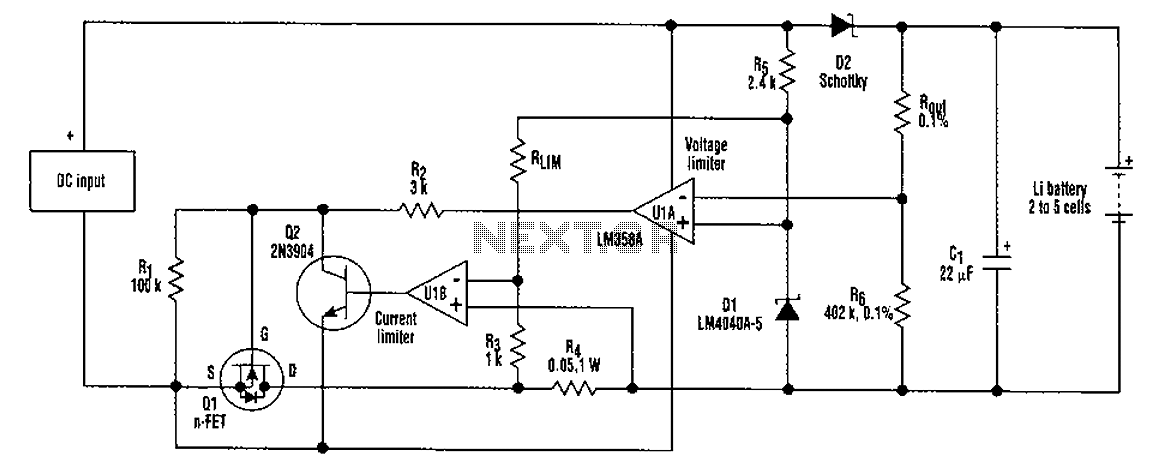
2-5-cell lithium battery charger circuit
A universal rechargeable lithium battery circuit design, applicable to different battery types and numbers of batteries. This is because both the charger output voltage or current limit setpoint and the maximum charging current can be adjusted by simply changing the...
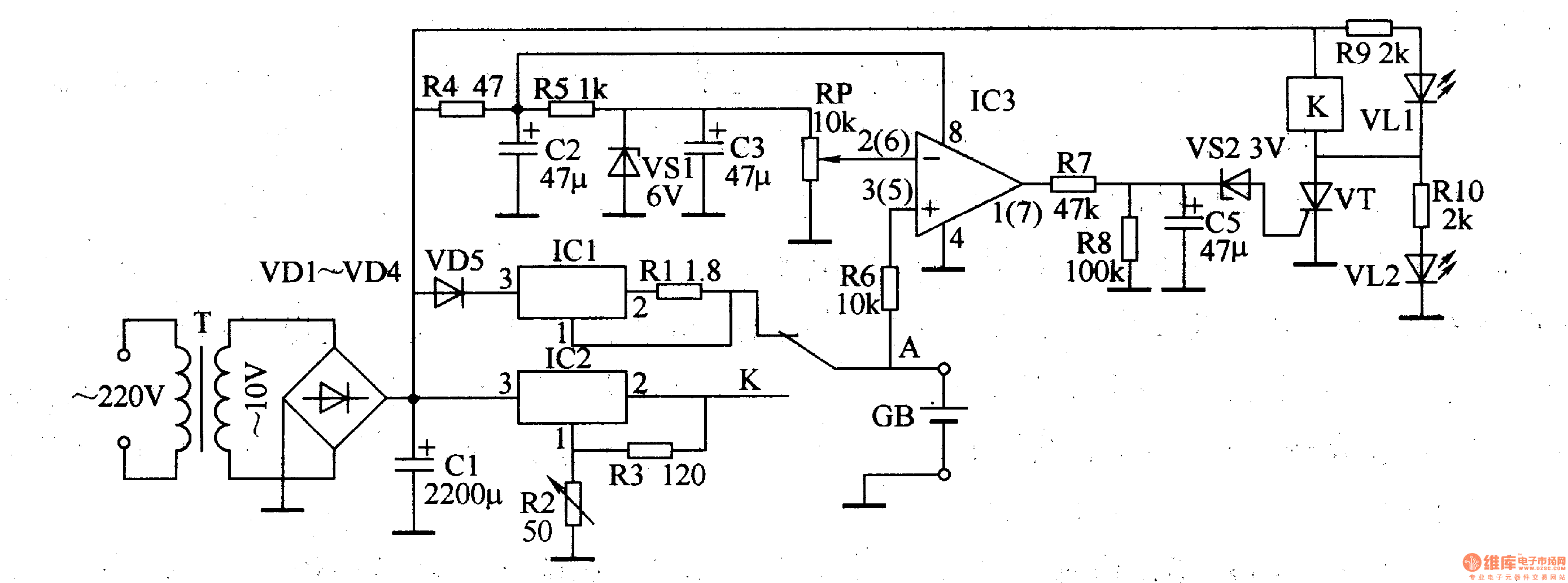
Lithium Dry Battery Charger Five
The lithium battery charger introduced in the example can charge a 6V lithium-ion battery in a constant current mode and switch to constant voltage charge mode when the battery voltage reaches 4.1V.
The lithium battery charger circuit operates on a...
Lithium Dry Battery Charger Five
The lithium battery charger introduced in the example can charge a 6V lithium-ion battery in a constant current mode and switch to constant voltage charge mode when the battery voltage reaches 4.1V.
The lithium battery charger circuit operates on a...
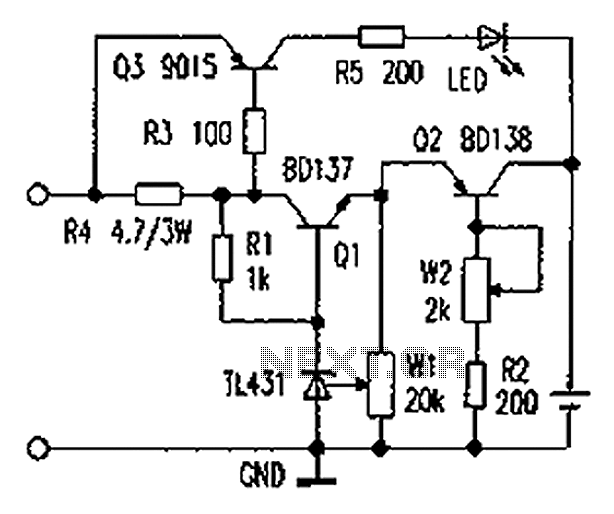
Lithium battery charging constant current circuit diagram
As illustrated in the figure, the lithium battery charging control board employs a constant current charging mechanism. The components Q1, R1, W1, and TL431 form a precision adjustable voltage regulator circuit. The components Q2, W2, and R2 create an adjustable...
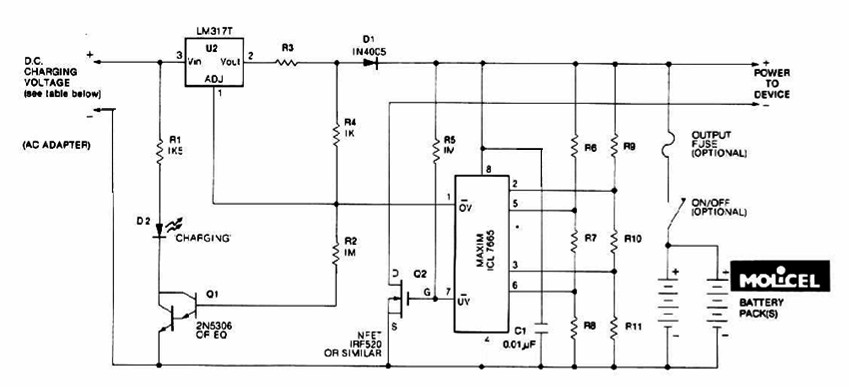
lithium battery charger
The charging system described is designed for multi-cell lithium battery packs comprising two to six series-connected cells or series/parallel configurations. The schematic diagram originates from the lithium battery charger power supply circuit. This circuit is specifically intended for charging lithium...
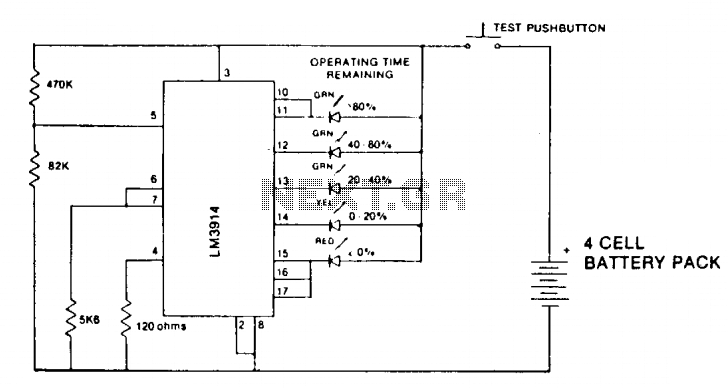
Lithium battery indicator
A state-of-charge indication of a sloping-voltage discharge can be utilized as a state-of-charge indicator. A typical voltage comparator circuit that provides a visual indication of the state of charge is presented. Components identified are for a 4-cell input voltage ranging...
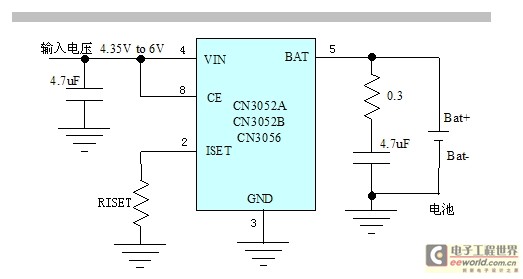
Manage the application of the chip in high-performance linear lithium battery charge
The CN3052A/CN3052B/CN3056 is a high-performance linear lithium battery management chip. It integrates a power transistor, eliminating the need for an external sense resistor and a choke flow diode for current sensing. Only a few peripheral components are required, and it...
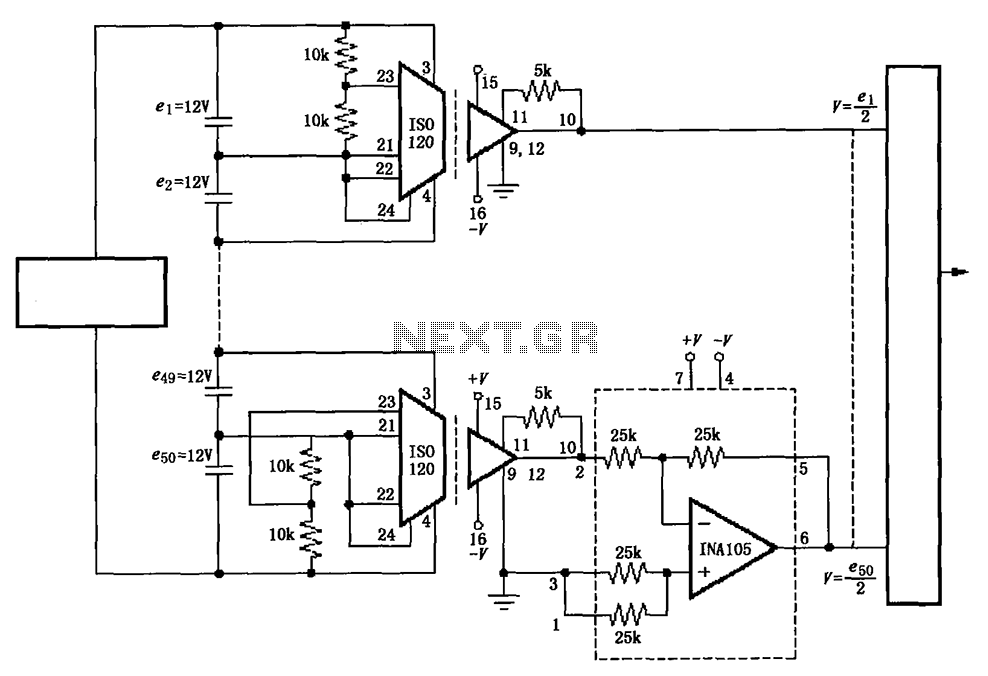
Battery monitoring instrumentation amplifier circuit diagram ISO120 and INA105 multiplexer 600V battery system
The circuit utilizes the ISO120 and INA105 instrumentation amplifiers to create a battery monitoring system for a 600V battery setup composed of 50 series-connected 12V batteries. This circuit is designed to detect charging and discharging conditions to prevent overcharging or...
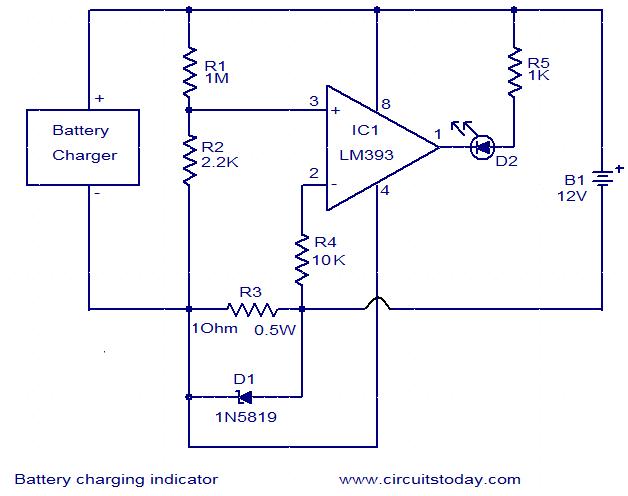
Battery charging indicator circuit
This simple circuit can be used to monitor whether a battery is charging. The voltage comparator IC LM393 is the core component of this circuit. The LED D1 will remain ON whenever there is at least 25 milliampere current flowing...