


Microchips MCP73113 Li-Ion Battery Charger
#Li-Ion
#LiFePO4
#overvoltage protection
#voltage regulation
#pass transistor
#Microchip
#MCP73113
#MCP73213
#battery management
#charging circuit
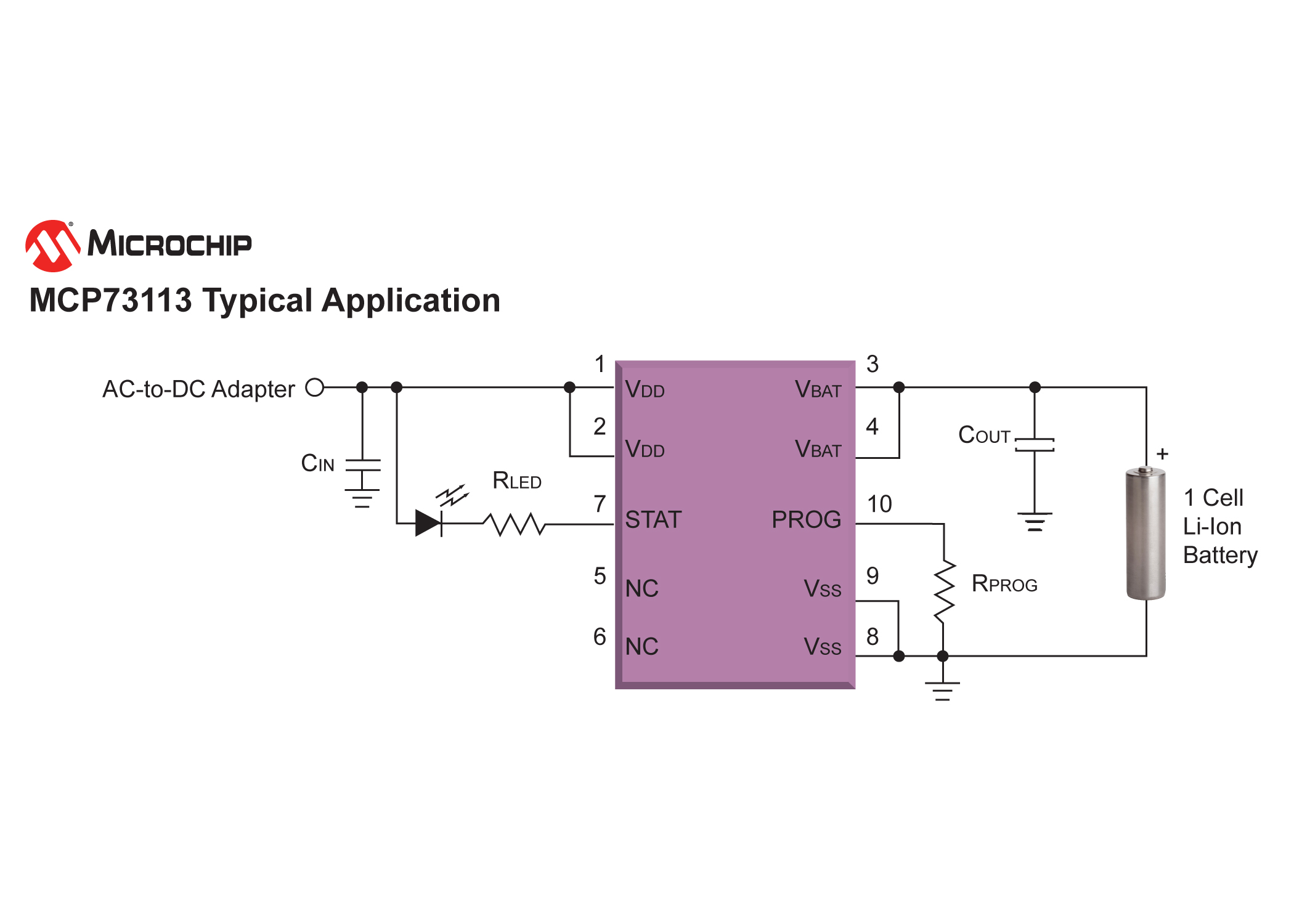
Description: Microchip Technology's MCP73113, MCP73114, and MCP73213 Lithium-Ion (Li-Ion) chargers, as well as the MCP73123 and MCP73223 Lithium Iron Phosphate (LiFePO4) chargers, are equipped with Overvoltage Protection (OVP) to prevent overheating and damage to the battery-charger circuit from input voltage spikes. These chargers also offer high-accuracy voltage regulation and come with an integrated pass transistor. The combination of these features allows for the development of smaller, safer portable electronic devices with longer run times, catering to consumer, medical, and industrial markets. All chargers are available in 10-pin, 3 mm x 3 mm DFN packages. The MCP73113, MCP73114, and MCP73123 devices are priced at $0.80 each in quantities of 10,000 units, while the MCP73213 and MCP73223 are priced at $1.28 each for the same quantity. Samples can be ordered, and the devices can be purchased in bulk.
The MCP73113, MCP73114, and MCP73213 are designed to provide efficient charging solutions for lithium-ion and lithium iron phosphate batteries, incorporating advanced features that enhance performance and safety. The Overvoltage Protection (OVP) feature is critical in safeguarding the circuit against voltage spikes that could potentially lead to battery damage or charger failure. This is particularly important in applications where the charger may be subjected to varying input conditions.
The high-accuracy voltage regulation ensures that the batteries are charged to their optimal voltage levels, which is essential for maintaining battery health and longevity. The integrated pass transistor further streamlines the charging process by reducing the number of external components required, thereby minimizing the overall footprint of the charger circuit.
These chargers are particularly suitable for portable electronic devices, where size and efficiency are paramount. Their compact 10-pin DFN package allows for easy integration into space-constrained designs, making them ideal for consumer electronics, medical devices, and industrial applications. The pricing structure also makes these chargers accessible for high-volume production, allowing manufacturers to implement reliable charging solutions without significantly increasing costs.
In summary, Microchip Technology's MCP73113, MCP73114, MCP73213, MCP73123, and MCP73223 chargers are robust solutions for lithium-based battery applications, offering essential features that enhance safety, efficiency, and design flexibility for modern electronic devices.Microchip Technology`s MCP73113, MCP73114 and MCP73213 Lithium-Ion (Li-Ion); and MCP73123, MCP73223 Lithium Iron Phosphate (LiFePO4) Chargers feature Overvoltage Protection (OVP), which prevents overheating and damage to the battery-charger circuit from input-voltage spikes. The chargers also feature high-accuracy voltage regulation and an integrated pass transistor. The combination of features enables smaller, safer portable electronic device designs with longer run times for the consumer, medical and industrial markets. All of these new chargers are all available in 10-pin, 3 mm x 3 mm DFN packages. The MCP73113, MCP73114 and MCP73123 devices are priced at $0. 80 each, in 10, 000-unit quantities; the MCP73213 and MCP73223 at $1. 28 each, in 10, 000-unit quantities. Samples can be ordered today, at sample. microchip. com, and the devices can be purchased in volume today at. More information is available at. [url= [url= Diagram, Microchip`s MCP73113 Li-Ion Battery Charger[/url] by [url= Technology[/url], on Flickr [url= [url= Diagram, Microchip`s MCP73113 Li-Ion Battery Charger[/url] by [url= Technology[/url], on Flickr [url= [url= Diagram, Microchip`s MCP73113 Li-Ion Battery Charger[/url] by [url= Technology[/url], on Flickr [url= [url= Diagram, Microchip`s MCP73113 Li-Ion Battery Charger[/url] by [url= Technology[/url], on Flickr [url= [url= Diagram, Microchip`s MCP73113 Li-Ion Battery Charger[/url] by [url= Technology[/url], on Flickr [url= [url= Diagram, Microchip`s MCP73113 Li-Ion
The MCP73113, MCP73114, and MCP73213 are designed to provide efficient charging solutions for lithium-ion and lithium iron phosphate batteries, incorporating advanced features that enhance performance and safety. The Overvoltage Protection (OVP) feature is critical in safeguarding the circuit against voltage spikes that could potentially lead to battery damage or charger failure. This is particularly important in applications where the charger may be subjected to varying input conditions.
The high-accuracy voltage regulation ensures that the batteries are charged to their optimal voltage levels, which is essential for maintaining battery health and longevity. The integrated pass transistor further streamlines the charging process by reducing the number of external components required, thereby minimizing the overall footprint of the charger circuit.
These chargers are particularly suitable for portable electronic devices, where size and efficiency are paramount. Their compact 10-pin DFN package allows for easy integration into space-constrained designs, making them ideal for consumer electronics, medical devices, and industrial applications. The pricing structure also makes these chargers accessible for high-volume production, allowing manufacturers to implement reliable charging solutions without significantly increasing costs.
In summary, Microchip Technology's MCP73113, MCP73114, MCP73213, MCP73123, and MCP73223 chargers are robust solutions for lithium-based battery applications, offering essential features that enhance safety, efficiency, and design flexibility for modern electronic devices.Microchip Technology`s MCP73113, MCP73114 and MCP73213 Lithium-Ion (Li-Ion); and MCP73123, MCP73223 Lithium Iron Phosphate (LiFePO4) Chargers feature Overvoltage Protection (OVP), which prevents overheating and damage to the battery-charger circuit from input-voltage spikes. The chargers also feature high-accuracy voltage regulation and an integrated pass transistor. The combination of features enables smaller, safer portable electronic device designs with longer run times for the consumer, medical and industrial markets. All of these new chargers are all available in 10-pin, 3 mm x 3 mm DFN packages. The MCP73113, MCP73114 and MCP73123 devices are priced at $0. 80 each, in 10, 000-unit quantities; the MCP73213 and MCP73223 at $1. 28 each, in 10, 000-unit quantities. Samples can be ordered today, at sample. microchip. com, and the devices can be purchased in volume today at. More information is available at.
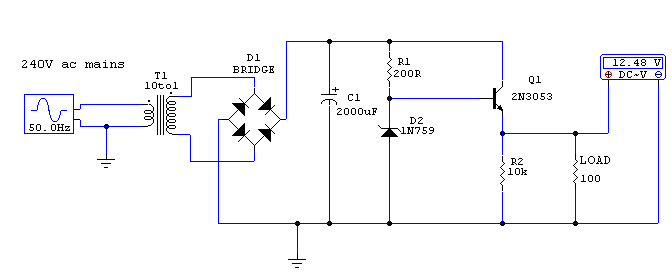
Regulated 12 Volt Supply
This circuit utilizes a 13-volt zener diode (D2) for voltage regulation. Approximately 0.7 volts are dropped across the base-emitter junction of the transistors, resulting in a higher current output of 12.3 volts. The circuit is capable of supplying loads up...
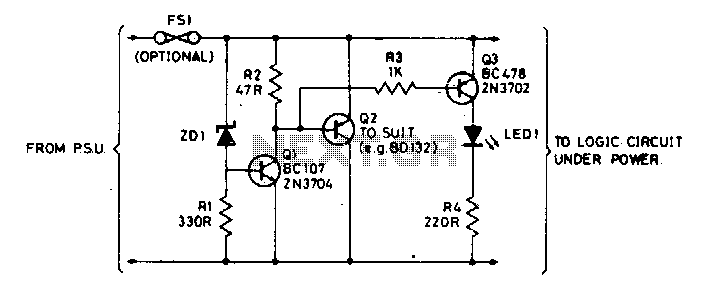
Overvoltage protection for logic
The Zener diode ZD1 monitors the supply voltage, and if the supply exceeds 6 V, transistor Q1 will activate. This activation causes transistor Q2 to conduct, thereby clamping the voltage rail. The subsequent behavior of the circuit is contingent upon...
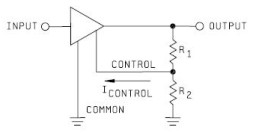
Voltage Regulator
Neither term describes a regulator, only its placement within a circuit or system. Any voltage regulator could meet the requirements, depending on its placement. A listing of Analog Voltage Regulator IC manufacturers. The types of products or devices they produce...
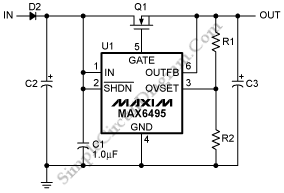
MAX6495 Overvoltage Limiter
To protect downstream circuits from overvoltage conditions that occur during load-dump events or transients, the MAX6495, MAX6499, MAX6397, and MAX6398 can be utilized.
The MAX6495, MAX6499, MAX6397, and MAX6398 are integrated circuits designed for overvoltage protection in various electronic applications. These...
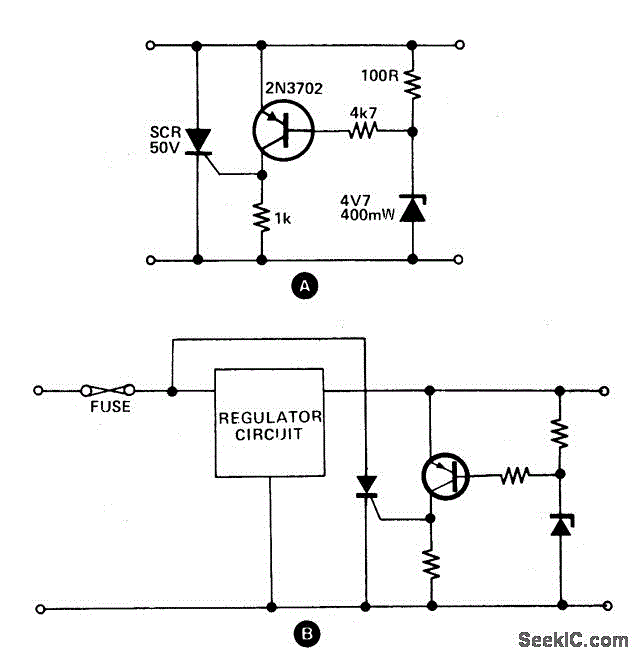
SIMPLE_CROWBAR
These circuits provide overvoltage protection in the event of a voltage regulator failure or the application of an external voltage. They are intended for use with a power supply that incorporates some form of short circuit protection, such as foldback,...
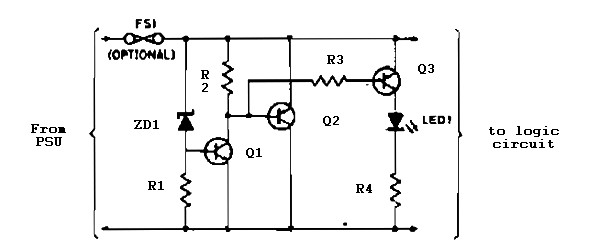
logic overvoltage protection
Logic overvoltage protection power supply. Refer to the designated page for an explanation of the power supply circuit diagram mentioned above.
The logic overvoltage protection power supply is designed to safeguard sensitive electronic components from voltage spikes that could potentially damage...
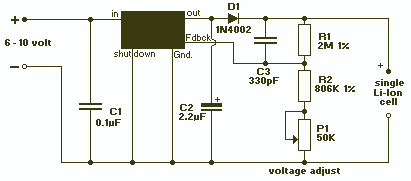
Simple Li-Ion Battery Charger
Charging current is about 100+mA, which is the internally-limited maximum current of the LP2951. For those wondering, this is compatible with just about any single-cell li-ion battery since li-ion can generally accept a charging current of up to about 1c...
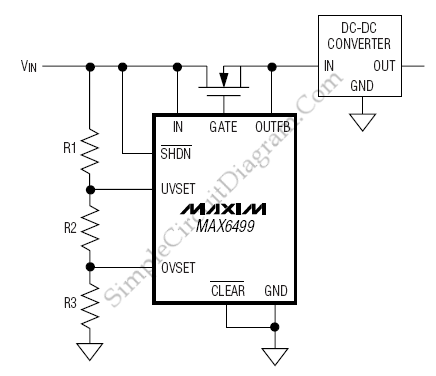
MAX6499 Overvoltage and Undervoltage Protection
The MAX6499 includes undervoltage and overvoltage comparators for window detection. When the monitored voltage is within the selected window, the GATE is enabled.
The MAX6499 is a precision voltage monitoring device designed to detect both undervoltage and overvoltage conditions within a...
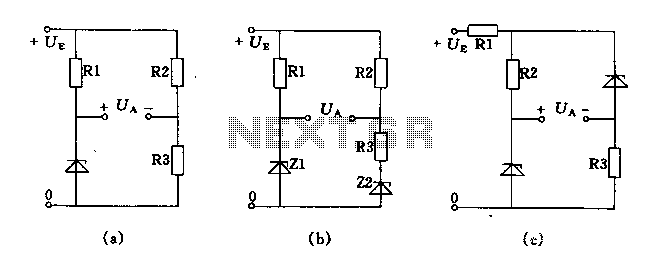
Bridge voltage regulator circuit diagram using the
The circuit depicted in Figures A, B, and C demonstrates a high voltage coefficient. When the regulator resistance \( r_z \) is held constant, the bridge configuration achieves an infinite voltage coefficient. In Figure A, the load circuit is connected...