


4-wire resistive touch screen interface circuit with ADS7846
#touch screen
#ADS7846
#resistive
#A/D converter
#interface circuit
#analog switch
#4-wire
#measurement
#control
#input device
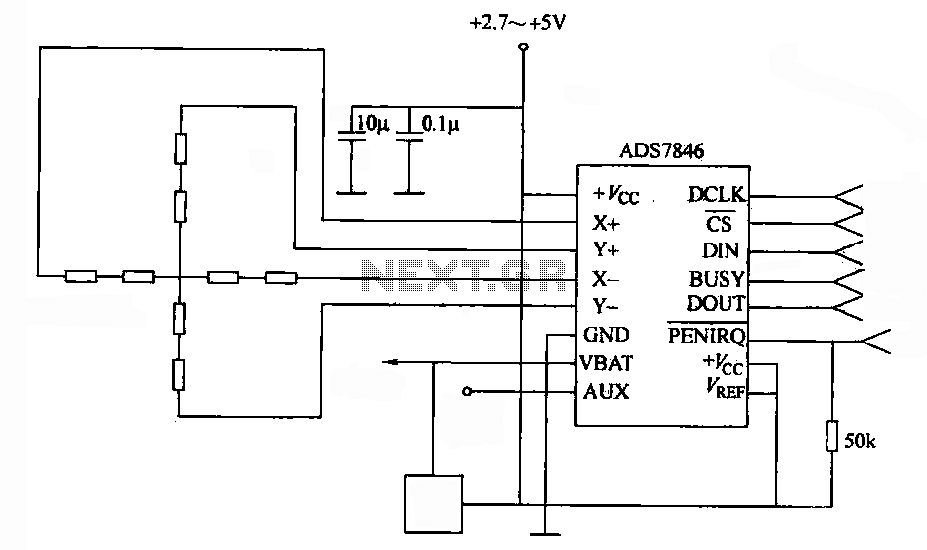
Description: A 4-wire resistive touch screen utilizes an ADS7846 interface circuit. The ADS7846 analog chip incorporates electronic switches and a successive approximation A/D converter. The analog switch chip controls the switching of the X+ (or Y+) positive supply terminal, while the X- (or Y-) terminal is grounded. The Y+ (or X+) terminal and the Y- (or X-) terminal create a differential input for the A/D converter. When a pen makes contact with the touch screen at various locations, the Y+ (or X+) terminal provides different voltage levels to the on-chip A/D converter. This conversion process yields output values corresponding to the Y (or X) coordinates, which are approximately linear in relation to the touch position. Consequently, the ADS7846 outputs the X and Y coordinates, effectively mapping the touch screen interaction.
The 4-wire resistive touch screen operates by detecting pressure applied to the screen's surface. It consists of two conductive layers separated by a thin insulating layer. When pressure is applied, these layers make contact, creating a voltage divider that varies based on the location of the touch. The ADS7846 interface circuit plays a crucial role in this process by converting the analog voltages generated at the touch points into digital values that can be interpreted by a microcontroller or other processing unit.
The ADS7846 chip features an integrated analog-to-digital converter (ADC) capable of handling the signals from the touch screen. It employs a successive approximation method, which allows for rapid and accurate conversion of the analog signal to a digital output. The chip also includes electronic switches that facilitate the selection of the X or Y channels based on the touch location, ensuring that the correct voltage levels are sampled.
In operation, the touch screen is connected to the ADS7846 through four main wires: two for the X-axis and two for the Y-axis. The X+ and X- terminals are responsible for the horizontal axis, while the Y+ and Y- terminals handle the vertical axis. When a user touches the screen, the voltage is read from the corresponding terminal, and the ADS7846 processes this voltage to determine the precise coordinates of the touch event.
The output from the ADS7846 is typically in the form of digital coordinates (X, Y), which can be utilized by various applications, including user interfaces and graphical displays. The linearity of the output values ensures that the touch response is accurate, thereby enhancing the user experience. Overall, the combination of the resistive touch screen and the ADS7846 interface circuit provides an effective solution for touch-based input in electronic devices.4-wire resistive touch screen. ADS7846 interface circuit. ADS7846 analog chip contains electronic switches and successive approximation A / D converter. Switched by the analog switch chip, the X + (or Y +) positive supply termination ( ), x- (or Yr) grounded (CND), the Y + (or X +) terminal and Y- (or X- ) terminal to the difference in the form of movable receiving a / D converter input. Pen contacts the touch screen at different locations, by Y + (or X +) terminal input to the on-chip A / D converter different voltage values within the input voltage through the chip A / D conversion after the stroke to give Y points (or x) output value, and the output value of the stroke position is approximately linear.
Therefore, ADS7846 output value of X and Y (ie coordinates) will be able to describe the strokes on the touch screen point of location.
The 4-wire resistive touch screen operates by detecting pressure applied to the screen's surface. It consists of two conductive layers separated by a thin insulating layer. When pressure is applied, these layers make contact, creating a voltage divider that varies based on the location of the touch. The ADS7846 interface circuit plays a crucial role in this process by converting the analog voltages generated at the touch points into digital values that can be interpreted by a microcontroller or other processing unit.
The ADS7846 chip features an integrated analog-to-digital converter (ADC) capable of handling the signals from the touch screen. It employs a successive approximation method, which allows for rapid and accurate conversion of the analog signal to a digital output. The chip also includes electronic switches that facilitate the selection of the X or Y channels based on the touch location, ensuring that the correct voltage levels are sampled.
In operation, the touch screen is connected to the ADS7846 through four main wires: two for the X-axis and two for the Y-axis. The X+ and X- terminals are responsible for the horizontal axis, while the Y+ and Y- terminals handle the vertical axis. When a user touches the screen, the voltage is read from the corresponding terminal, and the ADS7846 processes this voltage to determine the precise coordinates of the touch event.
The output from the ADS7846 is typically in the form of digital coordinates (X, Y), which can be utilized by various applications, including user interfaces and graphical displays. The linearity of the output values ensures that the touch response is accurate, thereby enhancing the user experience. Overall, the combination of the resistive touch screen and the ADS7846 interface circuit provides an effective solution for touch-based input in electronic devices.4-wire resistive touch screen. ADS7846 interface circuit. ADS7846 analog chip contains electronic switches and successive approximation A / D converter. Switched by the analog switch chip, the X + (or Y +) positive supply termination ( ), x- (or Yr) grounded (CND), the Y + (or X +) terminal and Y- (or X- ) terminal to the difference in the form of movable receiving a / D converter input. Pen contacts the touch screen at different locations, by Y + (or X +) terminal input to the on-chip A / D converter different voltage values within the input voltage through the chip A / D conversion after the stroke to give Y points (or x) output value, and the output value of the stroke position is approximately linear.
Therefore, ADS7846 output value of X and Y (ie coordinates) will be able to describe the strokes on the touch screen point of location.
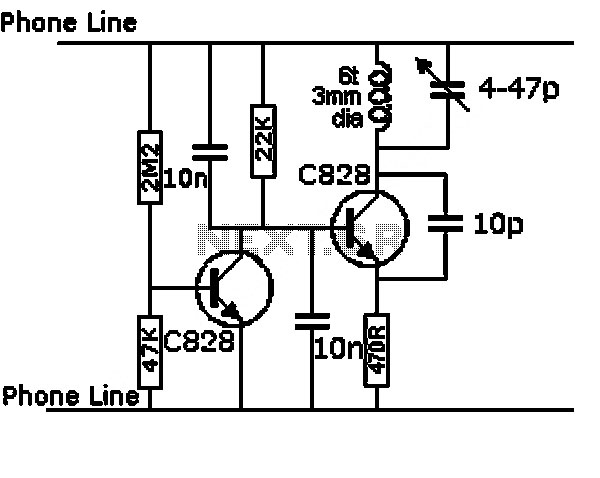
differential analog switch circuit
This circuit is designed for differential analog circuit switches. The FM1208 monolithic dual differential multiplexer is utilized in applications where the RDS (ON) must be closely matched. The RDS (ON) for the monolithic dual multiplexer operates with a precision better...
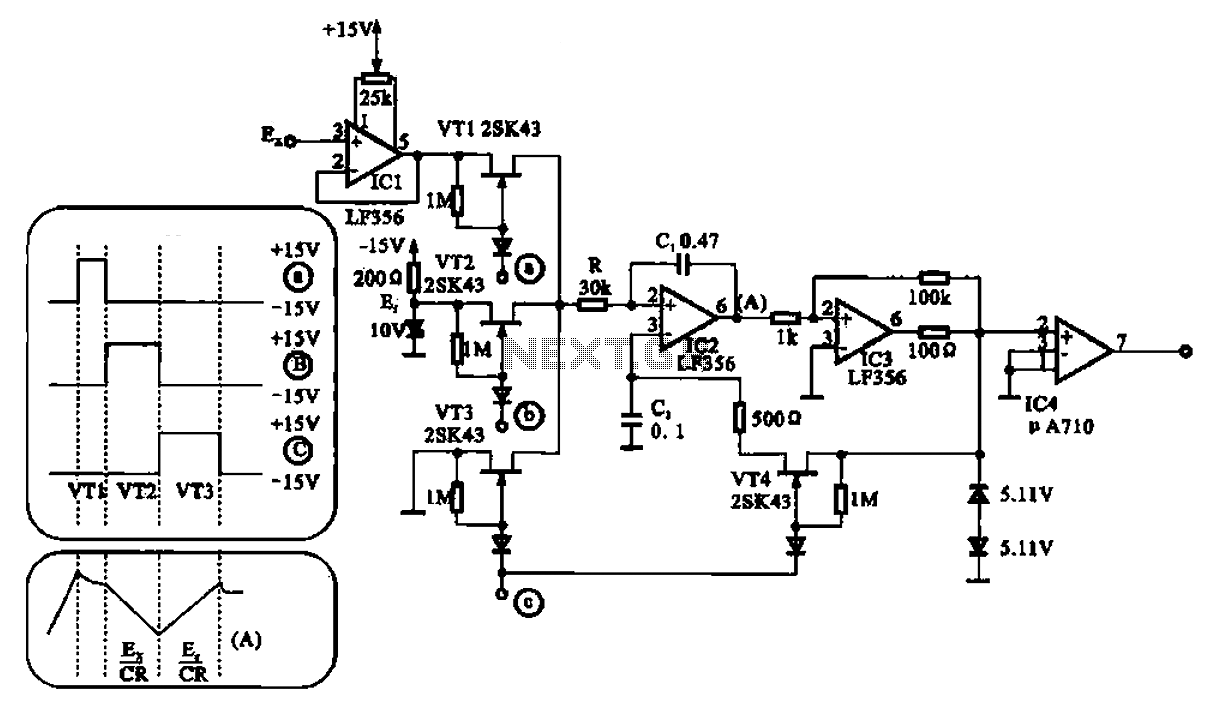
LF356 composed of AD converter
An A/D converter transforms an analog signal into a digital format. Various circuit configurations exist, as illustrated in Figures 21-24, which depict the structure of an A/D converter. One practical circuit configuration utilizes the integrated circuit LF356.
The A/D converter is...
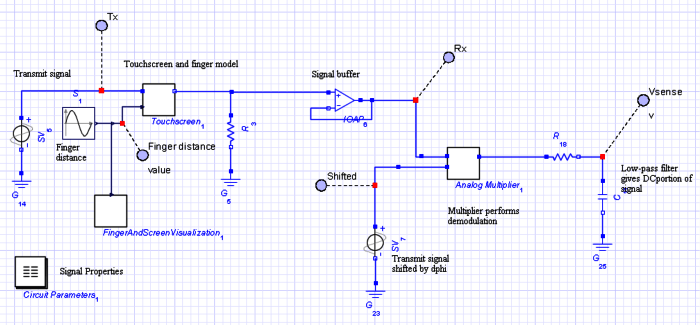
Touch Screen Model
The objective of this project is to develop a model of a capacitive touch screen, which includes the physical modeling of a user's finger, the materials of the touch screen, and the touch-detection circuitry. A capacitive touch screen functions by...
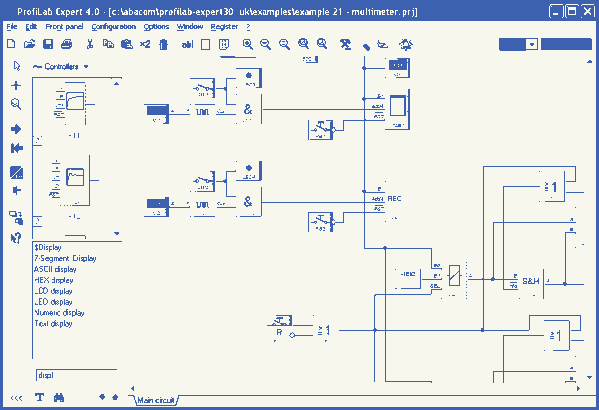
ProfiLab-Expert 4.0
The ProfiLab-Expert software allows you to develop your own digital or analogue measuring technology projects. It doesn't matter if you want to create analogue measurements or digital controls - you can realize it all. And for all this you don't...
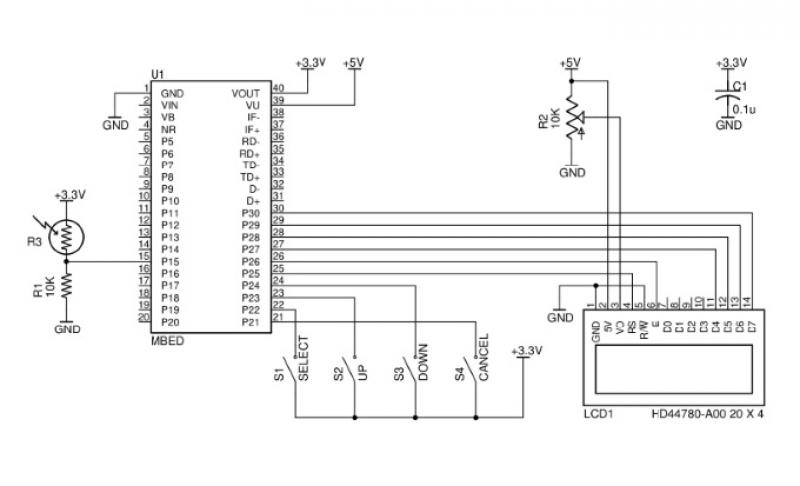
Advances in Measurement & Sensor Tech
This issue features articles on various measurement and sensor-related embedded design projects. Readers are encouraged to attempt similar projects and share their results. Starting on page 14, Petre Tzvetanov Petrov describes a multilevel audible logical probe design. Petrov notes that...
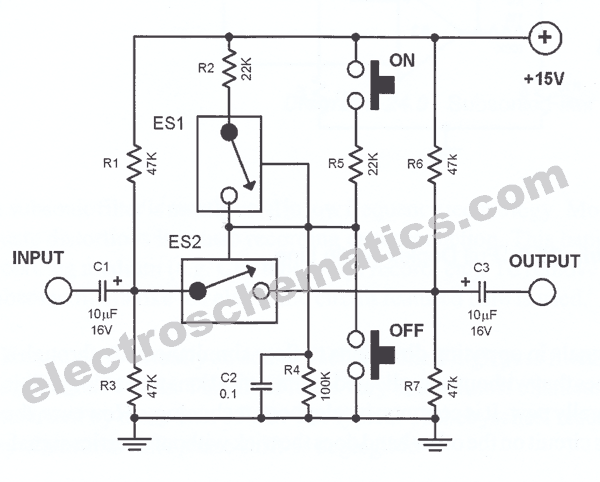
Analog Line Switch Circuit
This analog switch circuit is designed to switch an analog line on or off. It consists of two analog switches in integrated circuit (IC) form that are controlled by two pushbuttons.
The described analog switch circuit utilizes two integrated analog switches...
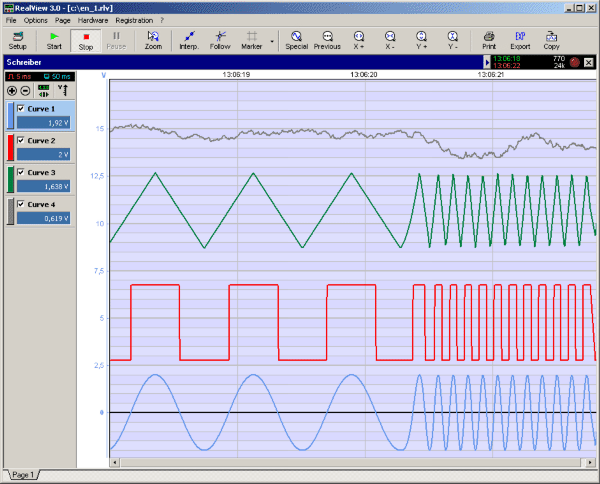
RealView 2.0
RealView is a measurement application, which records and plots measured values from analogue hardware devices in real-time. Several curves can be plotted into a single diagram. Several diagrams can be arranged on one or more pages if necessary. Plot options...
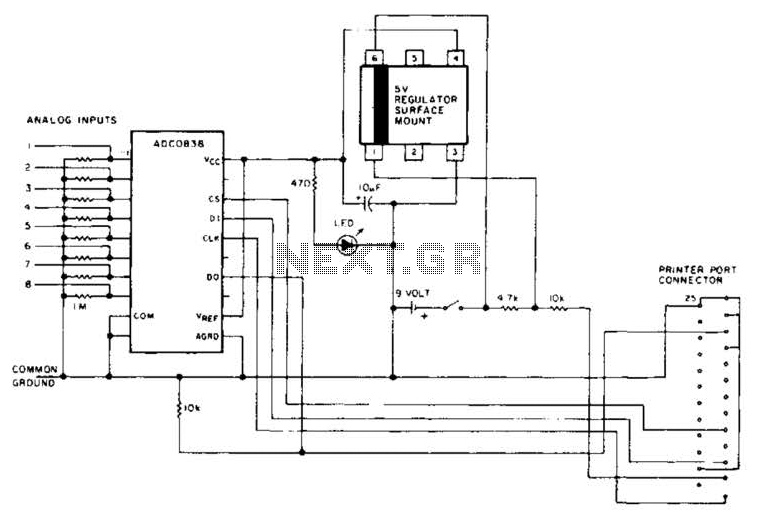
8-Channel A/D Converter For Pc Clones Circuit
An A/D converter by National Semiconductor (ADC0838) converts 0 to 5 V analog inputs into a digital data format. A 9 V battery is utilized. The converter connects to the pointer port connector through a 25-pin connector.
The ADC0838 is a...
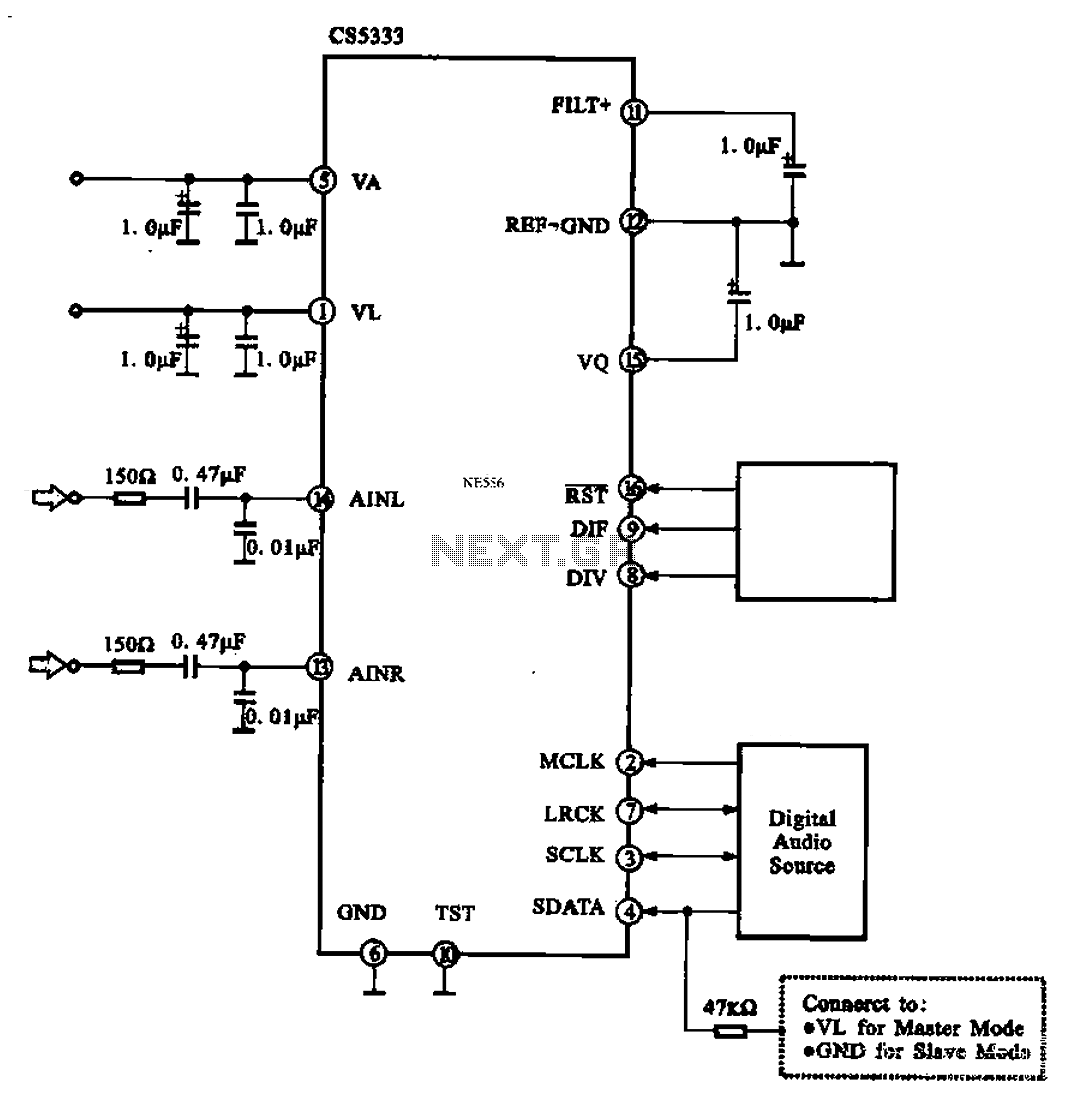
Audio AD converter circuit configuration
Audio A/D converter circuit configuration using the CS5333 chip, which is a high-performance 24-bit, 96 kHz stereo A/D converter commonly used in digital products. This circuit converts one or more audio signals into a digital signal for processing and storage.
The...