


INVERTER_AND_PULSE_STRETCHER
#multiplexer
#transfluxor
#analog-digital converter
#Gray code
#binary
#sampling
#current driver
#electronics
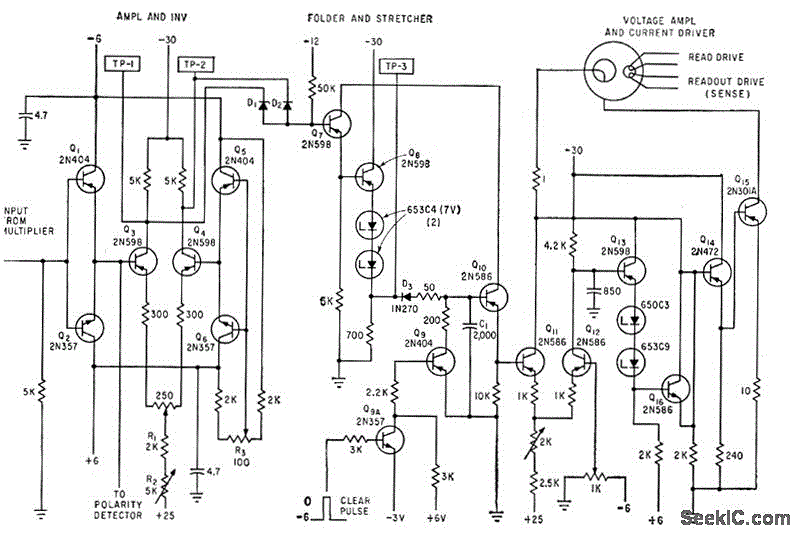
Description: The circuit samples the output of a multiplexer and provides the necessary current for driving a transfluxor in an analog-to-digital converter that generates a six-bit binary Gray code. -N. Aron and C. Granger, Analog-To-Digital Converter Uses Transfluxors, Electronics, 35:20, p 62-66.
The described circuit operates by utilizing a multiplexer to sample input signals, which are subsequently processed to generate the required output for a transfluxor. A transfluxor is a specialized component used in analog-to-digital converters (ADCs) that converts analog signals into a digital format, specifically producing a six-bit binary Gray code. This code is advantageous in digital systems due to its property of changing only one bit at a time during transitions, which minimizes errors and enhances reliability in digital communication.
In this circuit, the multiplexer selects among multiple input signals based on control signals, allowing for efficient sampling of the desired analog input. The output from the multiplexer is then directed to the transfluxor, which requires a specific current to operate effectively. The design must ensure that the current supplied is stable and meets the operational requirements of the transfluxor to achieve accurate analog-to-digital conversion.
The integration of these components in the circuit is crucial for achieving the desired performance in ADC applications. The design considerations include the selection of the multiplexer, the characteristics of the transfluxor, and the current-driving capability of the circuit to ensure optimal operation and fidelity in the conversion process. Overall, this circuit exemplifies an effective approach to analog-to-digital conversion utilizing advanced components and techniques.Circuit likes sampled output of multiplexer and provides current required for driving transfluxor in analog-digital converter that produces six-bit binary Gray code. -N. Aron and C. Granger, Analog-To-Digital Converter Uses Transfluxors, Electronics, 35:20, p 62-66.
The described circuit operates by utilizing a multiplexer to sample input signals, which are subsequently processed to generate the required output for a transfluxor. A transfluxor is a specialized component used in analog-to-digital converters (ADCs) that converts analog signals into a digital format, specifically producing a six-bit binary Gray code. This code is advantageous in digital systems due to its property of changing only one bit at a time during transitions, which minimizes errors and enhances reliability in digital communication.
In this circuit, the multiplexer selects among multiple input signals based on control signals, allowing for efficient sampling of the desired analog input. The output from the multiplexer is then directed to the transfluxor, which requires a specific current to operate effectively. The design must ensure that the current supplied is stable and meets the operational requirements of the transfluxor to achieve accurate analog-to-digital conversion.
The integration of these components in the circuit is crucial for achieving the desired performance in ADC applications. The design considerations include the selection of the multiplexer, the characteristics of the transfluxor, and the current-driving capability of the circuit to ensure optimal operation and fidelity in the conversion process. Overall, this circuit exemplifies an effective approach to analog-to-digital conversion utilizing advanced components and techniques.Circuit likes sampled output of multiplexer and provides current required for driving transfluxor in analog-digital converter that produces six-bit binary Gray code. -N. Aron and C. Granger, Analog-To-Digital Converter Uses Transfluxors, Electronics, 35:20, p 62-66.
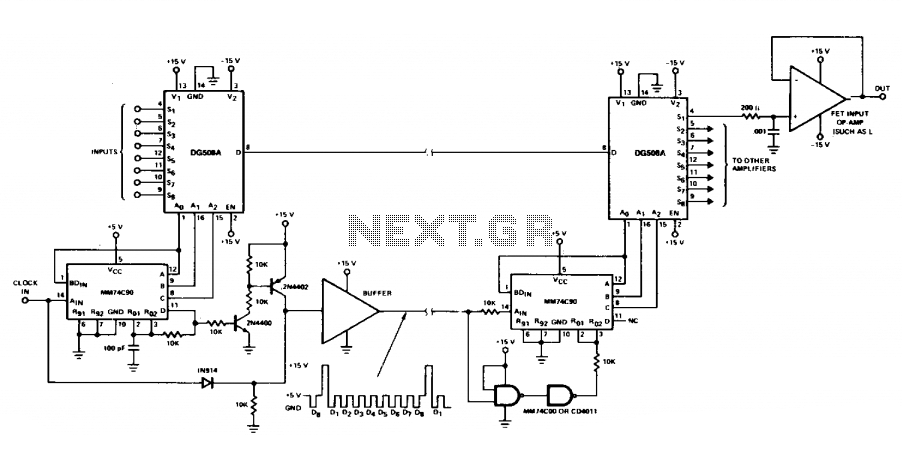
Mux-Demux system
Multiple signals can be transmitted between two locations at the same time by making a minor adjustment to the receiver circuit. An additional DG508A is employed as a demultiplexer, enabling continuous monitoring of all 8 channels.
To implement a system for...

4-Bit Computer
This article provides a simple introduction to binary and logic, explaining how they are interconnected with electronics to create both simple and complex computers. It highlights that digital computers represent two states—on and off, or zero and one—thus counting in...
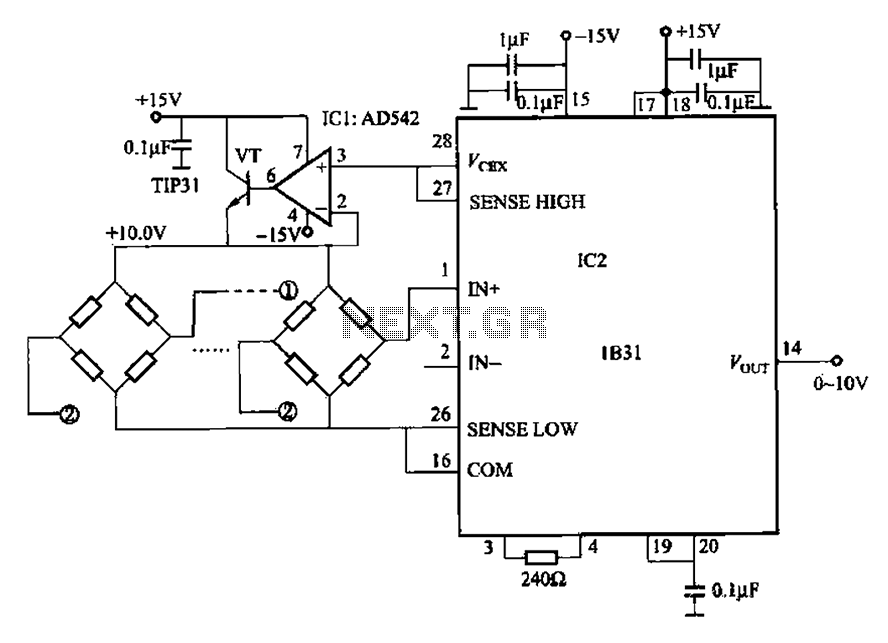
0 to 10V output multiplexer measuring circuit
The 1832 low drift input has a temperature coefficient of 0.07 µV/°C (RTI, G 500) and exhibits excellent linearity with a maximum deviation of 0.005%. It can drive resistive loads greater than 120 ohms in a bridge excitation circuit, with...
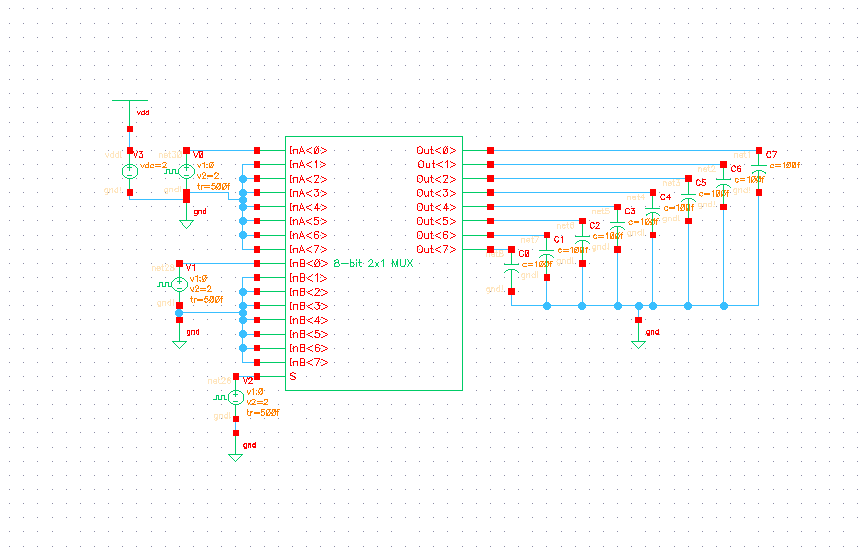
2-to-1 Multiplexer
The 8-bit 2x1 multiplexer comprises 16 tristate buffers and a static inverter. It is configured such that when the select bit is low, 8 of the input bits are transmitted through the tristate buffers to the 8 output bits. Conversely,...
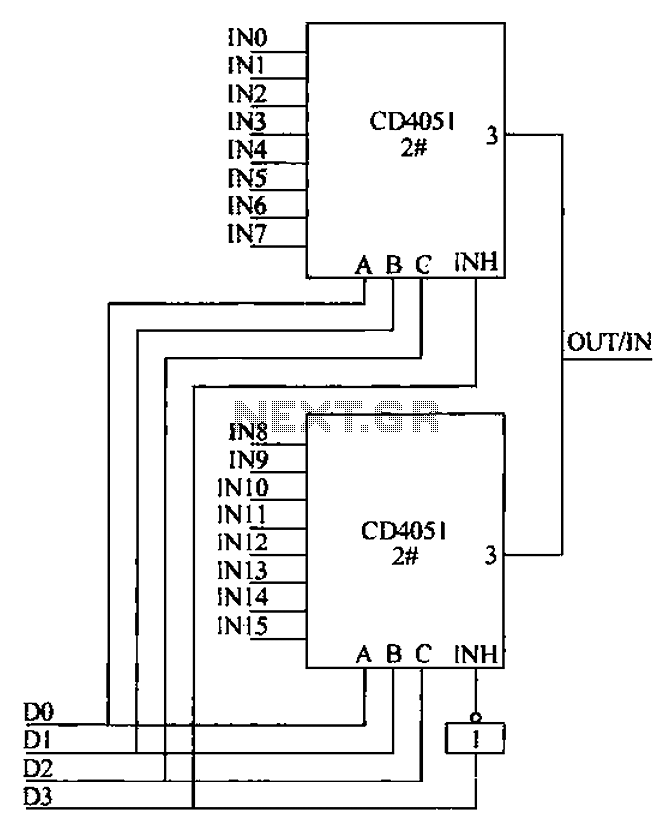
Analog multiplexer CD4051 extension circuit 1
The CD4051 is a single-ended input 8-channel multiplexer that features three channel select inputs (A, B, C) and an inhibit input (INH). The signals at inputs A, B, and C are utilized to control the selection of one of the...
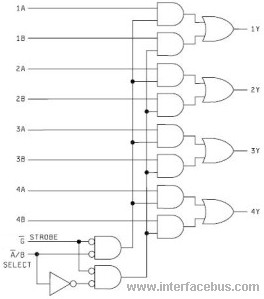
IC Multiplexers
There is a lack of clarity regarding the difference between a data selector and a multiplexer. The designs previously engaged in ceased utilizing small-scale integrated circuits in the early 1990s, as the physical aspect transitioned to general-purpose programmable array logic...
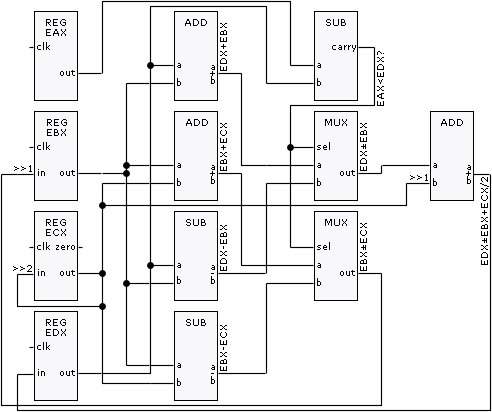
clock-synchronised multiplexers
This is the second part of the square root algorithm. It was developed during the final stages of finishing this website and reviewing this document for publication. While Part I focused on an empirical discovery for a sequential algorithm to...
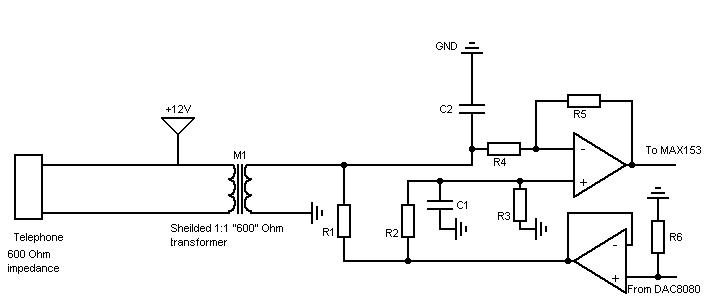
TIPE Project
A simple non-commercial grade multiplexer compatible with telephones. It will support four telephone lines and will multiplex over one cable. The topic was free of choice but had to be oriented around the theme of "PrG©vision" (prediction). As anticipated, the...
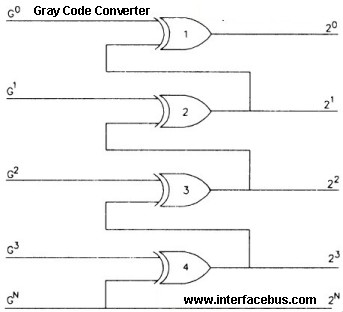
Gray Code Circuit
Gray Code is a positional binary number notation where any two numbers differing by one are represented by expressions that are identical except in one position, differing by only a single unit in that place. This code consists of a...