


AC Dimmer for Lamp 6.3V
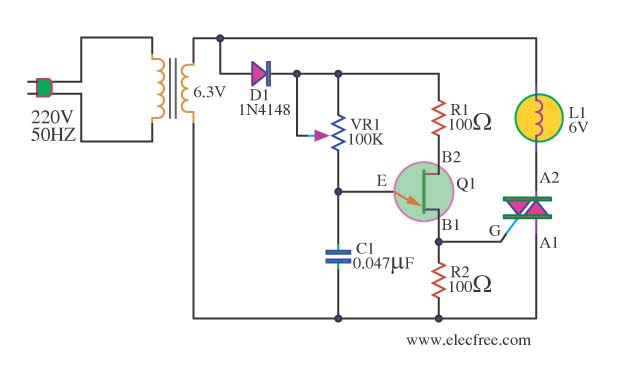
Description: This circuit is an AC dimmer designed for low voltage lamps operating at 6V. While some may not recognize the benefits of this circuit, it serves as an excellent introduction to understanding the operation of a TRIAC. Additionally, it is considered safe due to its use of low AC voltage. The circuit functions by utilizing a UJT (Q1) to generate a frequency that controls the TRIAC, thereby adjusting the brightness of the lamp. The TRIAC's operational rate can be modified using resistor R1, allowing for dimming capabilities. The UJT can be a 2N4891 or an equivalent component. This AC dimmer for 6V lamps can provide advantages for various applications.
This AC dimmer circuit utilizes a TRIAC to control the brightness of a low voltage lamp, specifically designed for 6V operation. The circuit's primary component, a Unijunction Transistor (UJT), serves as an oscillator that generates a pulse width modulation signal. This signal is fed into the gate of the TRIAC, which regulates the power delivered to the lamp, allowing for smooth dimming.
The UJT (Q1) is configured in such a way that it triggers the TRIAC at specific intervals, controlled by the resistor R1. By adjusting R1, the timing of the UJT's oscillation can be altered, thus modifying the phase angle at which the TRIAC is triggered. This adjustment directly influences the average power delivered to the lamp, achieving the desired dimming effect.
The use of low AC voltage enhances safety, making this circuit suitable for various applications where reduced voltage is preferred. The TRIAC selected for this design should have a suitable current rating to handle the load of the lamp effectively. The 2N4891 UJT is a common choice, but alternatives with similar characteristics can also be employed depending on availability and specific circuit requirements.
This circuit is particularly useful for educational purposes, allowing individuals to gain hands-on experience with TRIAC operation and dimming techniques. It can also be adapted for different voltage levels by recalibrating the components, making it a versatile solution for controlling lamp brightness in various settings. Overall, this AC dimmer circuit serves as a practical tool for both learning and application in low voltage lighting systems.This the circuit AC dimmer low voltage For lamp 6V. While this friends may don`t see the advantage of this circuit. But I thinks first step advantage be something get learn the work of Triac. And have tall safety, because of use AC Low Voltage. Which the work is simple be The UJT Q1 will do the frequency give Triac work or make Lamp the bright. B y have work rate of Triac can control with R1 or Be something dimmer there. You will may apply with the size Voltage the other all right. The Q1 use UJT 2N4891 or other. A friend may gain an advantage from AC Dimmer for Lamp 6V, please sir.
This AC dimmer circuit utilizes a TRIAC to control the brightness of a low voltage lamp, specifically designed for 6V operation. The circuit's primary component, a Unijunction Transistor (UJT), serves as an oscillator that generates a pulse width modulation signal. This signal is fed into the gate of the TRIAC, which regulates the power delivered to the lamp, allowing for smooth dimming.
The UJT (Q1) is configured in such a way that it triggers the TRIAC at specific intervals, controlled by the resistor R1. By adjusting R1, the timing of the UJT's oscillation can be altered, thus modifying the phase angle at which the TRIAC is triggered. This adjustment directly influences the average power delivered to the lamp, achieving the desired dimming effect.
The use of low AC voltage enhances safety, making this circuit suitable for various applications where reduced voltage is preferred. The TRIAC selected for this design should have a suitable current rating to handle the load of the lamp effectively. The 2N4891 UJT is a common choice, but alternatives with similar characteristics can also be employed depending on availability and specific circuit requirements.
This circuit is particularly useful for educational purposes, allowing individuals to gain hands-on experience with TRIAC operation and dimming techniques. It can also be adapted for different voltage levels by recalibrating the components, making it a versatile solution for controlling lamp brightness in various settings. Overall, this AC dimmer circuit serves as a practical tool for both learning and application in low voltage lighting systems.This the circuit AC dimmer low voltage For lamp 6V. While this friends may don`t see the advantage of this circuit. But I thinks first step advantage be something get learn the work of Triac. And have tall safety, because of use AC Low Voltage. Which the work is simple be The UJT Q1 will do the frequency give Triac work or make Lamp the bright. B y have work rate of Triac can control with R1 or Be something dimmer there. You will may apply with the size Voltage the other all right. The Q1 use UJT 2N4891 or other. A friend may gain an advantage from AC Dimmer for Lamp 6V, please sir.
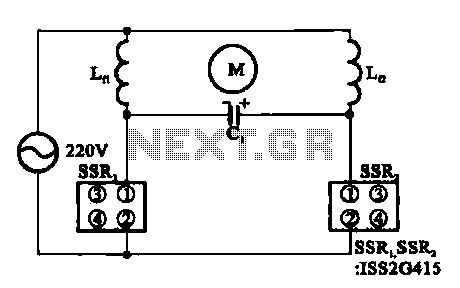
Triac motor drive circuit
The triac motor drive circuit depicted demonstrates the operation of a TRIAC, which is often referred to as a solid-state relay. Figure (a) illustrates the circuit configuration, while figure (b) presents the connections for the motor coils.
The triac motor drive...
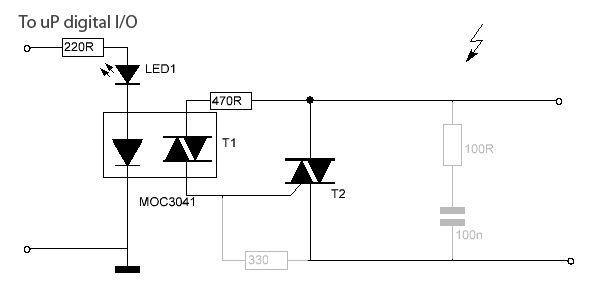
Small Triac Switch
To control floodlights using an Arduino, the small switch circuits designed around a 39MF22 were insufficient to manage the required current.
To effectively switch floodlights with an Arduino, a more robust circuit design is essential. The initial approach using the 39MF22,...
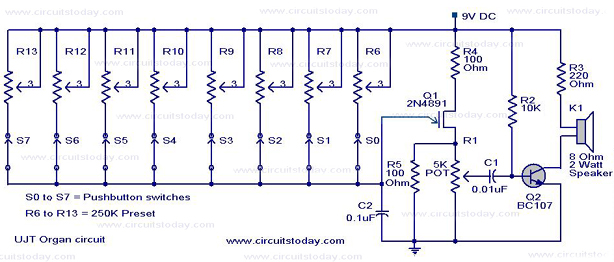
UJT Organ circuit with schematic and working
A UJT organ circuit with a circuit diagram is explained in detail. A 2N4891 UJT is used for the operation of the circuit.
The UJT (Uni-Junction Transistor) organ circuit is designed to utilize the unique characteristics of the 2N4891 UJT to...
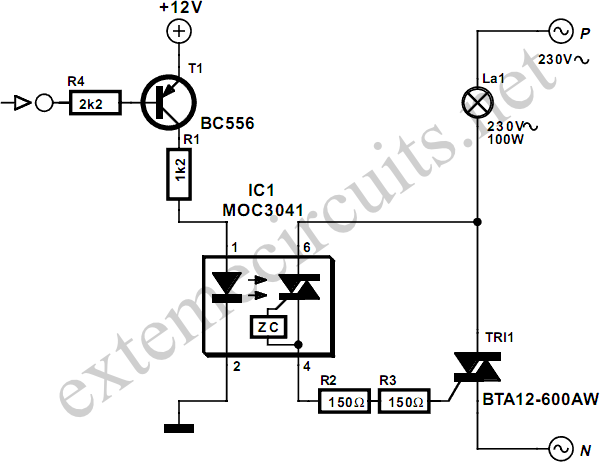
dc control for triacs
When switching a mains voltage, a relay serves as a straightforward solution for applications involving long switching times and high currents. However, for lower currents and applications requiring rapid switching, such as sound-to-light systems, a relay may not be suitable....
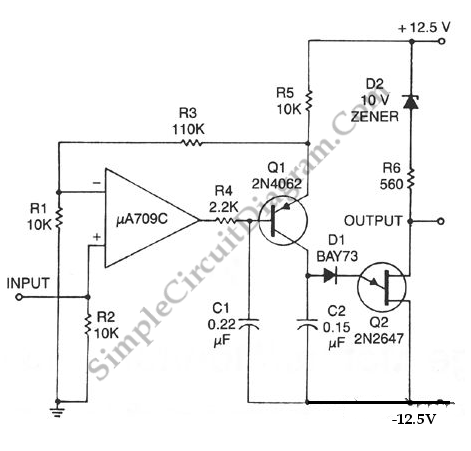
Voltage to Frequency Converter Using UJT
The voltage to frequency converter (V/FC - VCO) circuit consists of a UJT (uni-junction transistor) oscillator in which the timing charge capacitor C2 is utilized.
The voltage to frequency converter circuit operates by converting an input voltage into an output frequency....
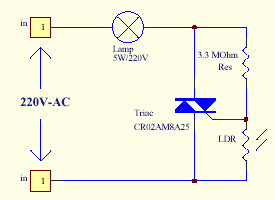
triac light switch circuit
The series of light switches is slightly different from traditional designs. These light switches can operate directly on the AC power network. The main components of the circuit include a TRIAC and a Light Dependent Resistor (LDR). The circuit is...
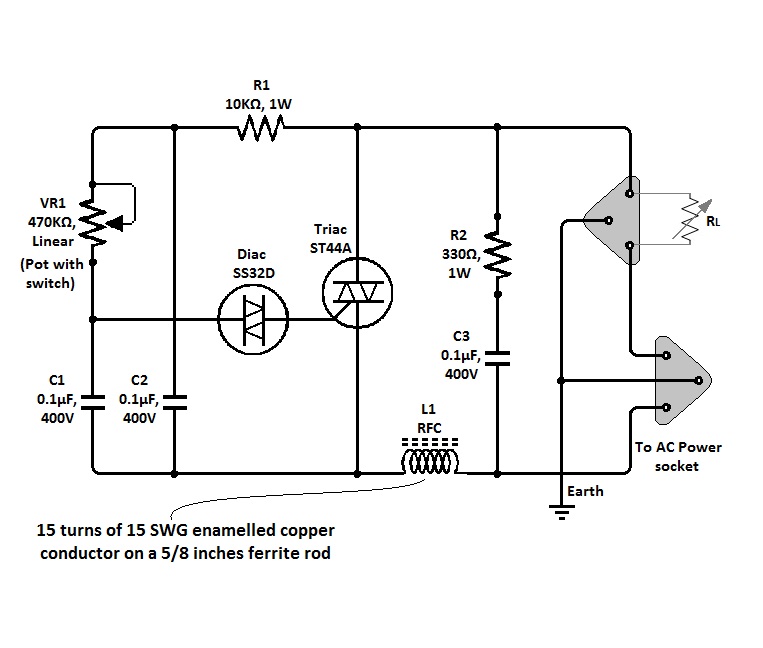
Triac Dimmer Circuit
The circuit of a simple triac light dimmer can be used to dim incandescent lamps directly from AC mains. It is easy to construct and requires very few components. A potentiometer is utilized to control the load power or light...
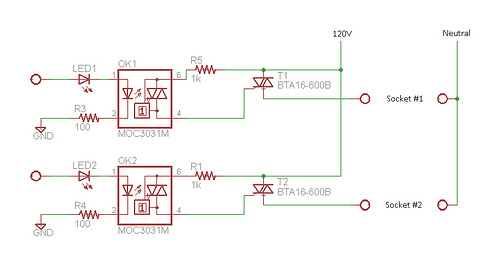
Triac circuit
Many projects involve 120VAC and require relatively slow switching. While mechanical relays are commonly used in such situations, they are often avoided due to the presence of moving parts. Solid-state relays (SSRs) have been utilized previously, but their high cost...
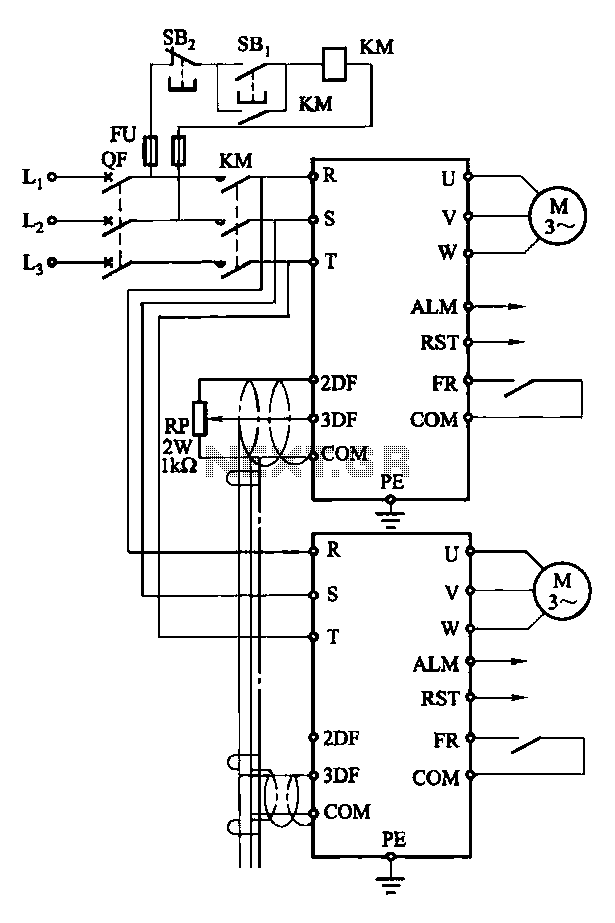
A given frequency control multiple motors operating in parallel circuits
Each motor operates with an independent drive; however, only one frequency is utilized for a specific device. This setup employs a single RP potentiometer to control multiple motors in parallel.
In this configuration, the circuit design allows for multiple motors to...