


Color organ
#color organ
#audio response
#LED control
#bass
#mid-range
#high notes
#level adjustment
#light pulsing
#sound activation
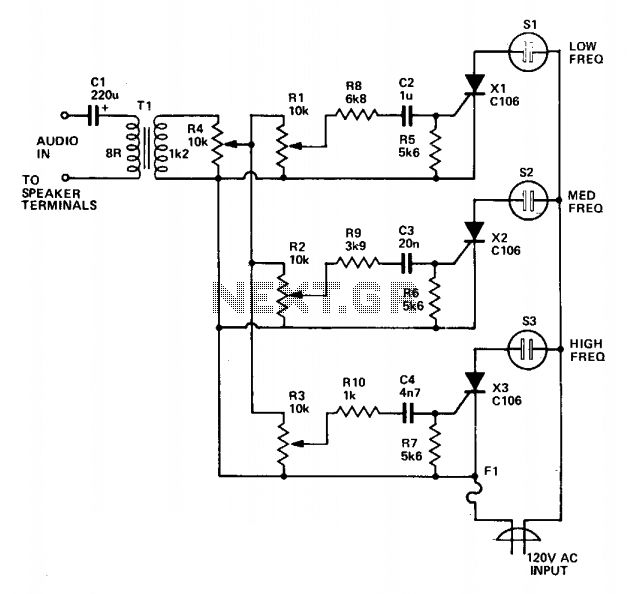
Description: Three lights are controlled by three channels. One light pulses in response to the bass, another illuminates with mid-range sounds, and the last lights up for high notes. Four level controls allow adjustment of the overall light level and each channel individually. Up to 200 watts per channel can be handled.
This electronic circuit design incorporates a three-channel lighting control system that responds dynamically to audio frequencies. Each channel is dedicated to a specific frequency range: low frequencies (bass), mid-range frequencies, and high frequencies. The circuit utilizes a signal processing unit to analyze the audio input and determine the amplitude of frequencies within each specified range.
The bass channel is equipped with a pulse-width modulation (PWM) controller that adjusts the intensity of the light based on the bass signal's amplitude. This creates a visual representation of the low-frequency sounds, causing the light to pulse in sync with the rhythm of the music.
Similarly, the mid-range channel employs a dedicated amplifier and light driver circuit that illuminates the light in response to the mid-range audio signals. The design ensures that the light output is proportional to the mid-range frequencies detected, enhancing the overall visual experience during sound playback.
The high-frequency channel operates in a comparable manner, utilizing a fast-acting light driver that can respond to rapid changes in high-frequency sound. This ensures that the light output is bright and responsive, effectively highlighting the treble elements of the audio spectrum.
The circuit includes four level control potentiometers, allowing users to adjust the overall brightness of the lights as well as the individual channel levels. This feature provides flexibility in tailoring the visual output to match the audio environment or personal preference.
The system is capable of handling up to 200 watts per channel, ensuring robust performance and reliability in various applications, such as live music events, DJ setups, or home audio systems. Proper heat management and component selection are critical to maintain the integrity of the circuit under high power conditions.Three lights are controlled by the three channels. One light will pulse in response to the bass, another illuminates with mid-range sounds, and the last lights for high notes. Four level controls allow adjustment of overall light level and each channel individually. Up to 200 watts per channel can be handled.
This electronic circuit design incorporates a three-channel lighting control system that responds dynamically to audio frequencies. Each channel is dedicated to a specific frequency range: low frequencies (bass), mid-range frequencies, and high frequencies. The circuit utilizes a signal processing unit to analyze the audio input and determine the amplitude of frequencies within each specified range.
The bass channel is equipped with a pulse-width modulation (PWM) controller that adjusts the intensity of the light based on the bass signal's amplitude. This creates a visual representation of the low-frequency sounds, causing the light to pulse in sync with the rhythm of the music.
Similarly, the mid-range channel employs a dedicated amplifier and light driver circuit that illuminates the light in response to the mid-range audio signals. The design ensures that the light output is proportional to the mid-range frequencies detected, enhancing the overall visual experience during sound playback.
The high-frequency channel operates in a comparable manner, utilizing a fast-acting light driver that can respond to rapid changes in high-frequency sound. This ensures that the light output is bright and responsive, effectively highlighting the treble elements of the audio spectrum.
The circuit includes four level control potentiometers, allowing users to adjust the overall brightness of the lights as well as the individual channel levels. This feature provides flexibility in tailoring the visual output to match the audio environment or personal preference.
The system is capable of handling up to 200 watts per channel, ensuring robust performance and reliability in various applications, such as live music events, DJ setups, or home audio systems. Proper heat management and component selection are critical to maintain the integrity of the circuit under high power conditions.Three lights are controlled by the three channels. One light will pulse in response to the bass, another illuminates with mid-range sounds, and the last lights for high notes. Four level controls allow adjustment of overall light level and each channel individually. Up to 200 watts per channel can be handled.
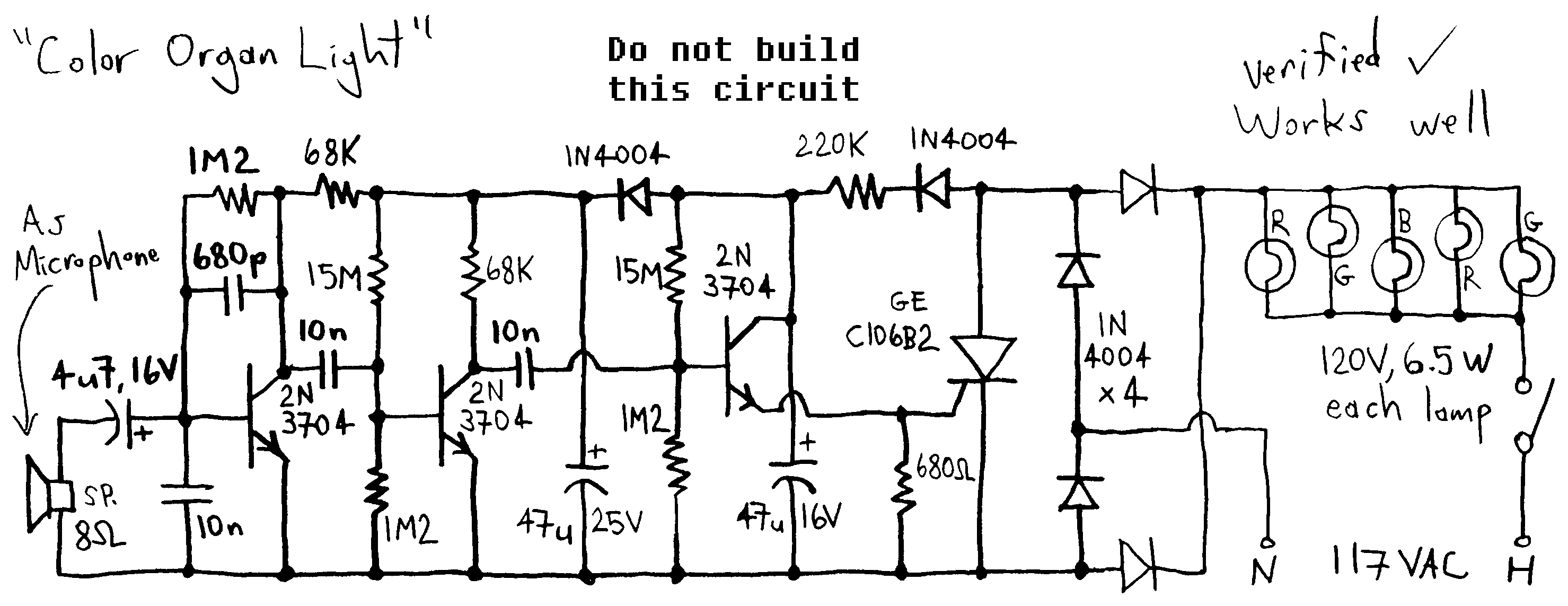
Color Organ Light
This circuit works REALLY well. Notice how it will fire even in complete silence. This provides a sort of automatic gain control.
The described circuit appears to function as an automatic gain control (AGC) system, which is crucial in various audio...
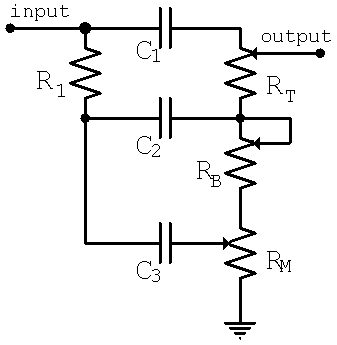
bassman tonestack low frequency
Bass and midrange frequencies are significantly influenced by Marshall's considerable adjustment of R1 and are somewhat affected by the 10-percent increase in C2 and C3. The following paragraphs will explain how the circuit responds to bass and midrange frequencies, calculating...
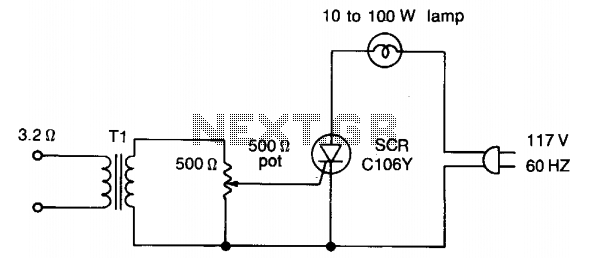
Simple color organ
Transformer Tl can be any matching transistor type in the range of 500/500 to 2500/2500 ohms. No connections from the SCR or its components are connected to ground. For safety, maintain the 117-V line voltage from the amplifier connections; this...
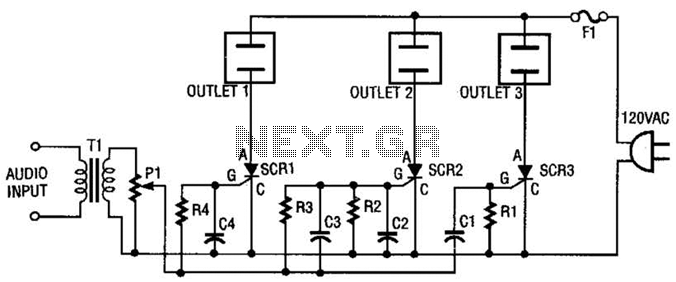
3 Channel Color Organ Circuit
The AC line power is introduced into the circuit through F1, a protective 5-A fuse. One side of the AC line is connected to one side of each AC outlet, while the other side is connected to each silicon-controlled rectifier...

Bass circuit diagram
The circuit operates by processing an input signal through IC1-1 and a fourth-order low-pass filter, which provides a slope of 24 dB/octave with a cutoff frequency (fc) of 70 Hz and an amplification of 8.2 dB. The output from this...