


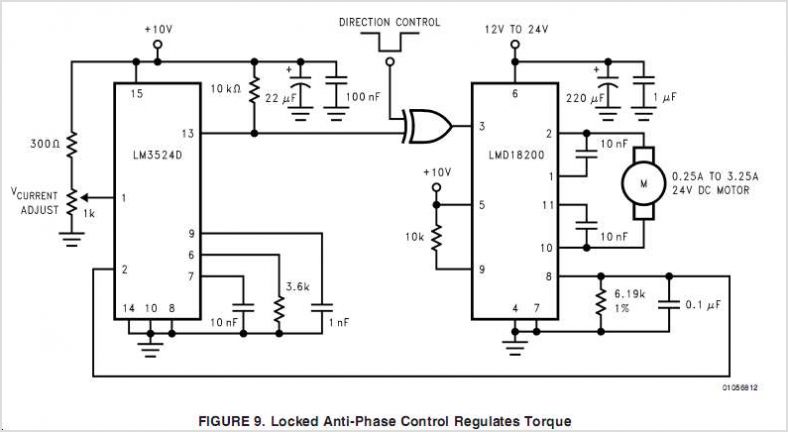
LMD18200 3A 55V H-Bridge
Description: The LMV1090 is a fully analog dual differential input, differential output microphone array amplifier designed to reduce background acoustic noise while delivering exceptional speech clarity in voice communication applications. The LMV1090 effectively preserves near-field voice signals within 4 cm of the microphones while rejecting far-field acoustic noise greater than 50 cm from the microphones. Up to 20 dB of far-field rejection is achievable with a proper configuration using ±0.5 dB matched microphones. As part of the Powerwise family of energy-efficient solutions, the LMV1090 consumes only 600 µA of supply current, providing superior performance compared to DSP solutions that consume more than ten times the power. The dual microphone inputs and the processed signal output are differential to ensure excellent noise immunity. The microphones are biased with an internal low-noise bias supply. By National Semiconductor Corporation.
The LMV1090 microphone array amplifier is engineered to enhance voice communication by minimizing unwanted ambient noise, making it particularly suitable for applications where clarity is essential, such as teleconferencing and voice recognition systems. The dual differential inputs allow for the connection of two microphones, which can be strategically placed to capture sound from desired sources while rejecting noise from other directions. This configuration is beneficial in environments with significant background noise, as it focuses on sound sources that are directly in front of the microphones.
The amplifier's ability to maintain high-quality audio signals at close range (within 4 cm) while effectively suppressing noise from distances greater than 50 cm is attributed to its advanced signal processing capabilities. The design accommodates microphones that are matched to within ±0.5 dB, ensuring optimal performance and consistency in sound capture. The 20 dB far-field rejection is a key feature, allowing the LMV1090 to be integrated into systems where noise reduction is critical.
Power efficiency is another significant advantage of the LMV1090, consuming only 600 µA of supply current. This low power requirement is particularly advantageous in battery-operated devices, where extended operational life is a priority. The device's performance is notably superior compared to digital signal processing (DSP) solutions, which typically require much higher power consumption, thus making the LMV1090 a cost-effective choice for portable applications.
The differential output configuration enhances noise immunity, reducing the susceptibility of the signal to interference from electromagnetic sources. This is crucial for maintaining audio fidelity in various environments. Additionally, the internal low-noise bias supply ensures that the microphones operate optimally, further contributing to the overall performance of the amplifier.
In summary, the LMV1090 is a sophisticated solution for applications requiring high-quality voice communication, combining effective noise reduction, low power consumption, and robust performance characteristics. Its design principles and operational efficiencies make it a valuable component in modern audio processing systems.The LMV1090 is a fully Analog dual differential input, differ- ential output, Microphone array Amplifier designed to reduce background acoustic noise, while delivering superb speech clarity in voice Communication applications. The LMV1090 preserves near-field voice signals within 4cm of the Microphones while rejecting far-field acoustic noise grea
ter than 50cm from the Microphones Up to 20dB of far- field rejection is possible in a properly configured and using ±0. 5dB matched micropohones. Part of the Powerwise family of energy efficient solutions, the LMV1090 consumes only 600 A of supply current pro- viding superior performance over DSP solutions consuming greater than ten times the power.
The dual Microphone inputs and the processed signal output are differential to provide excellent noise immunity. The mi- crophones are biased with an internal low-noise bias supply. By National Semiconductor Corporation
The LMV1090 microphone array amplifier is engineered to enhance voice communication by minimizing unwanted ambient noise, making it particularly suitable for applications where clarity is essential, such as teleconferencing and voice recognition systems. The dual differential inputs allow for the connection of two microphones, which can be strategically placed to capture sound from desired sources while rejecting noise from other directions. This configuration is beneficial in environments with significant background noise, as it focuses on sound sources that are directly in front of the microphones.
The amplifier's ability to maintain high-quality audio signals at close range (within 4 cm) while effectively suppressing noise from distances greater than 50 cm is attributed to its advanced signal processing capabilities. The design accommodates microphones that are matched to within ±0.5 dB, ensuring optimal performance and consistency in sound capture. The 20 dB far-field rejection is a key feature, allowing the LMV1090 to be integrated into systems where noise reduction is critical.
Power efficiency is another significant advantage of the LMV1090, consuming only 600 µA of supply current. This low power requirement is particularly advantageous in battery-operated devices, where extended operational life is a priority. The device's performance is notably superior compared to digital signal processing (DSP) solutions, which typically require much higher power consumption, thus making the LMV1090 a cost-effective choice for portable applications.
The differential output configuration enhances noise immunity, reducing the susceptibility of the signal to interference from electromagnetic sources. This is crucial for maintaining audio fidelity in various environments. Additionally, the internal low-noise bias supply ensures that the microphones operate optimally, further contributing to the overall performance of the amplifier.
In summary, the LMV1090 is a sophisticated solution for applications requiring high-quality voice communication, combining effective noise reduction, low power consumption, and robust performance characteristics. Its design principles and operational efficiencies make it a valuable component in modern audio processing systems.The LMV1090 is a fully Analog dual differential input, differ- ential output, Microphone array Amplifier designed to reduce background acoustic noise, while delivering superb speech clarity in voice Communication applications. The LMV1090 preserves near-field voice signals within 4cm of the Microphones while rejecting far-field acoustic noise grea
ter than 50cm from the Microphones Up to 20dB of far- field rejection is possible in a properly configured and using ±0. 5dB matched micropohones. Part of the Powerwise family of energy efficient solutions, the LMV1090 consumes only 600 A of supply current pro- viding superior performance over DSP solutions consuming greater than ten times the power.
The dual Microphone inputs and the processed signal output are differential to provide excellent noise immunity. The mi- crophones are biased with an internal low-noise bias supply. By National Semiconductor Corporation
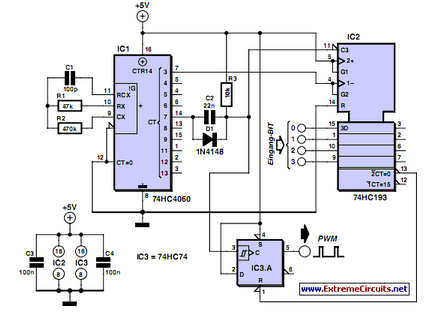
Discrete PWM Generator Circuit
PWM waveforms are frequently utilized to regulate the speed of DC motors. The duty cycle of the digital waveform can be defined using an adjustable parameter.
PWM (Pulse Width Modulation) is a technique employed to control the power delivered to electrical...
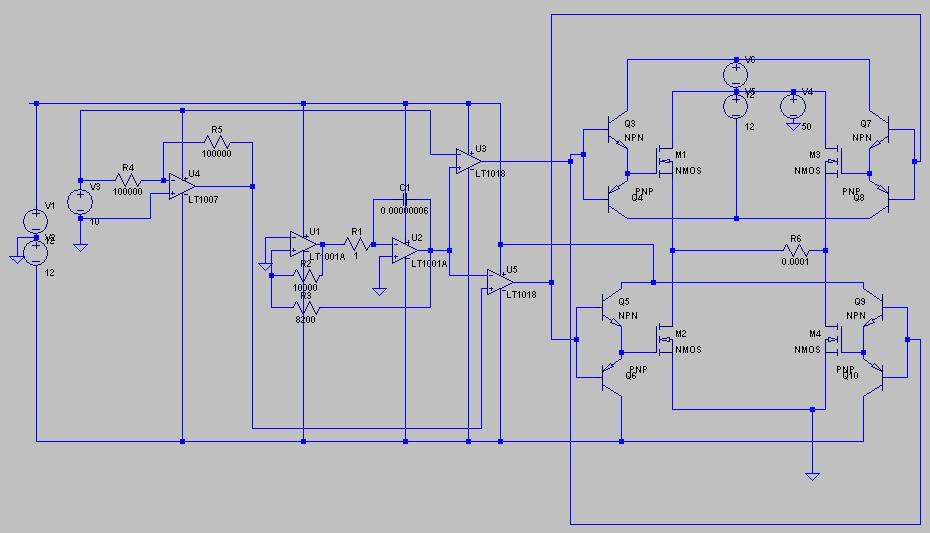
whats wrong my h bridge drivers
I have attempted to create drivers for my H-bridge circuit using complementary emitters; however, the square wave outputs consistently run at a constant 25V instead of a ±10V square wave. The image is somewhat difficult to interpret, but it appears...
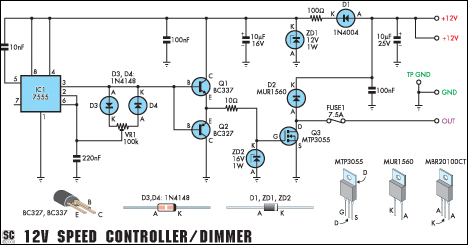
12V Speed Controller/Dimmer
This circuit functions as a speed controller for a 12V motor with a continuous rating of up to 5A or as a dimmer for a 12V halogen or incandescent lamp rated up to 50W. It adjusts the power to the...
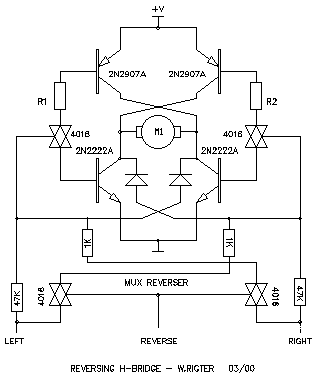
Wilf Rigter`s reversing H-bridge
This H-bridge variant was one of the first in which the reversing circuitry is built into the driver, rather than (as is more-commonly done) into the control circuitry upstream of the driver. This is a handy circuit, though, for 2-motor...
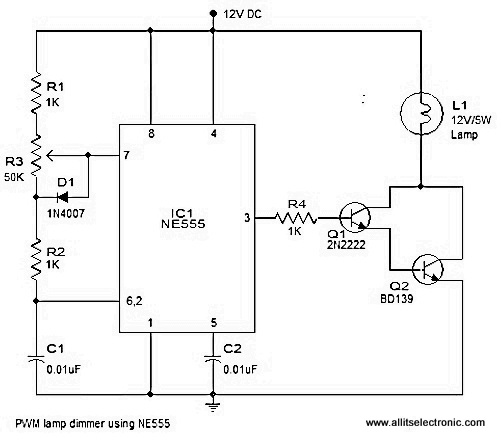
pwm lamp dimmer using ne555
A simple and efficient PWM lamp dimmer utilizing the timer IC NE555 is presented in this article. Traditional linear regulator-based dimmers achieve a maximum efficiency of only 50%, which is significantly lower than PWM-based dimmers that can exceed 90% efficiency....
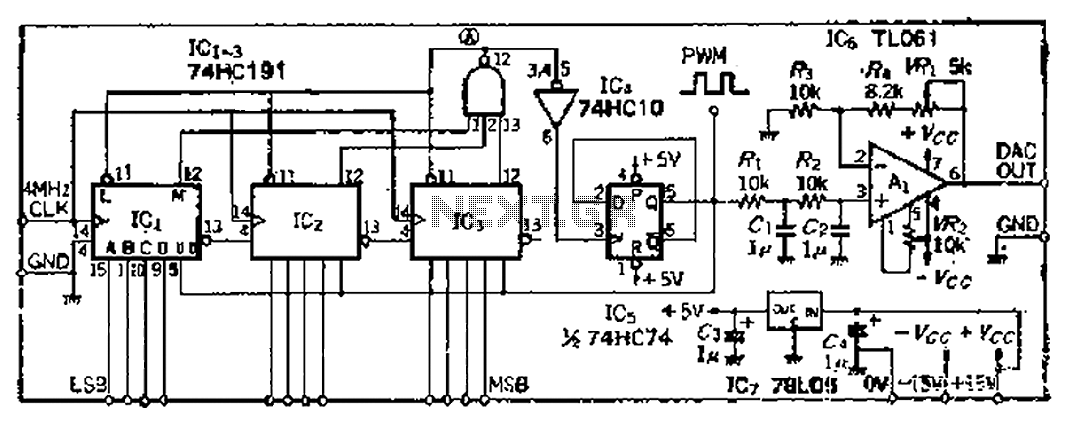
Easy to adjust high-precision PWM pulse width modulation 12-bit DA converter
A PWM clock signal is generated at 4096 times the input frequency, counting up (Q3) until the base of ICi-IC3 is full. The output point produces a maximum clock signal. On one side, voltage data is loaded into IC3, while...
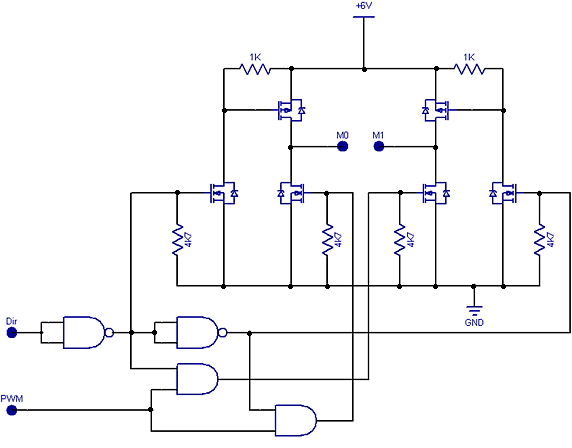
Dr. Iguanas Vivarium
A good thing too since I initially hooked the p-channel MOSFETs up backwards. No smoke, fortunately. I am using Pololu gear head motors (although continuous rotation servos will also be supported). To drive the motors in either direction, I am...
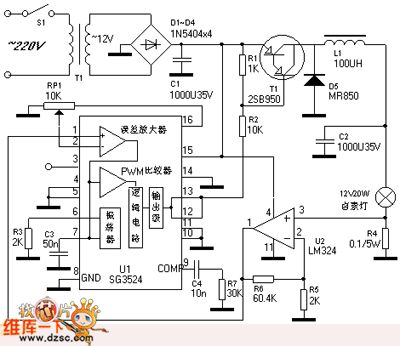
PWM Control Dimming Halogen Lamp
The PWM control dimming circuit for a halogen lamp is illustrated. The halogen lamp operates at a rated voltage of 12V with a nominal power of 20W. This dimmer circuit is capable of adjusting the intensity of the halogen lamp...
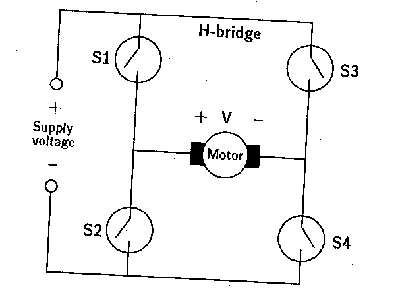
h-bridge circuitry
A microprocessor cannot drive a motor directly since it cannot supply enough current. Instead, an interface circuit is required so that the motor power is supplied from another source, with only control signals derived from the microprocessor. This interface can...