


Charge amplifier circuit diagram OPA128
#charge amplifier
#OPA128
#piezoelectric
#signal amplification
#high impedance
#operational amplifier
#circuit diagram
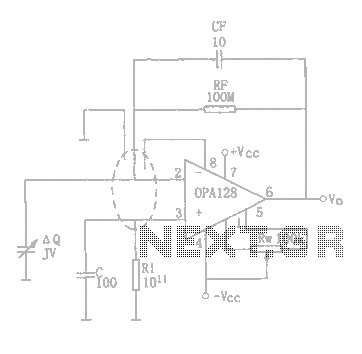
Description: A charge amplifier is designed to amplify the signal charge from a piezoelectric device. It features a high internal impedance to accommodate the weak signal charge, which can be at the picoampere (pA) level. This necessitates a charge amplifier with high input resistance and low bias current; otherwise, the bias current may overshadow the signal current, preventing normal amplification. Standard high-impedance amplifier circuits (10^12 ohms) are typically unsuitable for this application. Instead, integrated operational amplifiers like the OPA128 are commonly utilized in the charge amplifier circuit, as illustrated in the accompanying diagram.
A charge amplifier serves a critical role in signal processing, particularly when dealing with piezoelectric sensors that generate minimal charge output. The fundamental operation of a charge amplifier relies on its ability to convert the charge signal into a voltage signal while maintaining high fidelity. The high input impedance of the charge amplifier ensures that the sensor's output is not loaded, preserving the integrity of the signal.
The OPA128 operational amplifier is specifically chosen for its characteristics that align well with the requirements of charge amplification. With a low input bias current and high input resistance, the OPA128 minimizes any additional noise or distortion that could arise from the amplifier itself. This is crucial in applications where the signal levels are very low, as even minor perturbations can lead to significant inaccuracies in the output.
In the schematic, the charge amplifier configuration typically includes the OPA128 connected in a feedback loop that allows for the transformation of the input charge signal into a proportional output voltage. The feedback capacitor is a key component, as it determines the gain of the amplifier based on the charge it receives. The design must ensure that the selected feedback components are optimized to match the characteristics of the piezoelectric sensor being used.
Overall, the design of a charge amplifier circuit utilizing the OPA128 is essential for applications requiring precise measurement and amplification of low-level signals from piezoelectric devices. This configuration provides a reliable solution for accurately capturing and processing these signals in various electronic systems.The so-called charge amplifier means for amplifying the signal charge from the piezoelectric device amplifying circuit . Such high internal impedance of the amplifier signal source, while its charge very weak signal, the current source is formed only pA level, which requires a charge amplifier with a high input resistance and low bias current, otherwise when the amplifier bias current and signal current is similar to the bias current signal may be overwhelmed, and can not achieve normal zoom. Further, high-impedance (1012 ) in the usual sense amplifier circuit can not be used. Often used for this type of electrostatic integrated operational amplifier OPA128 amplifier circuit composed.
As shown for the charge amplifier OPA128 constituted.
A charge amplifier serves a critical role in signal processing, particularly when dealing with piezoelectric sensors that generate minimal charge output. The fundamental operation of a charge amplifier relies on its ability to convert the charge signal into a voltage signal while maintaining high fidelity. The high input impedance of the charge amplifier ensures that the sensor's output is not loaded, preserving the integrity of the signal.
The OPA128 operational amplifier is specifically chosen for its characteristics that align well with the requirements of charge amplification. With a low input bias current and high input resistance, the OPA128 minimizes any additional noise or distortion that could arise from the amplifier itself. This is crucial in applications where the signal levels are very low, as even minor perturbations can lead to significant inaccuracies in the output.
In the schematic, the charge amplifier configuration typically includes the OPA128 connected in a feedback loop that allows for the transformation of the input charge signal into a proportional output voltage. The feedback capacitor is a key component, as it determines the gain of the amplifier based on the charge it receives. The design must ensure that the selected feedback components are optimized to match the characteristics of the piezoelectric sensor being used.
Overall, the design of a charge amplifier circuit utilizing the OPA128 is essential for applications requiring precise measurement and amplification of low-level signals from piezoelectric devices. This configuration provides a reliable solution for accurately capturing and processing these signals in various electronic systems.The so-called charge amplifier means for amplifying the signal charge from the piezoelectric device amplifying circuit . Such high internal impedance of the amplifier signal source, while its charge very weak signal, the current source is formed only pA level, which requires a charge amplifier with a high input resistance and low bias current, otherwise when the amplifier bias current and signal current is similar to the bias current signal may be overwhelmed, and can not achieve normal zoom. Further, high-impedance (1012 ) in the usual sense amplifier circuit can not be used. Often used for this type of electrostatic integrated operational amplifier OPA128 amplifier circuit composed.
As shown for the charge amplifier OPA128 constituted.
Piezoelectric alarm rings clear as a bell
A common piezoelectric alarm, such as the Murata PKB5-3A, possesses many valuable attributes, including compactness, lightweight design, efficiency, and reliability. However, the loud, high-pitched sound output can be irritating in many applications. The circuit provided transforms this buzzer into a...
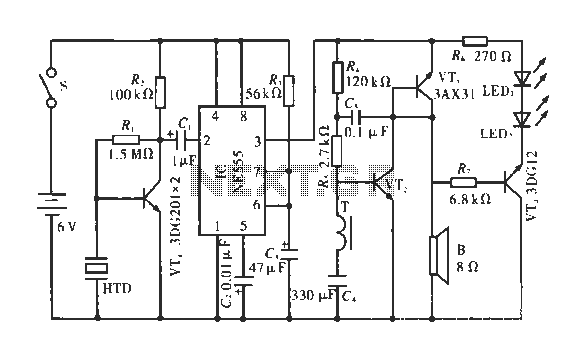
Cat toys electronic circuit
The circuit operates by detecting a clapping sound through a piezoelectric ceramic sensor, which converts the sound into an electrical signal. This signal is then amplified by the transistor VT1 and fed through a coupling capacitor C1 to the base...
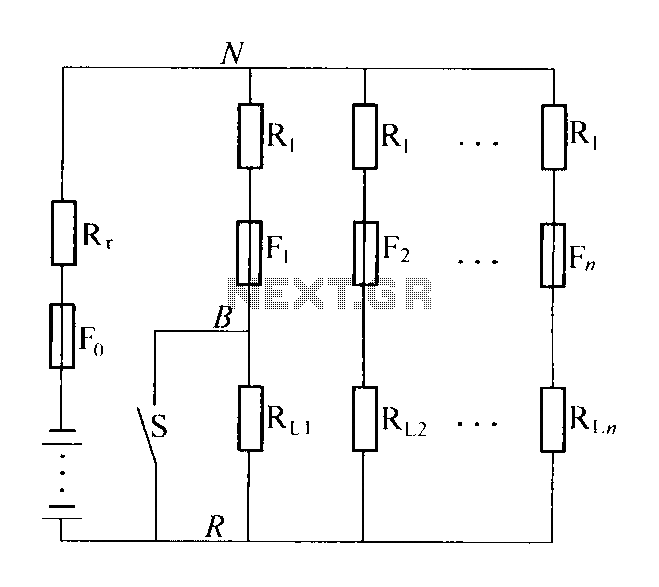
High resistance distribution circuit
The circuit diagram illustrates a high-impedance distribution system characterized by low resistivity distribution. A notable feature is the series resistance of the shunt load current limiting resistor R1, typically valued at five to ten times the internal resistance of the...
operational amplifier op amp oscillator
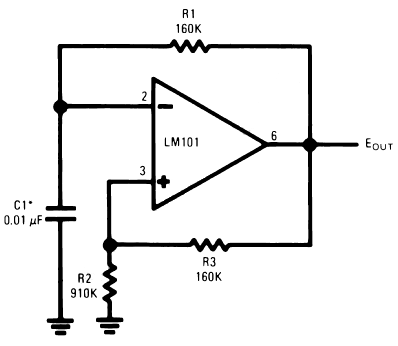
The timing capacitor (C1) generates multiple time constants, facilitating substantial voltage fluctuations at the input, attributable to the LM101's extensive input voltage range. It is advisable to decrease the value of resistor R2 and to increase the capacitance of C1...
Charge amplifier
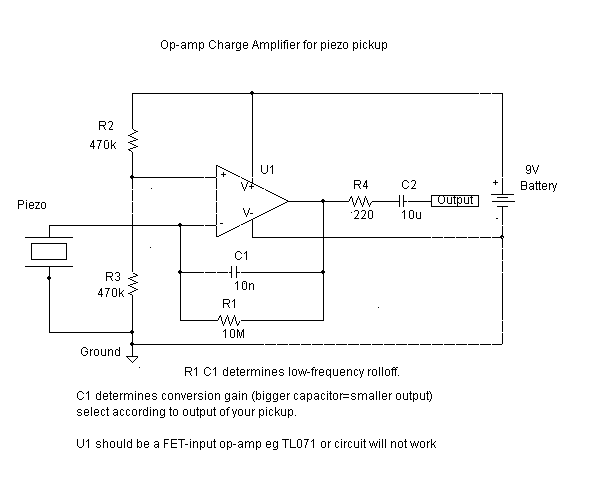
A charge amplifier is an amplifier whose equivalent input impedance is a capacitive reactance that is very high at low frequencies. Thus, contrary to what its name may suggest, a charge amplifier does not amplify the electric charge present at...
Precision current sink sourcel
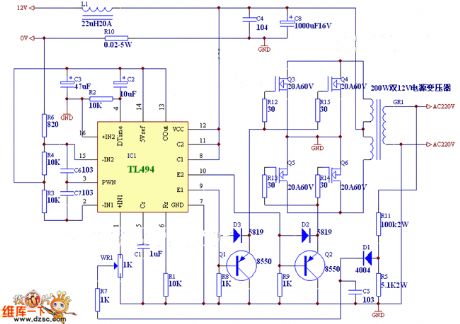
An operational amplifier circuit can provide a constant voltage source with a high amplification factor and substantial load current. Even with significant variations in circuit parameters, the output voltage maintains high precision. The output current limit is managed by transistors...
Piezoelectric Sound
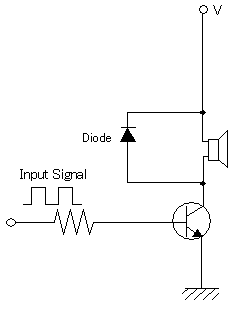
A piezoelectric sounder (self-drive type) consists solely of a piezoelectric diaphragm with a feedback electrode and is utilized in conjunction with an external drive circuit. The drive circuit for both types of sounders is a simple configuration comprising one transistor...
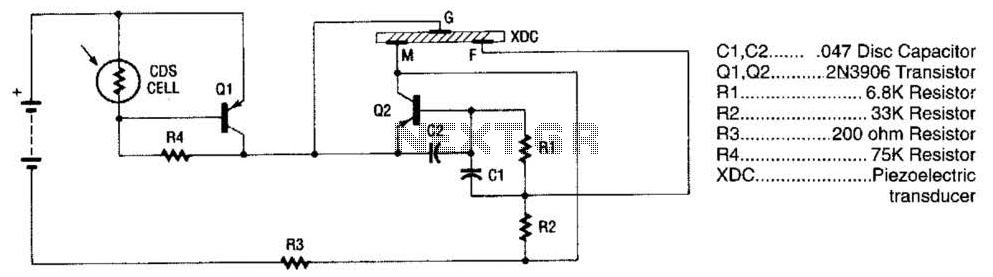
Piezoelectric Alarm Circuit
The alarm utilizes a fixed-frequency piezoelectric buzzer alongside a cadmium-sulfide (CDS) cell and a two-transistor circuit to create a distinctive effect. When light reaches the CDS photoelectric cell, the alarm remains silent. However, in the absence of light, transistor Q1...
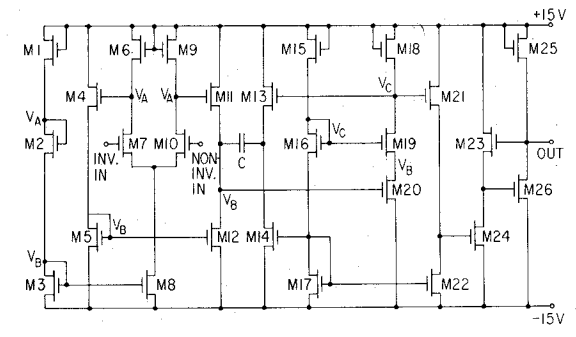
cut the feed forward in the miller compensation with voltage buffer
An internally compensated operational amplifier has been fabricated using n-channel Al-gate MOS technology, utilizing only enhancement mode devices. The circuit is designed to ensure that its performance remains insensitive to process parameters. The input stage consists of a source-coupled differential...