


Tube-type crystal oscillator
#tube
#crystal
#oscillator
#pilot lamp
#current limiting
#frequency generation
#vacuum tube
#resonator
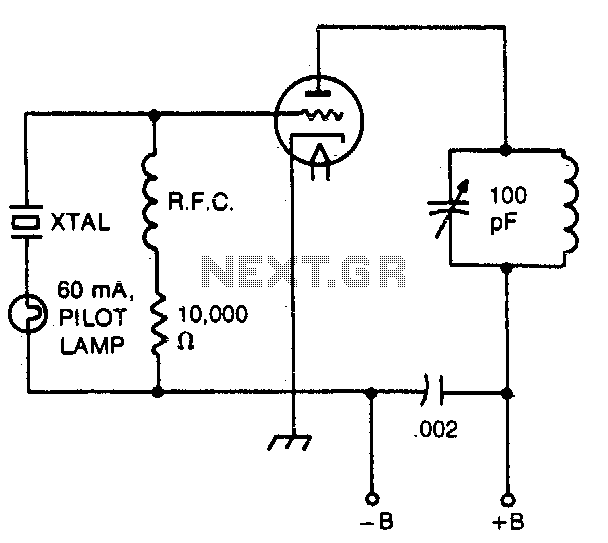
Description: The pilot lamp limits current to prevent damage to the crystal. A very useful circuit.
The circuit incorporates a pilot lamp designed to limit the current flowing to a crystal component, thereby safeguarding it from potential damage due to excessive current. The pilot lamp functions as a visual indicator and a current-limiting device. Typically, this is achieved by placing the pilot lamp in series with the crystal, which ensures that the current passing through the crystal does not exceed its rated specifications.
In a typical application, the pilot lamp is selected based on its voltage rating and current capacity, which should match the requirements of the circuit. When the circuit is powered, the pilot lamp illuminates, indicating that the circuit is operational while simultaneously limiting the current to a safe level for the crystal. This feature is particularly beneficial in preventing thermal runaway conditions that could lead to failure of the crystal.
Additionally, the circuit may include resistive or capacitive elements to further stabilize the current flow and enhance the overall functionality. The use of a pilot lamp not only serves a protective role but also provides a straightforward diagnostic tool for users to assess the operational status of the circuit. Overall, this design exemplifies a practical solution for integrating protective measures within electronic circuits, ensuring reliable and safe operation of sensitive components.The pilot lamp limits current to prevent damage to the crystal A very useful circuit.
The circuit incorporates a pilot lamp designed to limit the current flowing to a crystal component, thereby safeguarding it from potential damage due to excessive current. The pilot lamp functions as a visual indicator and a current-limiting device. Typically, this is achieved by placing the pilot lamp in series with the crystal, which ensures that the current passing through the crystal does not exceed its rated specifications.
In a typical application, the pilot lamp is selected based on its voltage rating and current capacity, which should match the requirements of the circuit. When the circuit is powered, the pilot lamp illuminates, indicating that the circuit is operational while simultaneously limiting the current to a safe level for the crystal. This feature is particularly beneficial in preventing thermal runaway conditions that could lead to failure of the crystal.
Additionally, the circuit may include resistive or capacitive elements to further stabilize the current flow and enhance the overall functionality. The use of a pilot lamp not only serves a protective role but also provides a straightforward diagnostic tool for users to assess the operational status of the circuit. Overall, this design exemplifies a practical solution for integrating protective measures within electronic circuits, ensuring reliable and safe operation of sensitive components.The pilot lamp limits current to prevent damage to the crystal A very useful circuit.
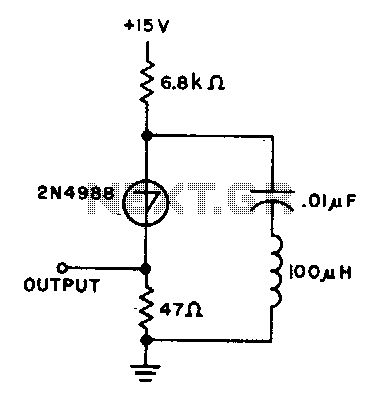
10Khz oscillator
The capacitor charges until the switching voltage is reached. When the switch (SUS) is activated, the inductor causes the current to oscillate. When the current through the switch drops below the holding current, the device turns off, and the cycle...
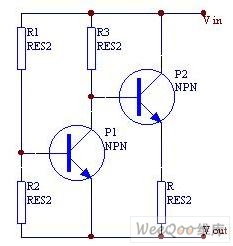
Simple current limiting circuit
When the current is below the specified threshold, the bias current supplied by resistor R1 causes transistor P3 to saturate and conduct. In this state, it is unable to regulate the current effectively. Conversely, when the current reaches or exceeds...
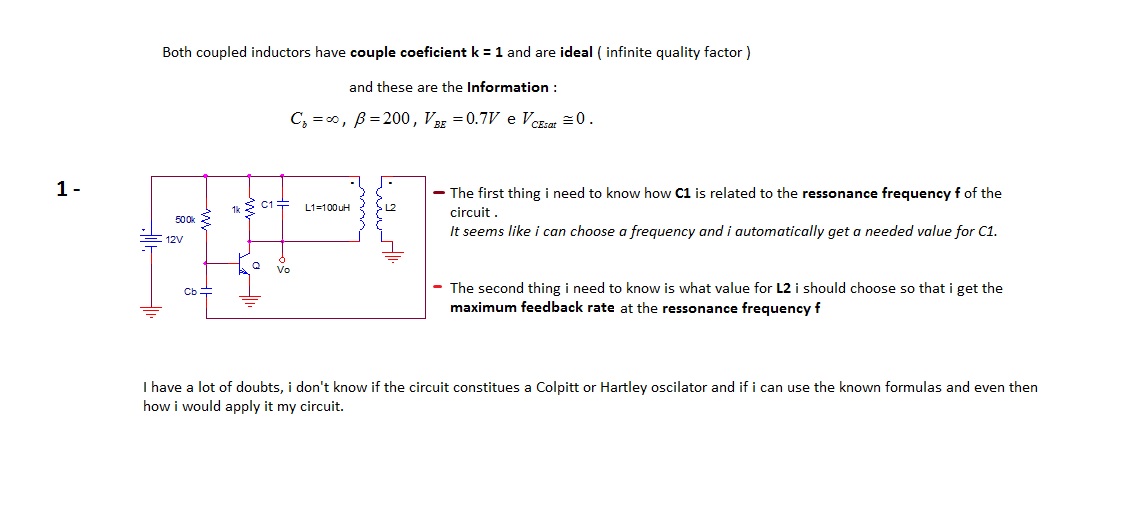
oscillation Oscillator circuit
The first thing to understand is how capacitor C1 is related to the resonance frequency f of the circuit. It appears that selecting a frequency allows for the automatic determination of the necessary value for C1. There are uncertainties regarding...
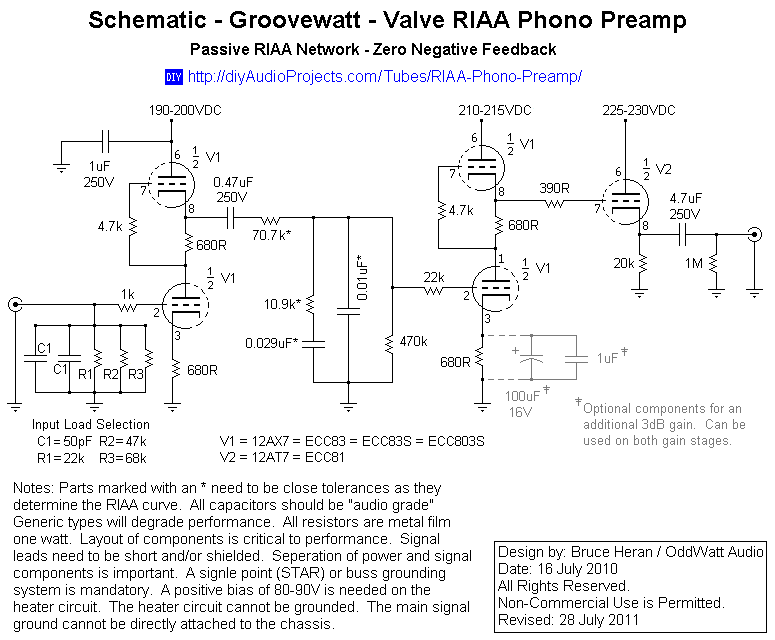
Groovewatt a DIY Vacuum Tube (Valve) RIAA Phono Preamplifier Project
This project has been in development for over a year, initially postponed due to concerns about design complexity and the availability of high-quality phono preamps. The objective was to create a preamp that would deliver performance comparable to commercial products...
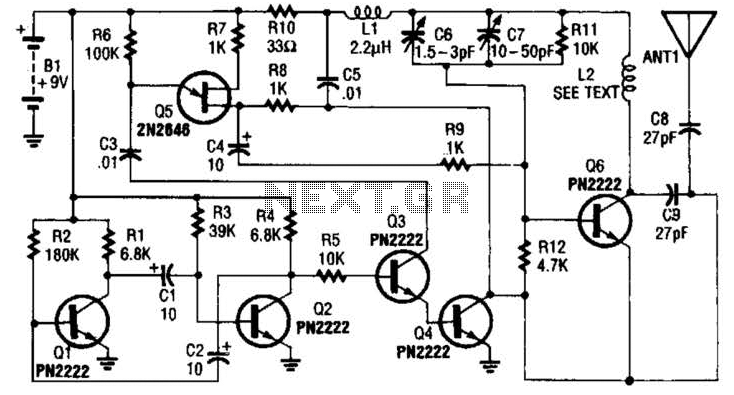
Vacuum Tube 80-40M Transmitter Circuit
The transmitter utilizes a 6BW6 vacuum tube to achieve an output power of approximately 5 watts. The circuit includes a component CI that is calibrated to produce the cleanest continuous wave (CW) note. The tuning capacitors C8 and C9 have...

Stable Start-Stop Oscillator
Oscillators that generate a predetermined number of pulses are often required in applications such as video work. This oscillator starts 13 ms after the control signal goes high and stops immediately when the input signal goes low.
In electronic applications, pulse...
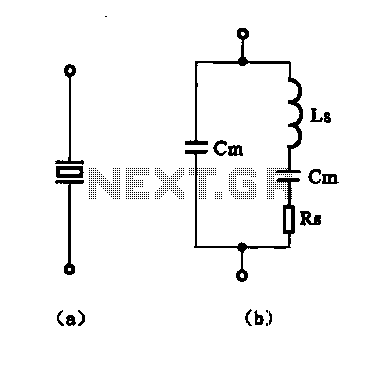
Crystal symbols and equivalent RLC circuit
The crystal equivalent RLC circuit is illustrated. The RLC circuit can operate in either a series resonant or parallel resonant configuration.
The crystal equivalent RLC circuit is a fundamental electronic circuit that models the behavior of a crystal oscillator. This circuit...
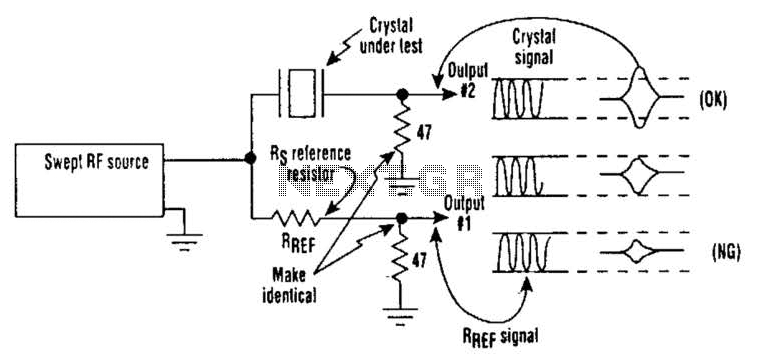
Easy Crystal Impedance Checker Circuit
Occasionally, microprocessors and microcomputers may not be compatible with certain microprocessor crystals. Many data sheets for microprocessors specify maximum values for a crystal's equivalent series resistance (Rs), which may not be met by some crystals marketed for use with these...
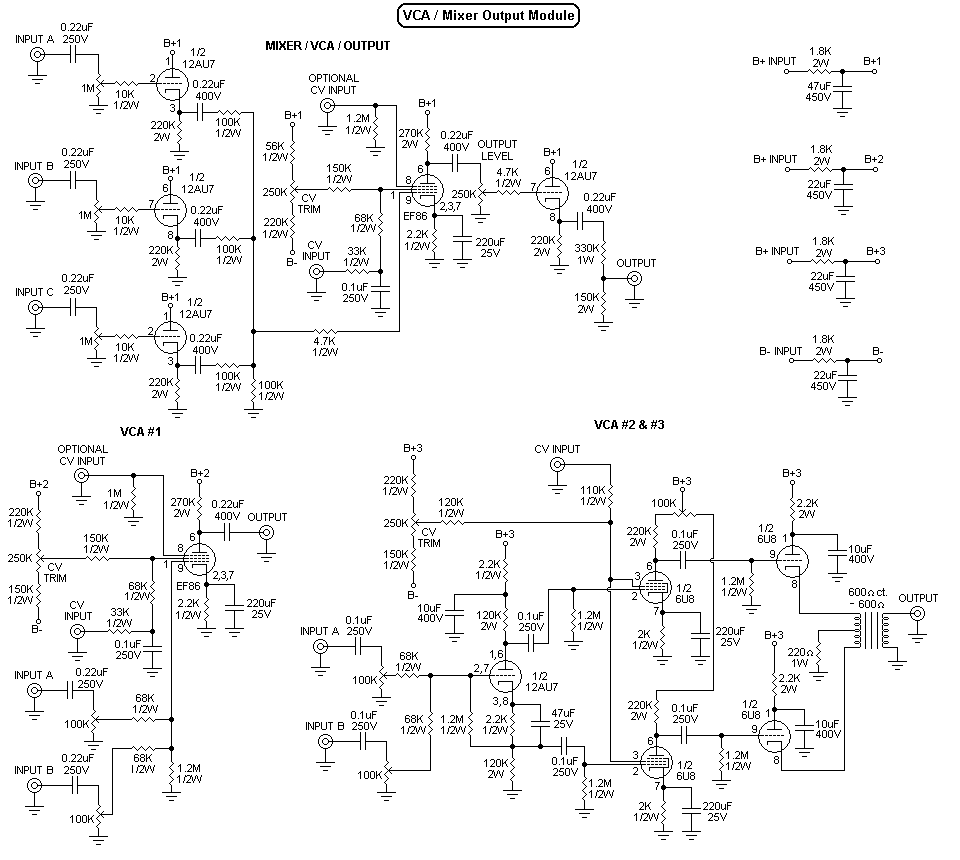
Vacuum Tube Synthesizers
Recently, a music synthesizer has been constructed using vacuum tubes. Although designed primarily as a percussion synthesizer, it can also be controlled via a keyboard or a MIDI to CV converter. The initial module developed is a dual voltage-controlled oscillator...