


220V 12V 150W switching power supply circuit diagram
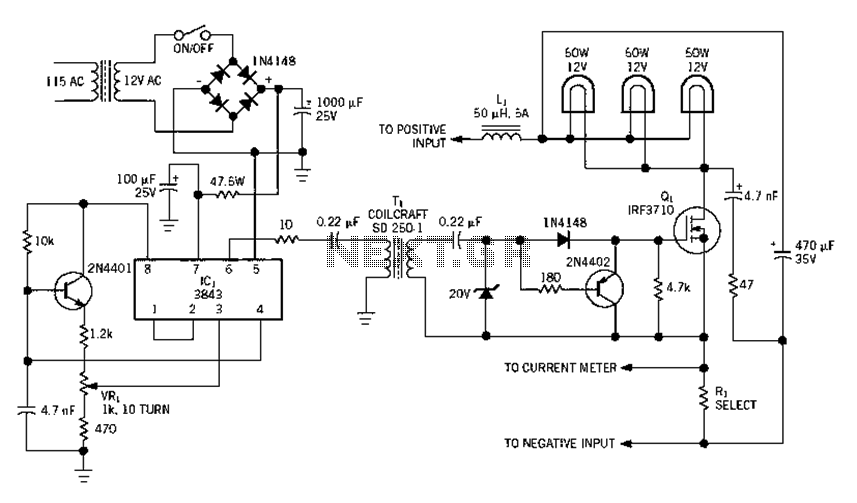
Description: Electrical equipment provided for a power supply circuit design in the power section, as illustrated below.
The power supply circuit design is a critical component in various electronic systems, serving as the backbone for powering other devices. The schematic typically includes a transformer, rectifier, filter, and voltage regulation stages, ensuring that the output voltage is stable and suitable for the intended application.
1. **Transformer**: The circuit begins with a transformer that steps down the voltage from the mains supply to a lower AC voltage. The transformer is selected based on the required output voltage and current specifications. It is essential to ensure that the transformer has sufficient power rating to handle the load without overheating.
2. **Rectifier**: Following the transformer, a rectifier converts the AC voltage into DC voltage. This can be achieved using either a half-wave or full-wave rectifier configuration. A full-wave bridge rectifier is commonly used for its efficiency and ability to provide a smoother DC output. The rectifier diodes must be rated for the peak inverse voltage (PIV) and forward current to prevent failure during operation.
3. **Filter**: The rectified DC voltage is often pulsating and requires smoothing. This is accomplished using filter capacitors, which store charge and release it to reduce voltage ripple. The choice of capacitance value is crucial; larger capacitors provide better smoothing but may increase inrush current during startup.
4. **Voltage Regulation**: To maintain a consistent output voltage despite variations in input voltage or load conditions, a voltage regulator is employed. This can be a linear regulator for low power applications or a switching regulator for higher efficiency in more demanding applications. The regulator ensures that the output remains within specified limits, protecting downstream components.
5. **Protection Features**: Additional components such as fuses, circuit breakers, and transient voltage suppressors may be included to enhance the reliability and safety of the power supply circuit. These components help prevent damage from overloads, short circuits, and voltage spikes.
In summary, the design of a power supply circuit involves careful selection and integration of various components to ensure efficient and reliable operation. Each stage of the circuit plays a vital role in transforming and regulating electrical energy for use in electronic devices.Electrical equipment supplied to a power supply circuit design power section, as shown below:
The power supply circuit design is a critical component in various electronic systems, serving as the backbone for powering other devices. The schematic typically includes a transformer, rectifier, filter, and voltage regulation stages, ensuring that the output voltage is stable and suitable for the intended application.
1. **Transformer**: The circuit begins with a transformer that steps down the voltage from the mains supply to a lower AC voltage. The transformer is selected based on the required output voltage and current specifications. It is essential to ensure that the transformer has sufficient power rating to handle the load without overheating.
2. **Rectifier**: Following the transformer, a rectifier converts the AC voltage into DC voltage. This can be achieved using either a half-wave or full-wave rectifier configuration. A full-wave bridge rectifier is commonly used for its efficiency and ability to provide a smoother DC output. The rectifier diodes must be rated for the peak inverse voltage (PIV) and forward current to prevent failure during operation.
3. **Filter**: The rectified DC voltage is often pulsating and requires smoothing. This is accomplished using filter capacitors, which store charge and release it to reduce voltage ripple. The choice of capacitance value is crucial; larger capacitors provide better smoothing but may increase inrush current during startup.
4. **Voltage Regulation**: To maintain a consistent output voltage despite variations in input voltage or load conditions, a voltage regulator is employed. This can be a linear regulator for low power applications or a switching regulator for higher efficiency in more demanding applications. The regulator ensures that the output remains within specified limits, protecting downstream components.
5. **Protection Features**: Additional components such as fuses, circuit breakers, and transient voltage suppressors may be included to enhance the reliability and safety of the power supply circuit. These components help prevent damage from overloads, short circuits, and voltage spikes.
In summary, the design of a power supply circuit involves careful selection and integration of various components to ensure efficient and reliable operation. Each stage of the circuit plays a vital role in transforming and regulating electrical energy for use in electronic devices.Electrical equipment supplied to a power supply circuit design power section, as shown below:
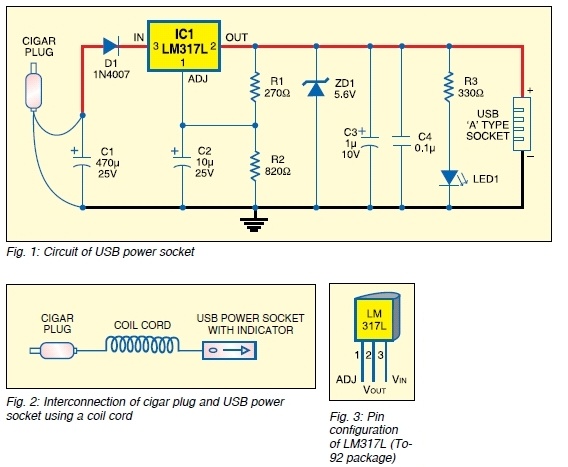
Safe 12V Car Adapter Circuit
The safe 12V car adapter described here can be used to limit the current from a +12 volt car battery, available from the in-dash cigar lighter power port, to below 2.6A.
The 12V car adapter is designed to ensure that the...
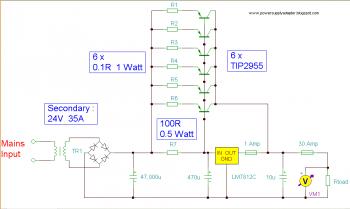
12v 30a regulated power supply
The input transformer is likely to be the most expensive component of the entire project. Alternatively, a pair of 12 Volt car batteries could be utilized. The input voltage to the regulator must be several volts higher than the output...
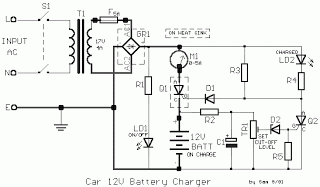
Car Battery Charger12V circuit and explanation
All car batteries require a 12V battery charger, which also applies to marine, RV, and power sports batteries. The high-efficiency lead-acid batteries available today necessitate more effective charging techniques. The battery charger is a crucial tool for prolonging battery life,...
Schematics power supply switching PCB
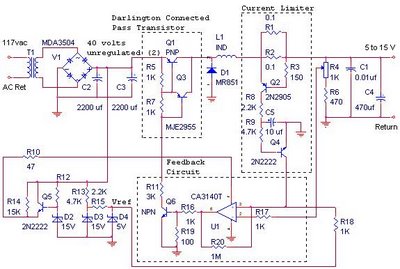
The switching power supply provides 12 volts at a maximum of 10 amps, utilizing a discrete transistor regulator with an operational amplifier acting as a comparator in the feedback circuit. The schematic does not depict the front panel power-on indicator....
12V Low Cost Car Battery Charger Circuit PCB
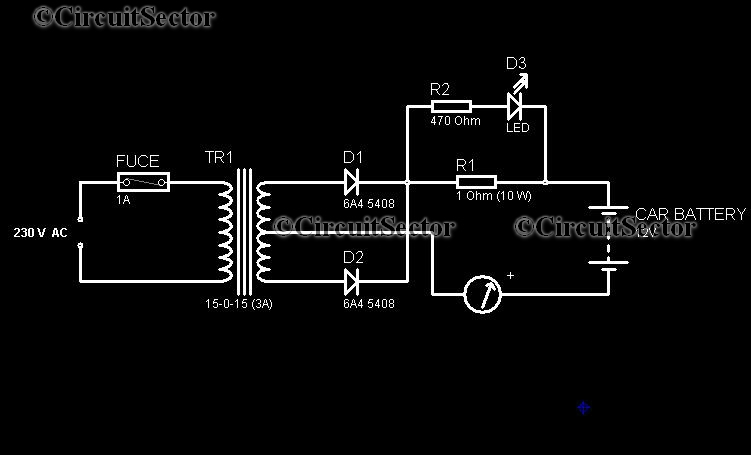
In today's world, owning a car battery charger at home has become essential. Having one readily available can help prevent starting issues caused by battery problems. While purchasing a commercial battery charger can be expensive, the components required for constructing...

symmetric 12v to 5v converter
Symmetric 12V to 5V converter power supply. Refer to the designated page for an explanation regarding the associated circuit diagram.
The symmetric 12V to 5V converter power supply is designed to efficiently step down a 12V input voltage to a regulated...
12V Auto-Powered Circuit For Cassette Recorders
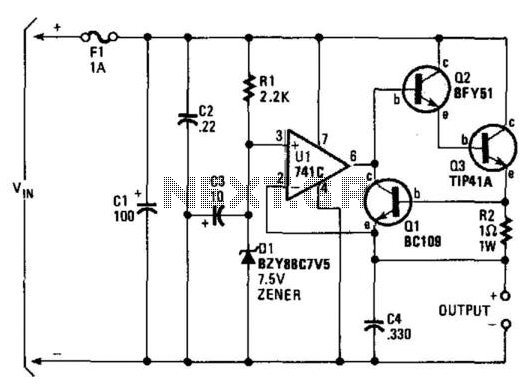
A regulator enables the powering of a 7.5-V cassette recorder or other devices from a 12-V DC automotive system. The circuit can provide approximately 600 mA of current. Q3 requires a heatsink due to its potential to dissipate up to...
220 V flashing light
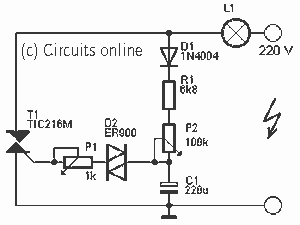
Here a simple design for a flashlight that operates on 220 V. The circuit is constructed with a triac. By R1 and C1 P1 is charged. Charging time is adjustable with P2. When C1 is charged, turn the diac D2....
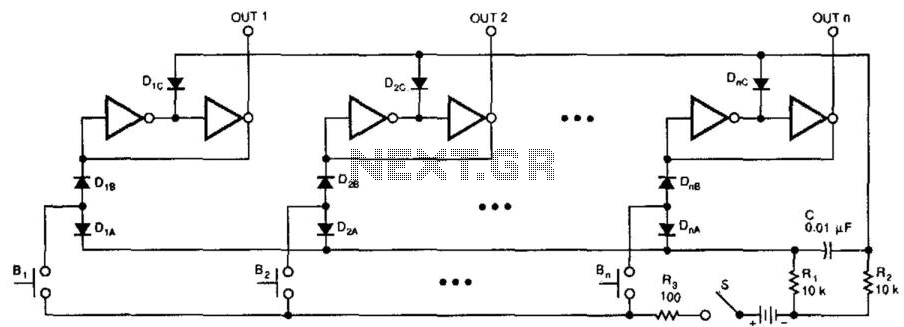
Switching Circuit
This switching circuit functions as a bank of interlocked mechanical switches. Activating one of the buttons latches its corresponding output while unlatching a previously selected output. A pair of inverters creates a latch for each output. For instance, pressing button...