


LM380 split power supply circuit diagram electronic project
#LM380
#split power supply
#audio power IC
#voltage regulation
#heatsink
#power dissipation
#electronic project
#circuit diagram
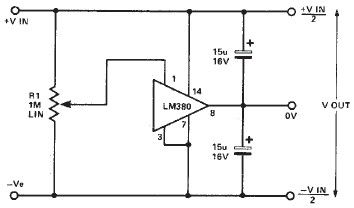
Description: A simple split power supply circuit can be designed using the schematic diagram based on the LM380 audio power integrated circuit (IC). The output voltage regulation is dependent on the circuit feeding the LM380. The power dissipation is approximately 1 watt, necessitating a small heatsink. If power dissipation exceeds the limit, the device will enter thermal shutdown protection. Current limiting activates if the output current surpasses 1.3 A. The R1 linear potentiometer, which should initially be set to the mid-level, is employed to nullify any output imbalance. This split power supply circuit should not be used with input voltages exceeding 20 volts. It is recommended to utilize this circuit following a regulated power supply circuit while adhering to the maximum rating specifications of this split voltage circuit.
The described split power supply circuit utilizes the LM380 audio power IC, which is designed for audio amplification applications but can be adapted for various low-power supply needs. The LM380 is known for its ability to provide a stable output voltage while managing power dissipation effectively. In this configuration, the circuit is arranged to deliver a split voltage output, which is beneficial for powering operational amplifiers and other analog devices requiring dual polarity supplies.
The output voltage regulation relies on the input voltage supplied to the LM380. It is crucial to ensure that the input voltage does not exceed 20 volts, as doing so may lead to circuit failure or damage to the IC. The power dissipation of around 1 watt indicates that thermal management is necessary. A small heatsink should be attached to the LM380 to maintain safe operating temperatures and prevent thermal shutdown, which is a protective feature of the IC that activates when the junction temperature exceeds safe limits.
The R1 linear potentiometer serves a critical role in balancing the output. By adjusting the potentiometer to the mid-level initially, it allows for fine-tuning of the output voltages, ensuring that both positive and negative outputs are equal and stable. This adjustment is vital for applications where output voltage precision is necessary.
Current limiting is another important feature of this circuit. The LM380 is designed to limit the output current to 1.3 A, protecting both the circuit and the connected load from excessive current that could lead to overheating or damage. This feature is particularly advantageous in applications where load conditions may vary, providing an additional layer of safety.
In summary, this split power supply circuit is a straightforward yet effective design for applications requiring dual voltage supplies. It is essential to follow the specified input voltage limits and utilize thermal management practices to ensure reliable operation.A very simple split power supply circuit project can be designed using this schematic diagram which is based on a LM380 audio power IC. The regulation of the output voltage depends of the upon circuit feeding the LM380. The power dissipation is around 1 watt so an small heatsink may be required. If the power dissipation is exceeded, the device will go into thermal shut-down protection. Current limiting occurs if the output current exceeds 1. 3 A. The R1 linear potentiometer is, should be initially set to mid level, is used nullify any imbalance in the output. This split power supply circuit should not be used for input voltages which exceed 20 volts. Use this circuit after a regulated power supply circuit, but try to keep the specifications for the maximum rating of this split voltage circuit.
The described split power supply circuit utilizes the LM380 audio power IC, which is designed for audio amplification applications but can be adapted for various low-power supply needs. The LM380 is known for its ability to provide a stable output voltage while managing power dissipation effectively. In this configuration, the circuit is arranged to deliver a split voltage output, which is beneficial for powering operational amplifiers and other analog devices requiring dual polarity supplies.
The output voltage regulation relies on the input voltage supplied to the LM380. It is crucial to ensure that the input voltage does not exceed 20 volts, as doing so may lead to circuit failure or damage to the IC. The power dissipation of around 1 watt indicates that thermal management is necessary. A small heatsink should be attached to the LM380 to maintain safe operating temperatures and prevent thermal shutdown, which is a protective feature of the IC that activates when the junction temperature exceeds safe limits.
The R1 linear potentiometer serves a critical role in balancing the output. By adjusting the potentiometer to the mid-level initially, it allows for fine-tuning of the output voltages, ensuring that both positive and negative outputs are equal and stable. This adjustment is vital for applications where output voltage precision is necessary.
Current limiting is another important feature of this circuit. The LM380 is designed to limit the output current to 1.3 A, protecting both the circuit and the connected load from excessive current that could lead to overheating or damage. This feature is particularly advantageous in applications where load conditions may vary, providing an additional layer of safety.
In summary, this split power supply circuit is a straightforward yet effective design for applications requiring dual voltage supplies. It is essential to follow the specified input voltage limits and utilize thermal management practices to ensure reliable operation.A very simple split power supply circuit project can be designed using this schematic diagram which is based on a LM380 audio power IC. The regulation of the output voltage depends of the upon circuit feeding the LM380. The power dissipation is around 1 watt so an small heatsink may be required. If the power dissipation is exceeded, the device will go into thermal shut-down protection. Current limiting occurs if the output current exceeds 1. 3 A. The R1 linear potentiometer is, should be initially set to mid level, is used nullify any imbalance in the output. This split power supply circuit should not be used for input voltages which exceed 20 volts. Use this circuit after a regulated power supply circuit, but try to keep the specifications for the maximum rating of this split voltage circuit.
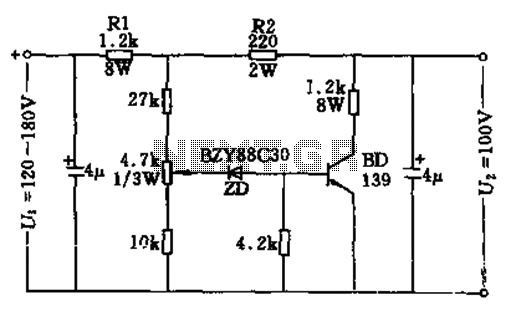
100v / 10ma regulator circuit
The circuit features no-load and short circuit protection mechanisms. To accommodate short circuit conditions, it is necessary to increase resistors R1 and R2 to allow for power dissipation; for example, R1 can be set to 1.2kΩ with a power rating...
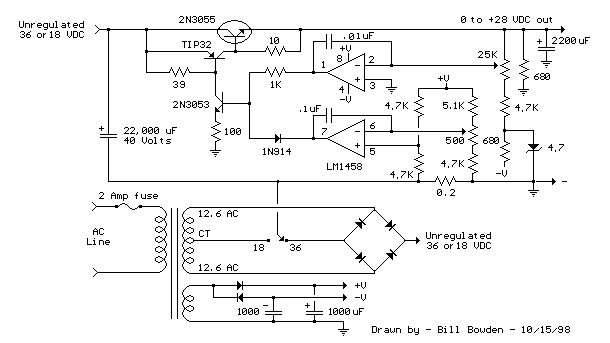
Current and Variable Voltage Power Supply
Another adjustment of application operational amplifiers to adapt a power supply is apparent below. The power supply requires an additional adjustment to supply the op-amps with a bipolar voltage (+/- 8 volts), and the negative voltage is also used to...
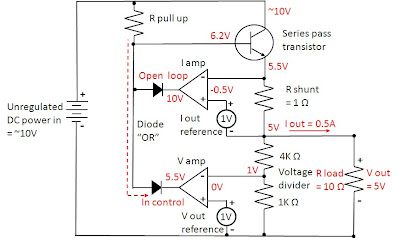
how does power supply regulate its
Most power supplies regulate either their output voltage or current at a constant level, depending on the load resistance relative to the power supply's output voltage and current settings. This can be summarized as follows: To accomplish this, most power...
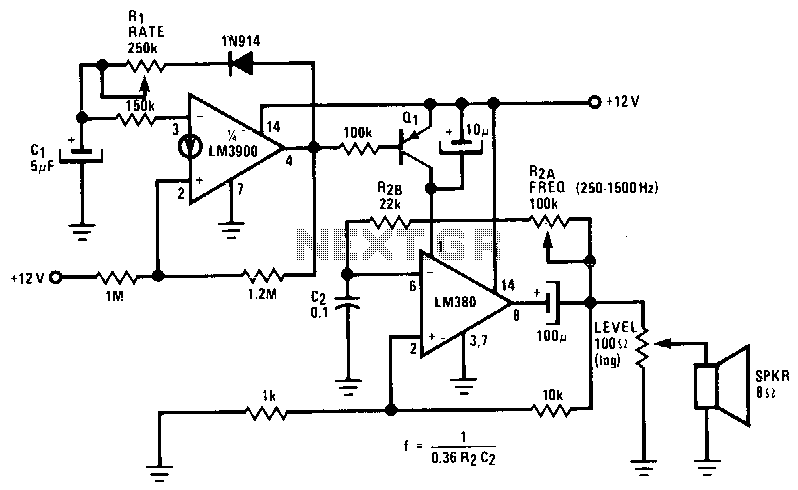
Programmable-frequency-adjustable-rate-siren
The LM380 functions as an astable oscillator, with the frequency set by R2 and C2. By adding Q1 and driving its base, the output of an LM3900 is configured as a second astable oscillator. This setup gates the output of...
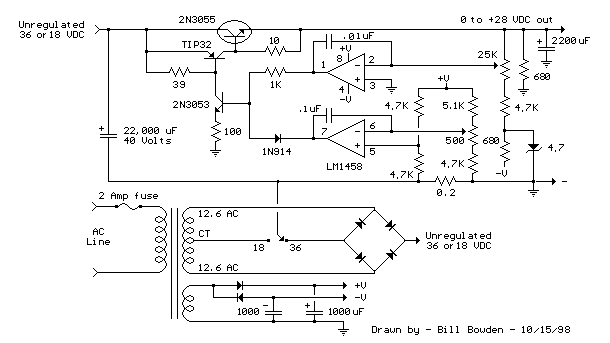
variable voltage and current power supply
An alternative method for utilizing operational amplifiers (op-amps) to regulate a power supply is illustrated below. The power transformer necessitates an additional winding to provide the op-amps with a bipolar voltage of +/- 8 volts. This negative voltage is also...
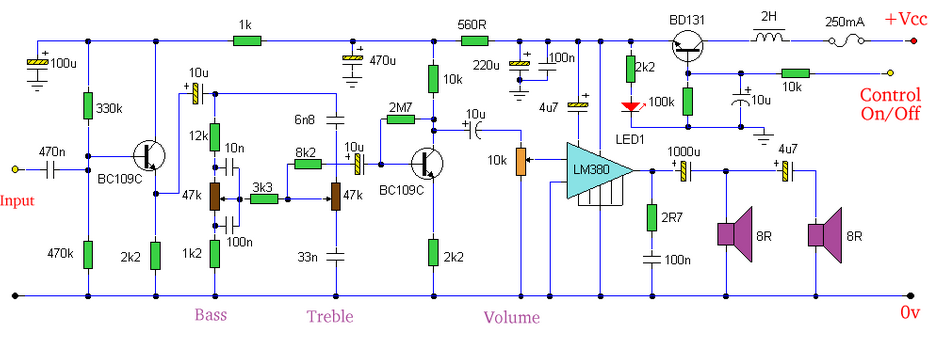
Amplifier with Tone Controls and Soft Switching
Built around an LM380, this amplifier includes tone controls and electronic soft switching. The soft switching circuitry ensures power is balanced.
The LM380 is a power audio amplifier capable of delivering up to 14 watts of output power. It is designed...
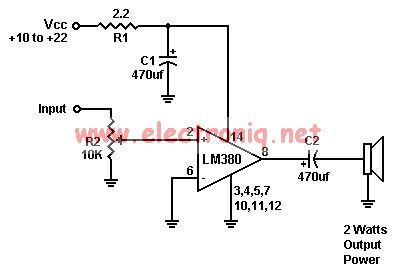
LM380 audio amplifier electronic project circuit design
A simple audio amplifier can be designed using the LM380 along with a few external components. This amplifier features a wide supply voltage range, an input impedance of 150 kΩ, low distortion, and a current capability of 1.3 A.
The LM380...
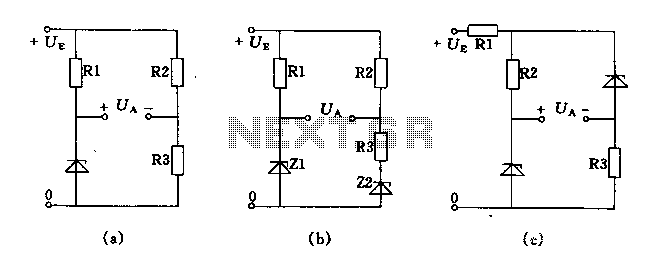
Bridge voltage regulator circuit diagram using the
The circuit depicted in Figures A, B, and C demonstrates a high voltage coefficient. When the regulator resistance \( r_z \) is held constant, the bridge configuration achieves an infinite voltage coefficient. In Figure A, the load circuit is connected...
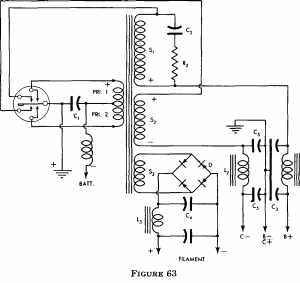
power supply design
The more one understands about any subject, the more interesting it becomes. As this article is read, it will be found that the subject of...
A comprehensive electronic schematic typically involves various components, each serving a specific function in the overall...