


Dual-Gate Mosfet Rf-Amp Stage
#dual-gate mosfet
#rf amplifier
#tuned circuit
#rf selectivity
#single-tuned output
#double-tuned input
#rf stage
#mosfet amplifier
#radio frequency
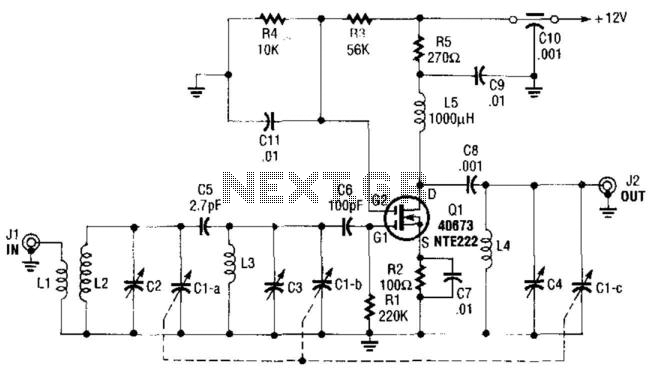
Description: The use of a double-tuned input and a single-tuned output yields superior RF selectivity compared to equivalent single-tuned designs. Automatic Gain Control (AGC), if required, can be added to gate 2 of Q1 and should drive gate 2 negative for decreased gain.
The circuit employs a double-tuned input stage, which enhances the selectivity of radio frequency (RF) signals by allowing the circuit to better discriminate between closely spaced frequencies. This configuration typically consists of two inductors and two capacitors, tuned to resonate at the desired frequency while providing a narrow bandwidth. The single-tuned output stage, in contrast, utilizes a single resonant circuit to extract the amplified signal, resulting in a simpler design but potentially reduced selectivity.
Incorporating Automatic Gain Control (AGC) into the circuit can improve performance by automatically adjusting the gain of the amplifier based on the strength of the incoming signal. In this design, the AGC is connected to gate 2 of transistor Q1, which is part of the amplification stage. The AGC circuit modulates the voltage applied to gate 2, driving it negative when higher gain is not needed. This negative bias effectively reduces the amplification, preventing distortion and ensuring that the output signal remains within optimal levels, even when faced with strong incoming signals.
The overall design benefits from the combination of double-tuned input and AGC, providing a robust solution for RF applications requiring high selectivity and stable gain control. This configuration is particularly useful in communication systems where signal integrity is paramount, allowing for improved reception and clarity in the presence of competing signals. The use of a double-tuned input and a single-tuned output yield superior RF selectivity to that of equivalent single-tuned designs. AGC, if required, can be added to gate 2 of Ql, and should drive gate 2 negative for decreased gain.
The circuit employs a double-tuned input stage, which enhances the selectivity of radio frequency (RF) signals by allowing the circuit to better discriminate between closely spaced frequencies. This configuration typically consists of two inductors and two capacitors, tuned to resonate at the desired frequency while providing a narrow bandwidth. The single-tuned output stage, in contrast, utilizes a single resonant circuit to extract the amplified signal, resulting in a simpler design but potentially reduced selectivity.
Incorporating Automatic Gain Control (AGC) into the circuit can improve performance by automatically adjusting the gain of the amplifier based on the strength of the incoming signal. In this design, the AGC is connected to gate 2 of transistor Q1, which is part of the amplification stage. The AGC circuit modulates the voltage applied to gate 2, driving it negative when higher gain is not needed. This negative bias effectively reduces the amplification, preventing distortion and ensuring that the output signal remains within optimal levels, even when faced with strong incoming signals.
The overall design benefits from the combination of double-tuned input and AGC, providing a robust solution for RF applications requiring high selectivity and stable gain control. This configuration is particularly useful in communication systems where signal integrity is paramount, allowing for improved reception and clarity in the presence of competing signals. The use of a double-tuned input and a single-tuned output yield superior RF selectivity to that of equivalent single-tuned designs. AGC, if required, can be added to gate 2 of Ql, and should drive gate 2 negative for decreased gain.
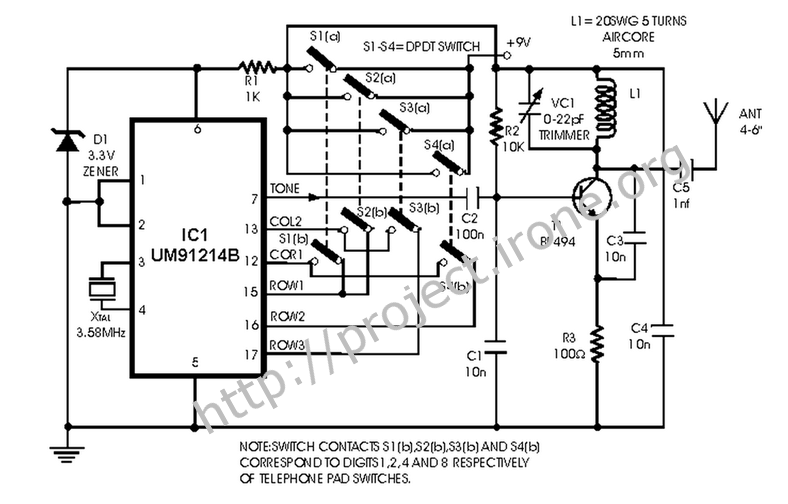
Radio frequency Of Remote Control
This is a remote control circuit that uses radio frequency electrical signals to control a variety of applications. Component: Transistor.
The remote control circuit operates by transmitting radio frequency (RF) signals to communicate with various devices. At its core, the circuit...
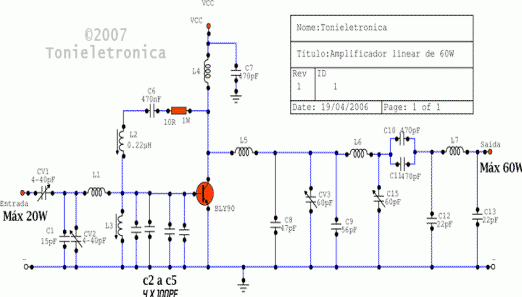
Circuit for power linear RF amplifier with BLY90
This circuit functions as an RF power amplifier designed to operate with a power supply capable of delivering 13 volts at a current of 10 amperes. Careful assembly of the power source is essential. It utilizes a shielded transformer and...
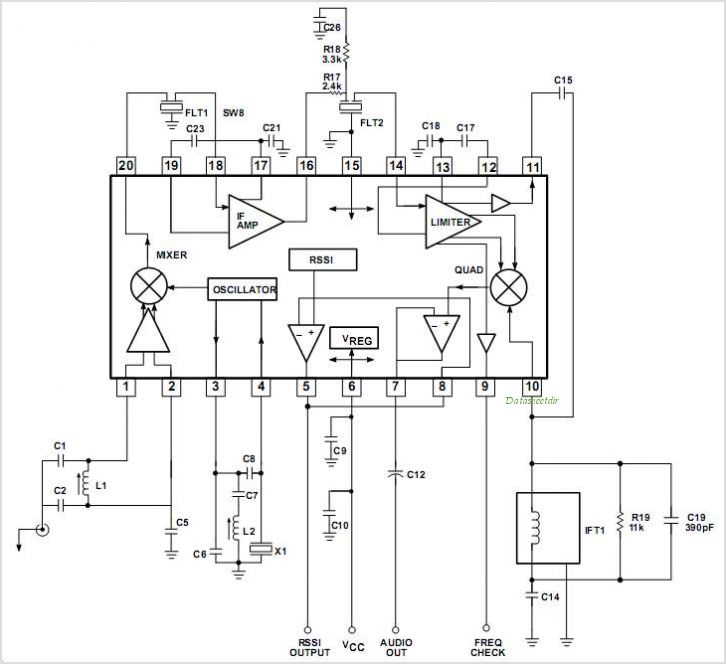
SA608 SA608 Low Voltage High Performance Mixer FM IF System
The SA9614 is an RF amplifier utilized for signal conversion and automatic laser power control (ALPC) between the CD optical pickup head and the decoding chip. The SA9614 incorporates an interface for the CD optical diode RF signal amplifier and...
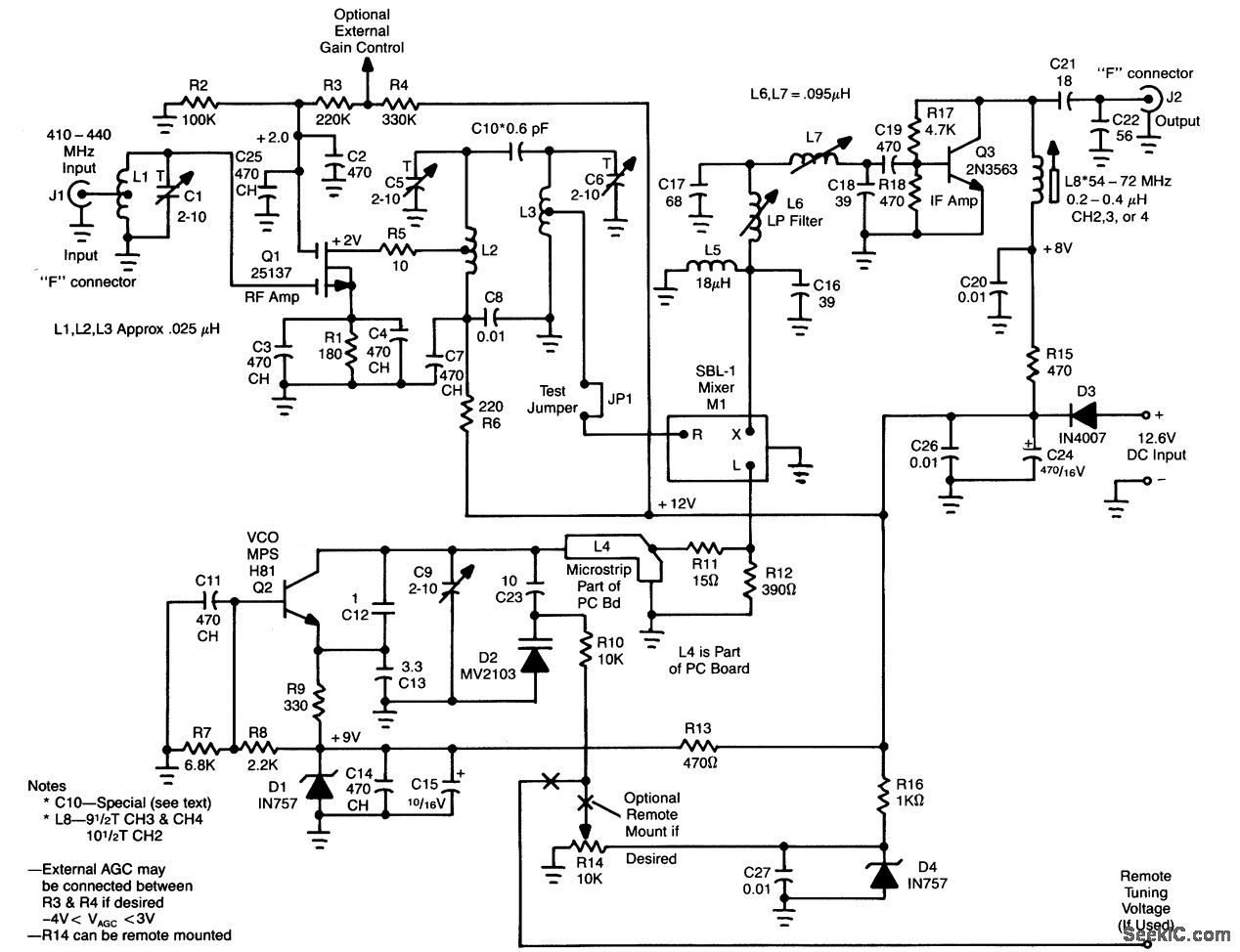
LOW NOISE 420 MHz ATV RECEIVER CONVERTER
L1, Q1, L2, and L3 form an RF amplifier stage that drives M1, a doubly balanced mixer. Q4 serves as a local oscillator stage operating in the 375-MHz range. Signals in the 420 to 450-MHz range from Q1 are mixed...
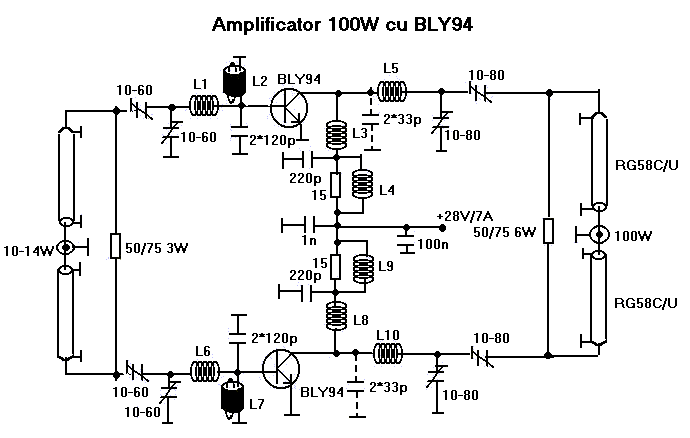
BLY94 100W RF Power Amplifier
A 100W RF power amplifier circuit is constructed using two BLY94 transistors. For additional RF amplifier options, refer to the list below. Components include active components.
The 100W RF power amplifier circuit utilizing BLY94 transistors is designed to amplify radio frequency...
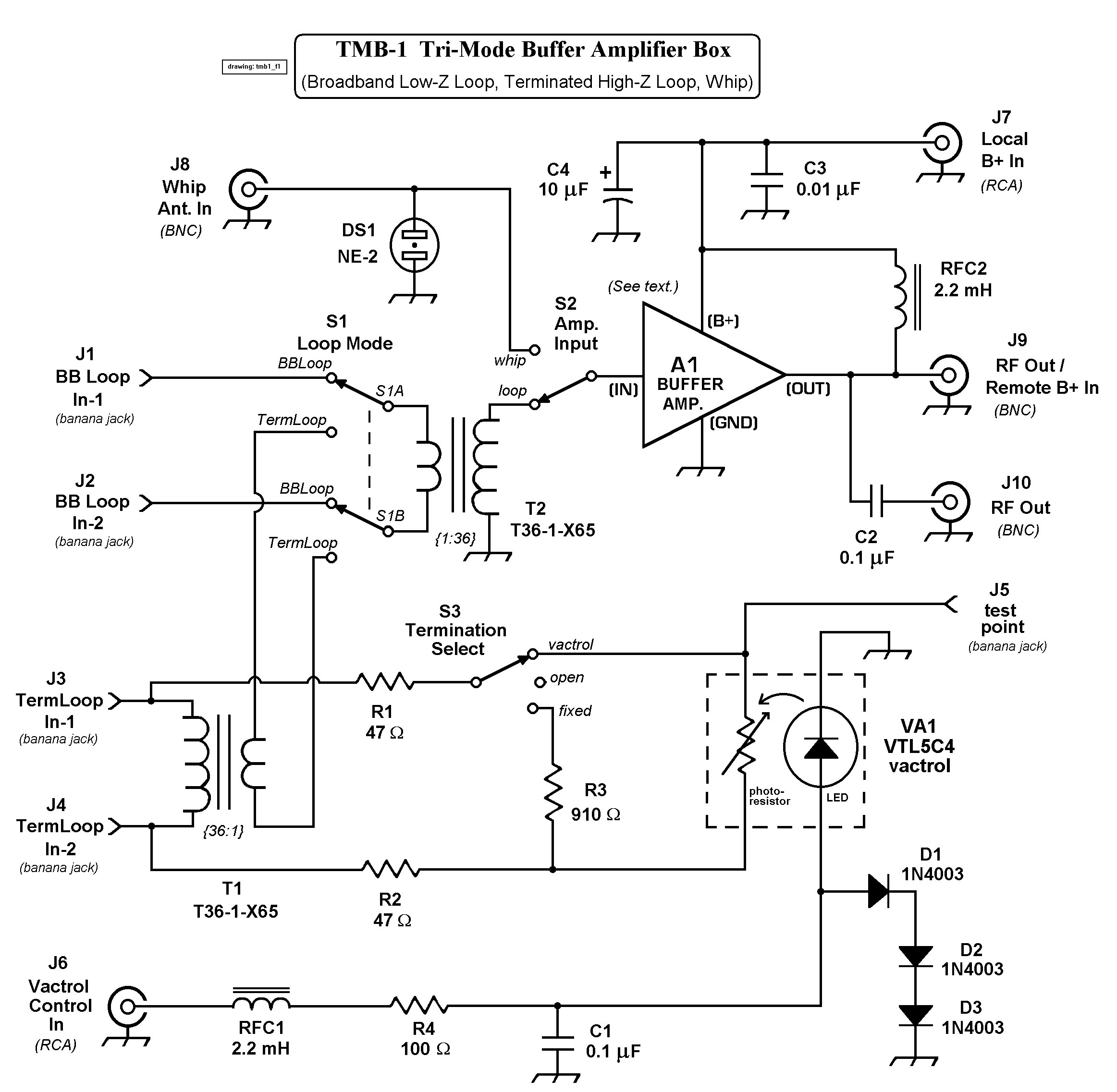
TMB-1 Tri-Mode Buffer Amplifier Box
The TMB-1 is an RF amplifier unit and receiving accessory compatible with low-impedance broadband loops, high-impedance terminated loops (such as Pennant, Flag, or Kaz Delta), and whip (telescoping rod) antennas. This design is optimized for operation within the frequency range...
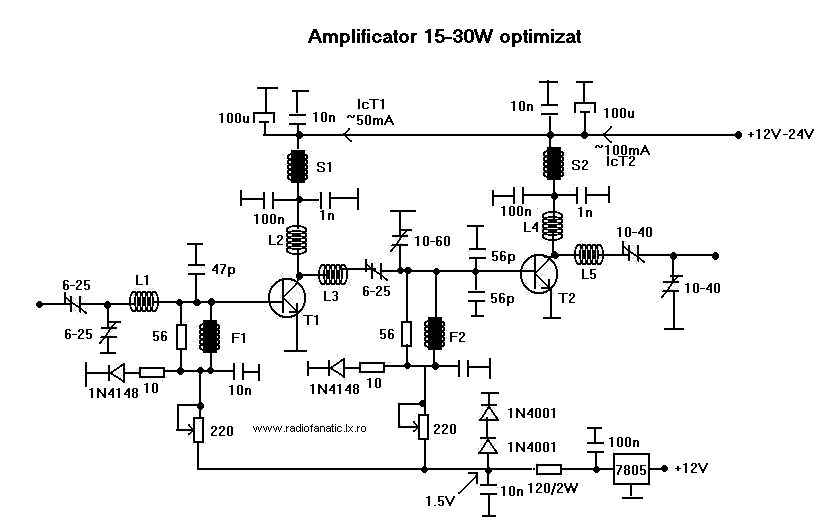
15W - 30W RF Power Amplifier KT922 KT930 KT934
This RF amplifier ensures the power required to boost a small transmitter. Depending on the input RF power, power supply, and transistor, this amplifier can boost the signal.
The RF amplifier is a critical component in various communication systems, designed to...
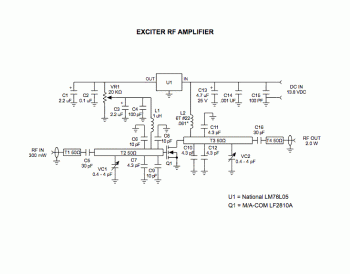
MOSFET LF2810 IC For 2W RF Amplifier Circuit diagram
This circuit illustrates a 2W RF amplifier based on the M/A-Com LF2810A MOSFET. The transistor is rated for 10 watts at 28 volts.
The 2W RF amplifier circuit utilizing the M/A-Com LF2810A MOSFET is designed to amplify radio frequency signals efficiently....
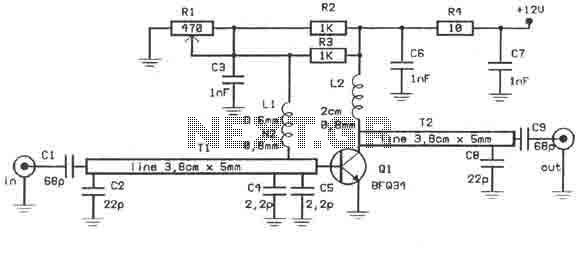
TV signal amplifier 470Mhz-860Mhz
This amplifier is designed to amplify RF signals from an antenna by 10 dB and operates as a Class A amplifier using the BFQ34 transistor from Philips. The BFQ34 is packaged in an SOT122A case. The BFQ34T variant is available...