


Ultra wideband RF detector design challenge
#RF detector
#wideband
#LC tank
#resonant circuit
#frequency detection
#RF measurement
#signal detection
#radio frequency
#electromagnetic
#spectrum analysis
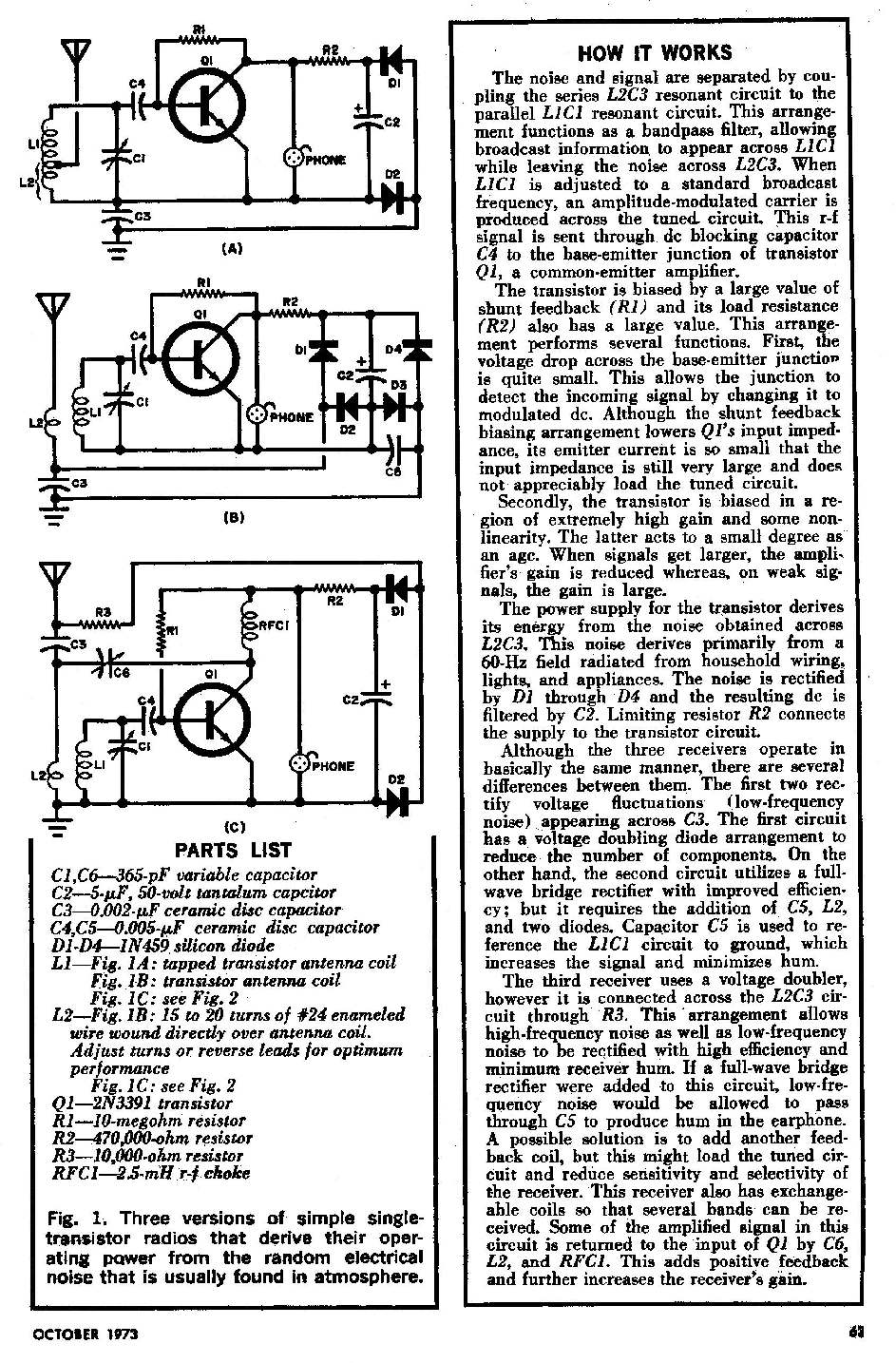
Description: A wideband RF detector is being designed, utilizing a series of resonant LC tanks spaced between 5 to 10 MHz apart, with an exception of 1 MHz spacing from 9 MHz onwards.
The design of a wideband RF detector incorporating multiple resonant LC tanks offers the capability to capture a broad spectrum of radio frequencies. The LC tank circuits serve as selective filters that resonate at specific frequencies, allowing the detector to identify and process signals within the designated frequency ranges.
The proposed configuration suggests employing a series of LC tank circuits, each tuned to different frequencies spaced 5 to 10 MHz apart. This spacing is crucial for ensuring that the detector can effectively cover a wide frequency range while maintaining sensitivity to the desired signals. The exception of 1 MHz spacing from 9 MHz indicates a focus on finer resolution in that specific frequency band, which may be relevant for applications requiring precise detection in that range.
Each LC tank circuit consists of an inductor (L) and a capacitor (C) arranged to form a resonant circuit. The resonant frequency (f) of each tank is determined by the formula:
f = 1 / (2π√(LC))
Where L is the inductance in henries and C is the capacitance in farads. By selecting appropriate values for L and C, the desired resonant frequencies can be achieved.
The output from each LC tank can be fed into a common detection stage, which may include a diode for envelope detection or a more complex demodulation circuit, depending on the intended application. The output signals can then be processed further for amplitude measurement or converted to a digital format for display or analysis.
In summary, the design of a wideband RF detector using resonant LC tanks provides a versatile solution for RF signal detection across a broad frequency range, with specific tuning to enhance performance in critical areas of interest. Proper component selection and circuit design will ensure optimal functionality and sensitivity of the detector.I`d like to make a wideband RF detector. I`m thinking of using a range of resonant LC tanks, 5 to 10 mhz apart, (except / or 1 mhz apart from 9 to..
The design of a wideband RF detector incorporating multiple resonant LC tanks offers the capability to capture a broad spectrum of radio frequencies. The LC tank circuits serve as selective filters that resonate at specific frequencies, allowing the detector to identify and process signals within the designated frequency ranges.
The proposed configuration suggests employing a series of LC tank circuits, each tuned to different frequencies spaced 5 to 10 MHz apart. This spacing is crucial for ensuring that the detector can effectively cover a wide frequency range while maintaining sensitivity to the desired signals. The exception of 1 MHz spacing from 9 MHz indicates a focus on finer resolution in that specific frequency band, which may be relevant for applications requiring precise detection in that range.
Each LC tank circuit consists of an inductor (L) and a capacitor (C) arranged to form a resonant circuit. The resonant frequency (f) of each tank is determined by the formula:
f = 1 / (2π√(LC))
Where L is the inductance in henries and C is the capacitance in farads. By selecting appropriate values for L and C, the desired resonant frequencies can be achieved.
The output from each LC tank can be fed into a common detection stage, which may include a diode for envelope detection or a more complex demodulation circuit, depending on the intended application. The output signals can then be processed further for amplitude measurement or converted to a digital format for display or analysis.
In summary, the design of a wideband RF detector using resonant LC tanks provides a versatile solution for RF signal detection across a broad frequency range, with specific tuning to enhance performance in critical areas of interest. Proper component selection and circuit design will ensure optimal functionality and sensitivity of the detector.I`d like to make a wideband RF detector. I`m thinking of using a range of resonant LC tanks, 5 to 10 mhz apart, (except / or 1 mhz apart from 9 to..
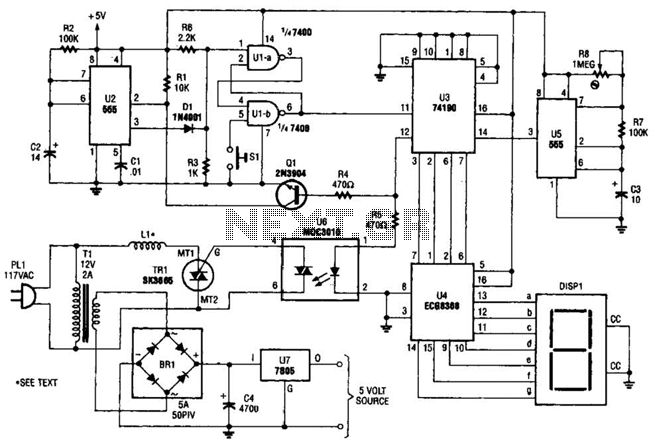
Electromagnetic Ring Launcher Circuit
The electromagnetic ring launcher consists of four subcircuits: a clock circuit utilizing U5, a 555 oscillator/timer configured for astable operation; a countdown/display circuit incorporating U3, a 74190 synchronous up/down counter with BCD outputs set for countdown operation; U4, an ECG8368...
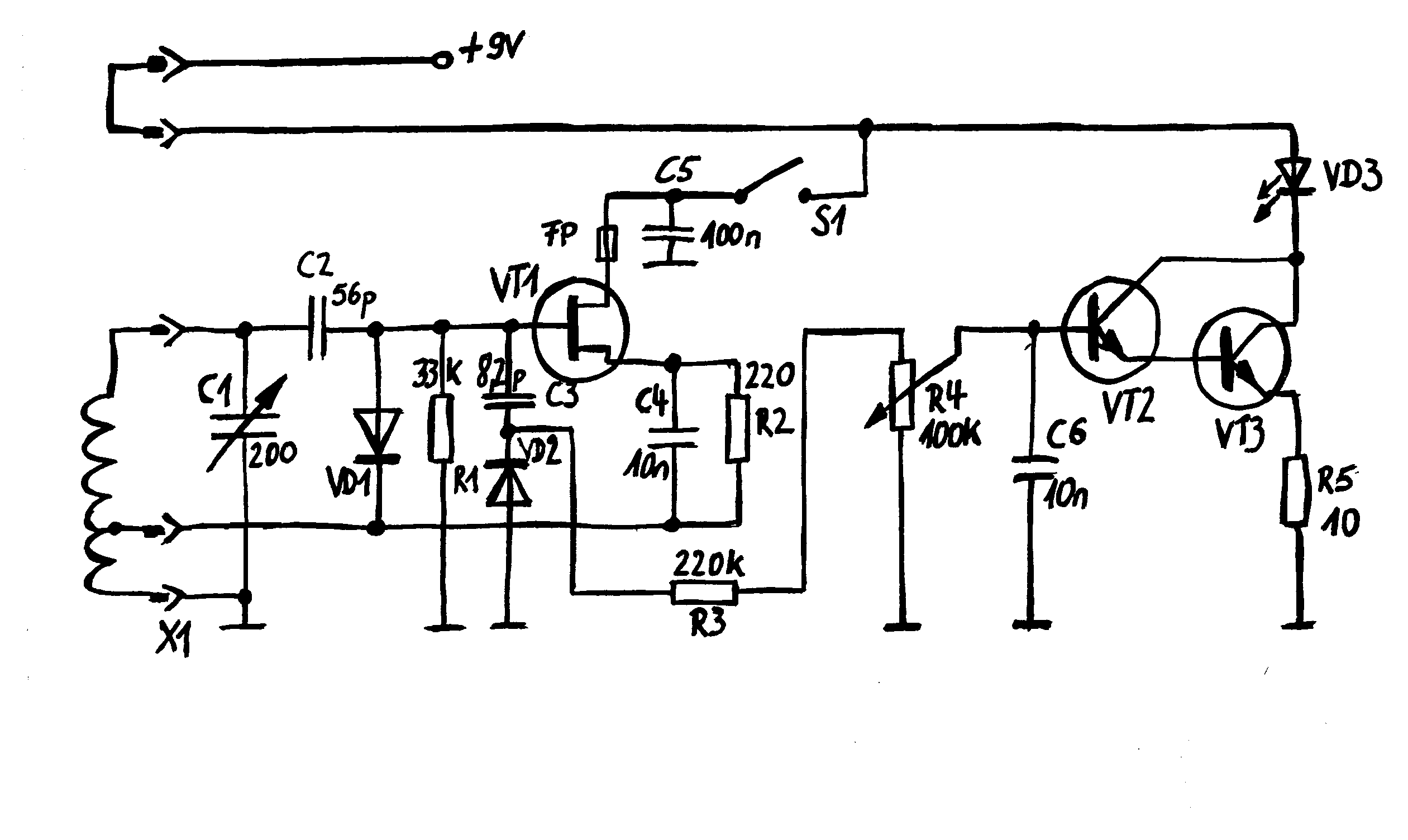
Fishermans Dipper
The measuring resonant circuit, while actively operating, is loosely coupled to the resonant circuit of the dipper, meaning it is brought close to it. The dipper is tuned from the lowest to the highest frequency. When the dipper and the...
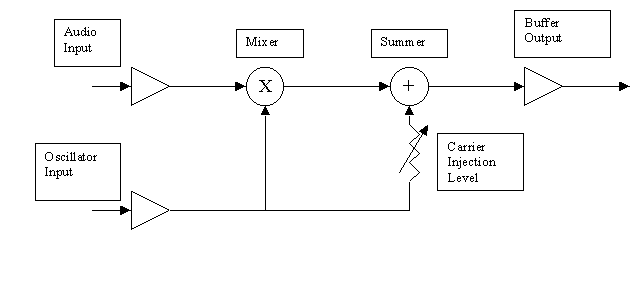
dsb exciter
A wideband circuit design of a Double Sideband Exciter. The circuit can generate a low-level signal with suppressed carrier or with any desired percentage of carrier injection. It is simple and can easily provide an output of 1 V peak-to-peak...
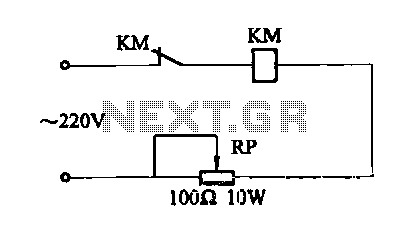
One circuit electromagnetic vibration table
An electromagnetic vibration table or feeder is designed to move small objects along a specific track or cylindrical path through forced vibrations. This device can be custom-built to facilitate the movement of items along a rail tube. The vibration source...
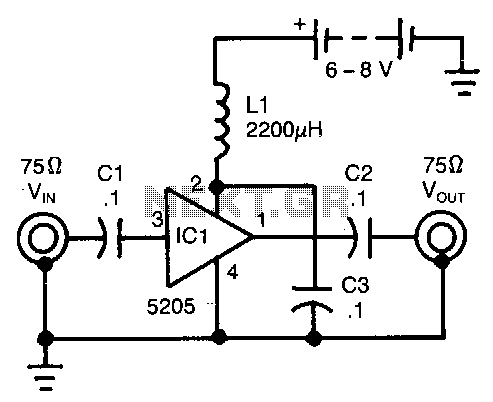
Miniature-wideband-amplifier
This wideband amplifier utilizes only five components. External signals are introduced to pin 3 of IC1 through an AC coupling capacitor, C1. After amplification, the enhanced signals from pin 1 of IC1 are transmitted to the output via capacitor C2....
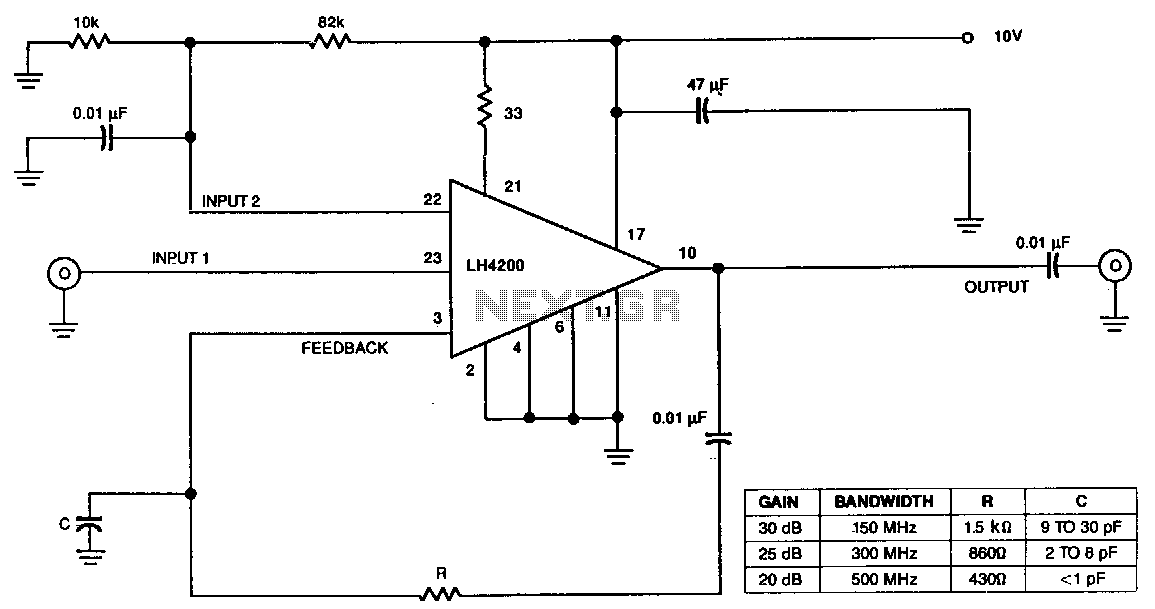
Wideband-500khz-1ghz-hybrid-amplifier
The amplifier's input stage features a dual-gate GaAs FET, which offers low input capacitance and high transconductance. The first input accepts the signal, while the second input regulates the amplifier's gain. Additionally, there is a third input for series feedback....
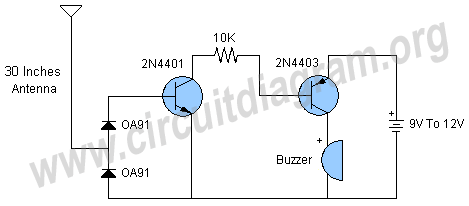
rf detector
Similar to a field strength meter, an RF detector circuit serves as a valuable project for detecting nearby RF signals. The circuit presented here is capable of detecting a wide range of RF frequencies and provides an alarm when an...
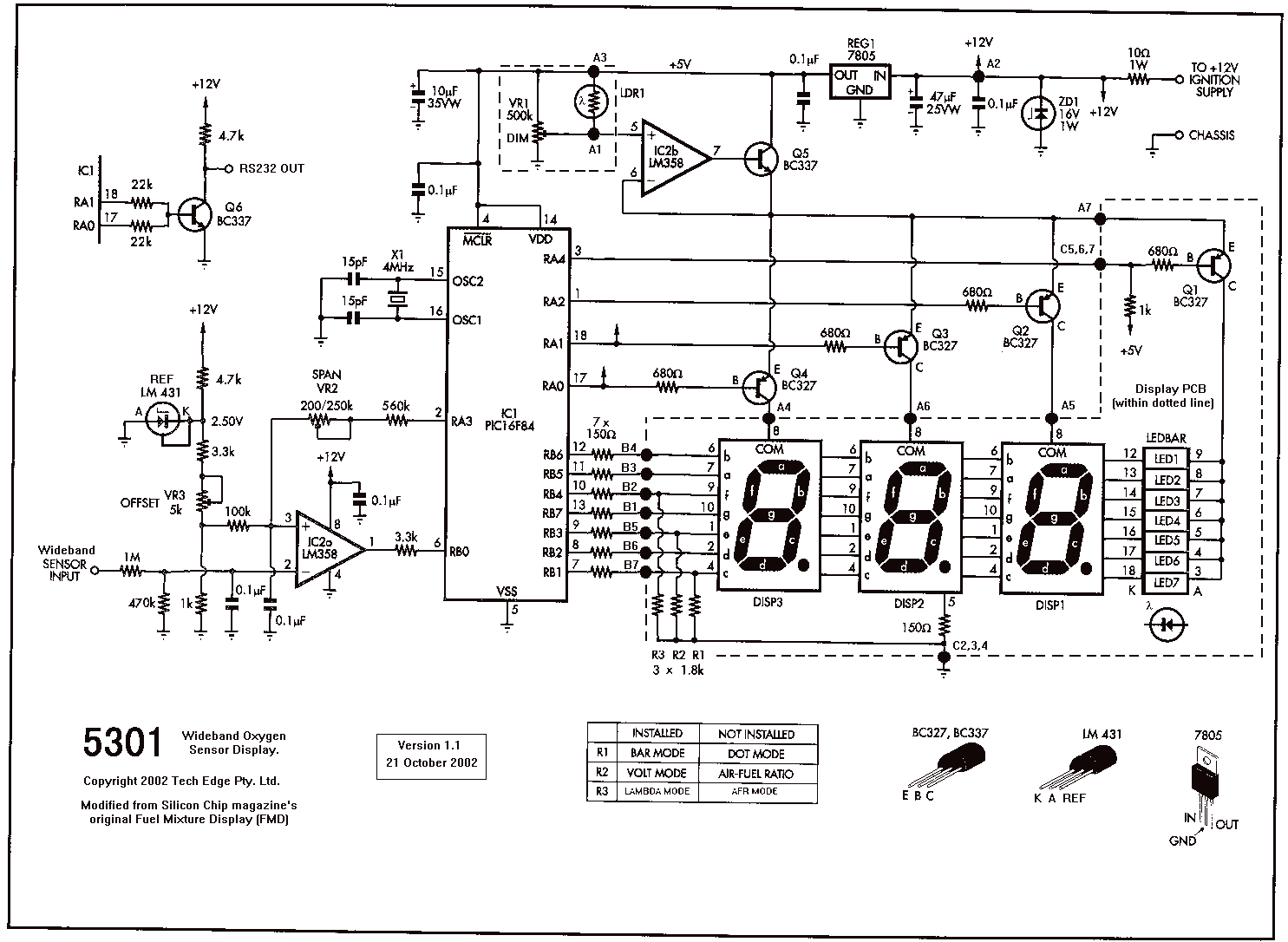
Wideband Display
This is the construction guide for the 5301 wideband fuel mixture display kit. The 5301 is the Tech Edge version (rather than the Jaycar version) of the modified Silicon Chip FMD design, and it features, compared to the original kit,...
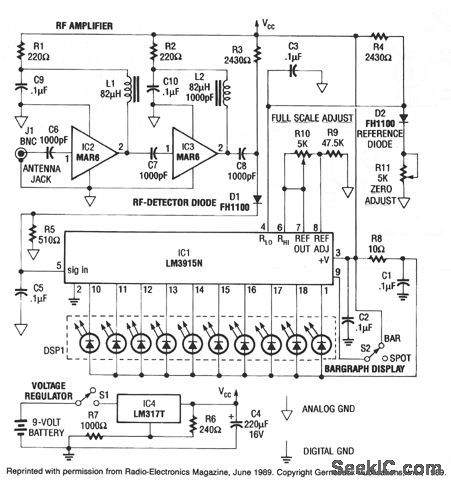
BUG DETECTOR
This RF detector can locate low-power transmitters (bugs) that are hidden from sight. It can sense the presence of a 1-mW transmitter at a distance of 20 feet, which is sensitive enough to detect the smallest bug. As the RF...