


Obstacle Avoidance & Navigation for Industrial Robots
#obstacle avoidance
#navigation
#industrial robot
#path tracing
#automation
#sensors
#motor control
#arduino
#microcontroller
Description: A project focused on obstacle avoidance and path tracing navigation for industrial robots. A robot is a self-guided machine capable of performing tasks autonomously. Additionally, robots often exhibit characteristics through their design or movements that give the impression of having intent or agency.
The project on obstacle avoidance and navigation for path tracing manipulators in industrial robots involves the integration of various sensors, control algorithms, and actuators to enable the robot to navigate complex environments while avoiding obstacles. The primary components of such a system typically include ultrasonic or infrared sensors for distance measurement, which help the robot detect obstacles in its path.
The control unit processes the sensory data using algorithms that implement techniques such as reactive navigation or global path planning. These algorithms can be based on methods like A* or Dijkstra's algorithm, allowing the robot to determine the most efficient route while dynamically adjusting to unforeseen obstacles.
The actuators, often in the form of motors, are responsible for the movement of the robot. They receive commands from the control unit to change direction or speed based on the navigation algorithms' outputs. The entire system may also incorporate a feedback loop, where the robot continuously monitors its environment and adjusts its path in real-time.
Power management is another critical aspect of this project, as the robot must maintain sufficient energy to perform its tasks throughout its operational period. This can involve the use of rechargeable batteries or energy harvesting techniques to ensure longevity and efficiency.
In summary, the project encompasses the design and implementation of a sophisticated robotic system capable of autonomous navigation and obstacle avoidance, emphasizing the integration of sensor technology, control algorithms, and actuation mechanisms to achieve efficient and intelligent movement in industrial settings.A project on Obstacle Avoidance & Navigation of Path Tracing Manipulator for Industrial Robots. A robot is an automatically guided machine, able to do task on its own. Another common characteristic is that by its appearance or movements, a robot often conveys a sense that it has intent or agency of its own
The project on obstacle avoidance and navigation for path tracing manipulators in industrial robots involves the integration of various sensors, control algorithms, and actuators to enable the robot to navigate complex environments while avoiding obstacles. The primary components of such a system typically include ultrasonic or infrared sensors for distance measurement, which help the robot detect obstacles in its path.
The control unit processes the sensory data using algorithms that implement techniques such as reactive navigation or global path planning. These algorithms can be based on methods like A* or Dijkstra's algorithm, allowing the robot to determine the most efficient route while dynamically adjusting to unforeseen obstacles.
The actuators, often in the form of motors, are responsible for the movement of the robot. They receive commands from the control unit to change direction or speed based on the navigation algorithms' outputs. The entire system may also incorporate a feedback loop, where the robot continuously monitors its environment and adjusts its path in real-time.
Power management is another critical aspect of this project, as the robot must maintain sufficient energy to perform its tasks throughout its operational period. This can involve the use of rechargeable batteries or energy harvesting techniques to ensure longevity and efficiency.
In summary, the project encompasses the design and implementation of a sophisticated robotic system capable of autonomous navigation and obstacle avoidance, emphasizing the integration of sensor technology, control algorithms, and actuation mechanisms to achieve efficient and intelligent movement in industrial settings.A project on Obstacle Avoidance & Navigation of Path Tracing Manipulator for Industrial Robots. A robot is an automatically guided machine, able to do task on its own. Another common characteristic is that by its appearance or movements, a robot often conveys a sense that it has intent or agency of its own
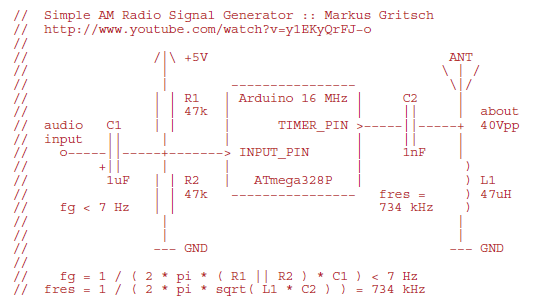
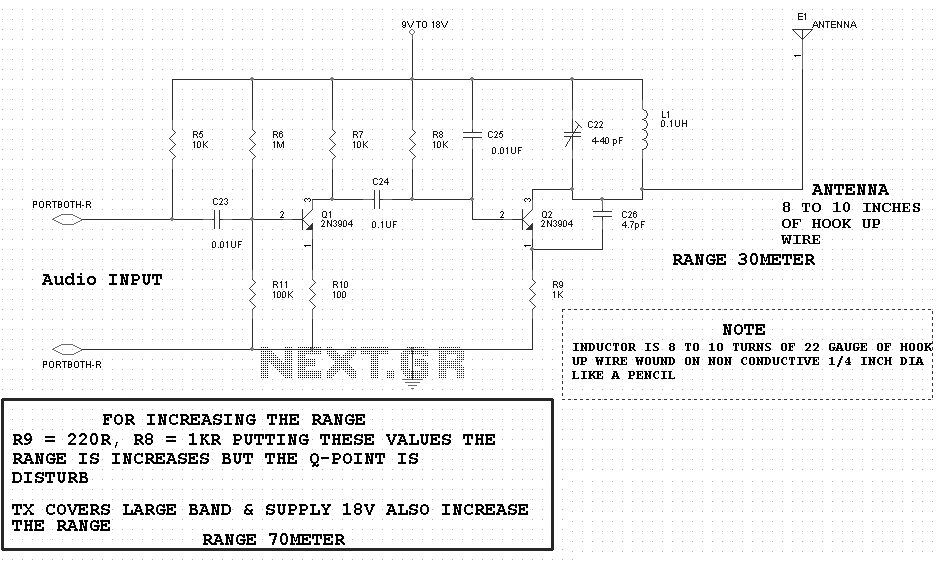
AM sofware radio using Arduino
Markus constructed a software AM radio transmitter utilizing an Arduino. The audio signal is supplied to the ADC input via a decoupling capacitor. A PWM output pin directly controls a capacitor-inductor circuit connected to an antenna. The schematic and firmware...
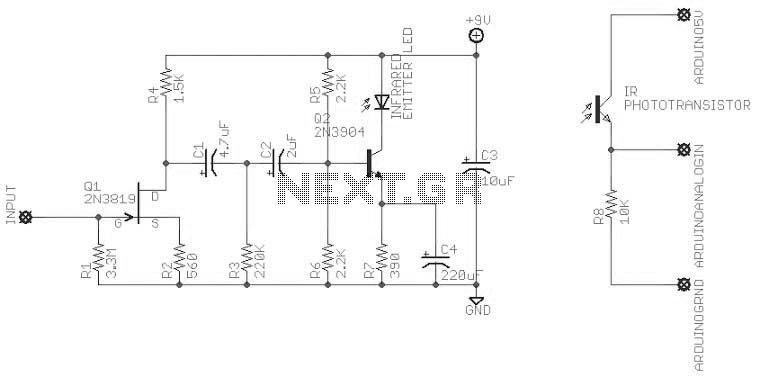
Arduino Guitar Delay Pedal
An attempt at an Arduino guitar pedal. The guitar signal feeds through a PT2399 delay circuit, modified to include a JFET preamp phase. The delay circuit has Echo and Delay knobs. From there, it feeds into an optoisolated-Arduino-5V preamp, and...
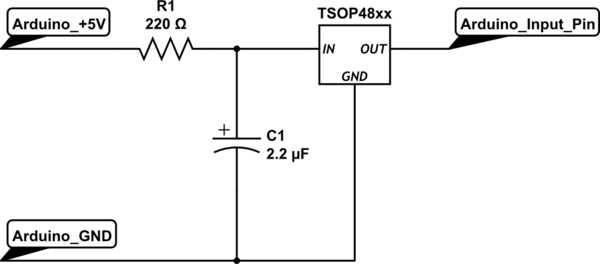
How should I wire up the circuit to connect a TSOP4838 (Radio Shack 276-64) infrared receiver to an Arduino
To set up the circuit, a resistor is required; a value of 200 Ohms is suggested, with a supply voltage of 3.3V. The resistor should be connected to the power line and grounded. The data line must be connected to...
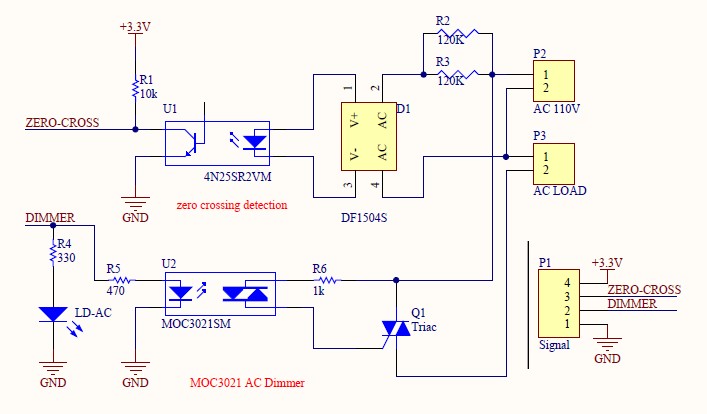
microcontroller Arduino 230v Light bulb dimming
Have you verified whether you can see the zero crossings on your input pin? It may be beneficial to write a sketch that toggles the LED on pin 13 every 50 or 60 zero crossings. This should result in a...
Bug Eyed Eggliner
The Bug-Eyed Eggliner project involves creating a whimsical animated figure with large, illuminated, and movable eyes. The project utilizes a combination of wooden balls for the eyes, a PICAXE microcontroller for control, and a servo mechanism to achieve eye movement....
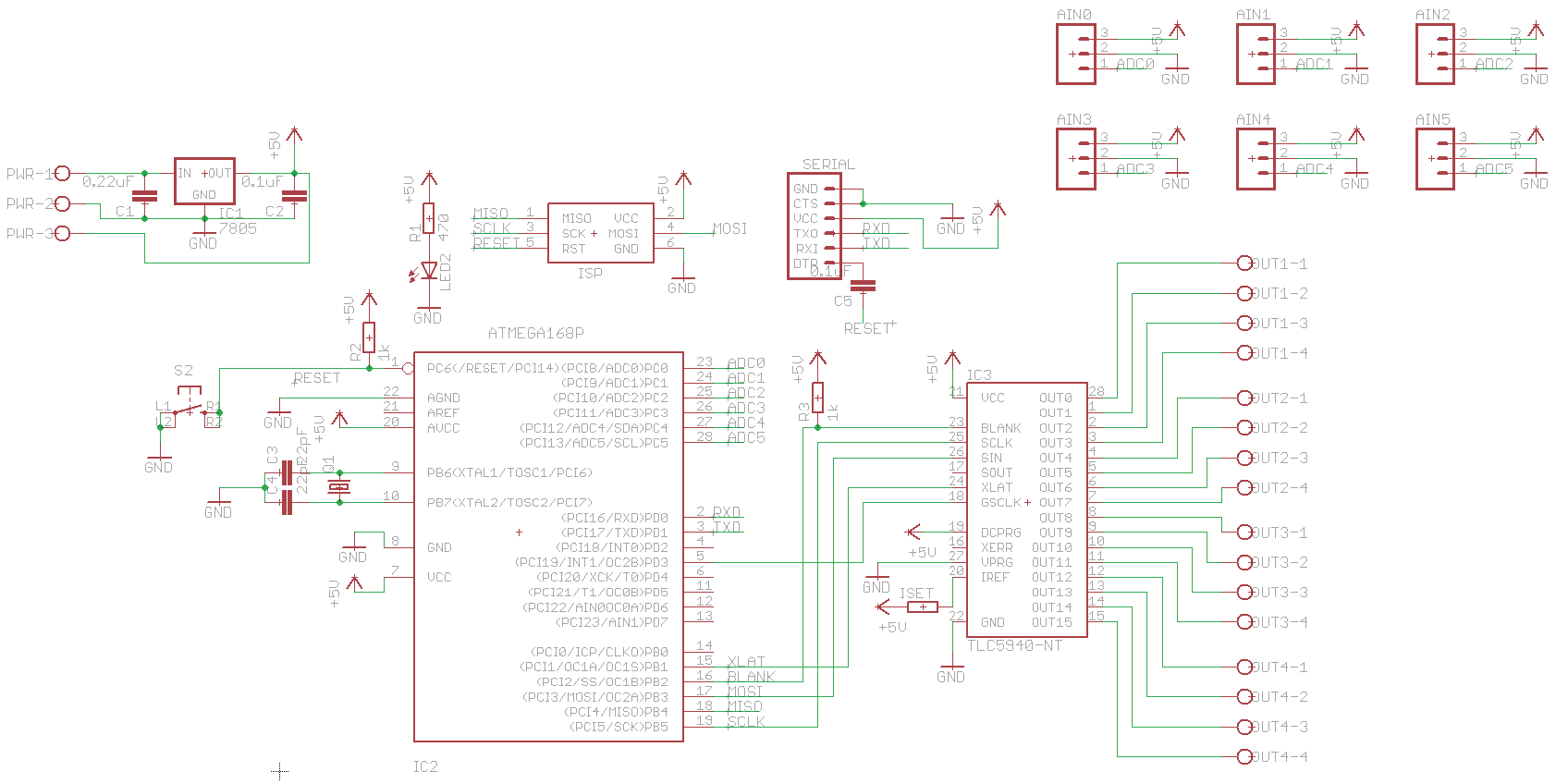
Arduino LED Dimmer
The initial step involves selecting software, and CadSoft Eagle was chosen due to the abundance of available tutorials, making it a suitable starting point. Once the process is understood, the choice of software can be reconsidered. For now, the free...
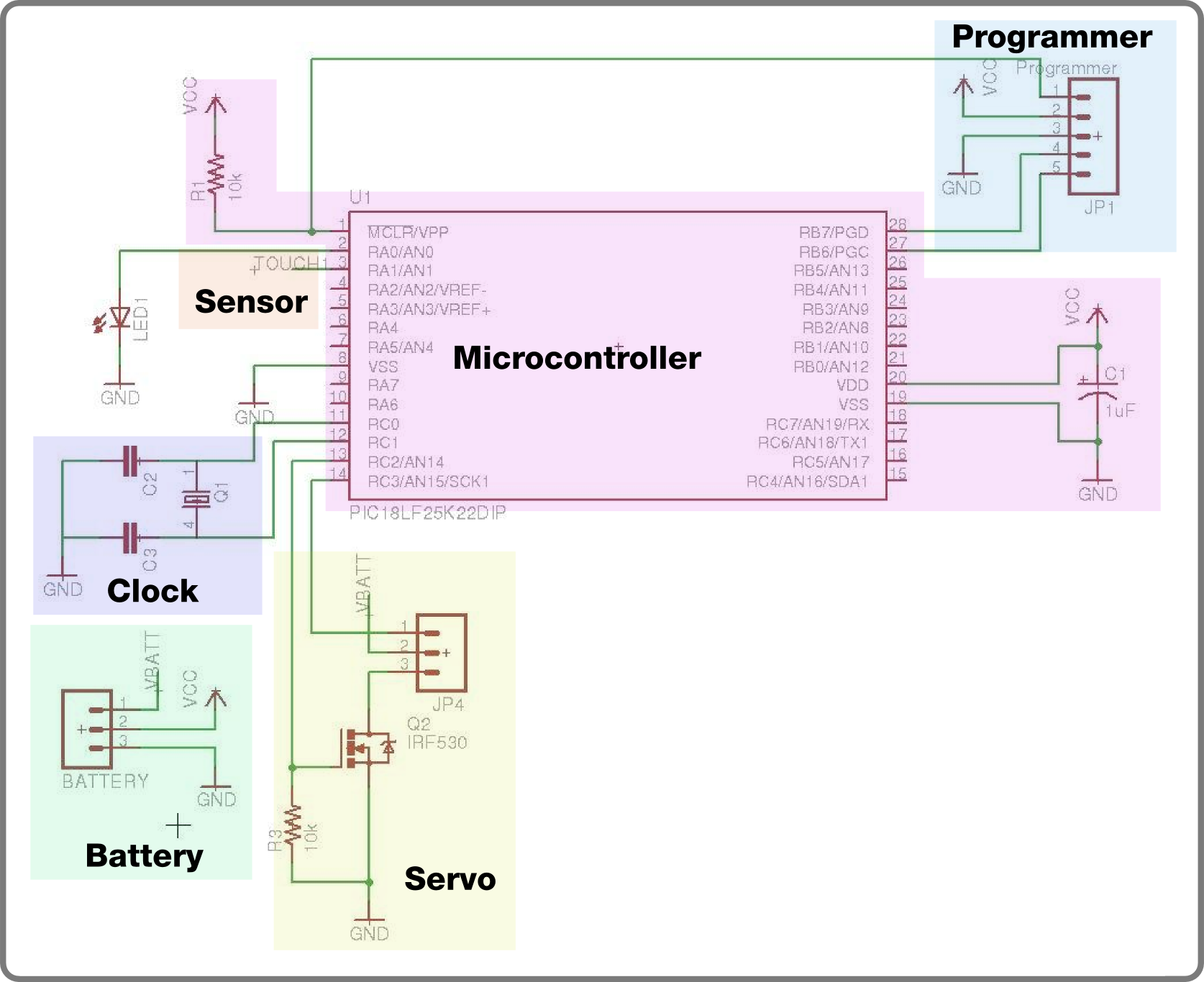
series robot circuit
For the second build in the Make It Last Build Series, a robotic plant is being constructed. This week focuses on assembling the control circuit, which will be used in future weeks to animate the plant. The basic circuit will...
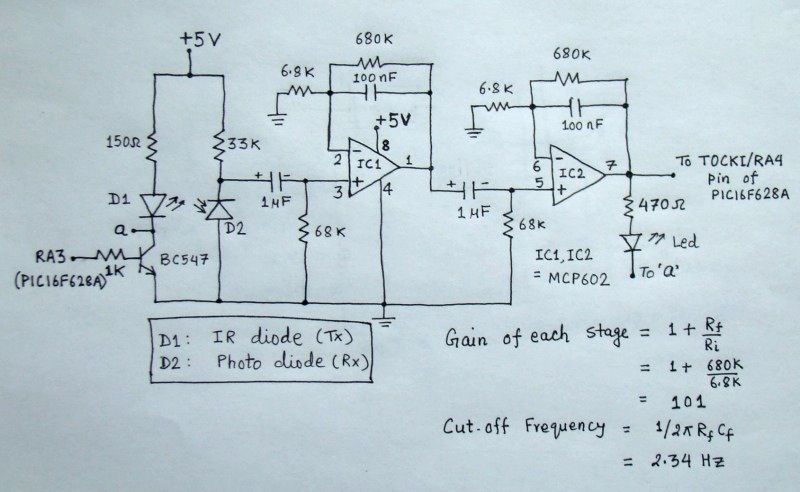
Microcontroller measures heart rate through fingertip
The reflected infrared (IR) signal detected by the photodiode is sent to a signal conditioning circuit, which filters out unwanted signals and amplifies the desired output.
The circuit begins with a photodiode that captures the reflected IR signals. The photodiode operates...
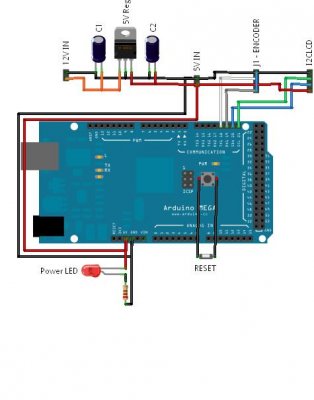
Using an Arduino in a Production environment
The requirement was to add a digital readout to a manually operated bend roller machine to accurately monitor the amount of material fed into the machine. The readout should be user-friendly, requiring no setup other than initial calibration, and must...