


Wideband radiation monitor
#radiation monitor
#photodiode
#operational amplifier
#alpha particles
#beta particles
#gamma rays
#microammeter
#Mylar foil
#wideband
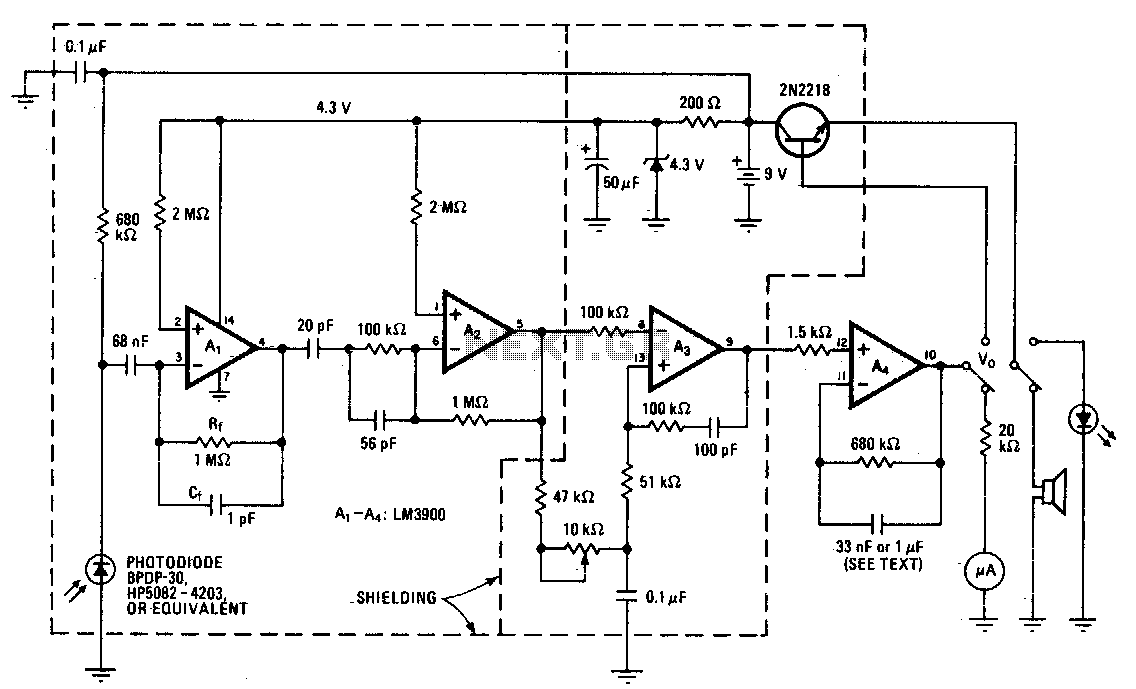
Description: A sensitive radiation monitor can be constructed using a large-area photodiode in conjunction with a quad operational amplifier. By replacing the glass window of the diode with Mylar foil, it is shielded from light and infrared energy, allowing it to detect nuclear radiation such as alpha and beta particles, as well as gamma rays. Operational amplifier A4 integrates the output from A3 to drive a microammeter. Additionally, a 1 microfarad capacitor is utilized in the integrating network, while a smaller capacitor, such as 33 nanofarads, can be employed to drive a small loudspeaker, producing a 50-hertz output signal, or a light-emitting diode.
The radiation monitor circuit is designed to be sensitive and responsive to various types of nuclear radiation. The large-area photodiode serves as the primary sensor, detecting the ionizing radiation. The Mylar foil acts as an effective barrier against unwanted light and infrared radiation, ensuring that the photodiode's output is solely due to the nuclear radiation it encounters.
The quad operational amplifier configuration is critical for processing the weak signals generated by the photodiode. The first stage of the amplifier amplifies the photodiode's current output, converting it into a more manageable voltage signal. The integration process performed by operational amplifier A4 takes the amplified signal from A3 and produces a steady output that can be easily read on a microammeter, providing a clear indication of the radiation levels.
Incorporating a 1 microfarad capacitor in the integrating network helps to smooth out the output signal, allowing for accurate readings over time. For applications requiring sound or visual alerts, a smaller capacitor value of 33 nanofarads can be used to produce a 50-hertz signal, driving a small loudspeaker or light-emitting diode. This feature adds a layer of functionality to the radiation monitor, enabling it to provide immediate feedback in response to detected radiation levels.
The design emphasizes simplicity and effectiveness, making it accessible for various applications in radiation monitoring, whether for educational purposes, research, or safety monitoring in environments where radiation exposure is a concern.A sensitive radiation monitor may be simply constructed with a large-area photodiode and a quad operational amplifier. Replacing the glass window of the diode with Mylar foil will shield it from light and infrared energy, enabling it to respond to such nuclear radiation as alpha and beta particles and gamma rays.
A4 integrates the output of A3 in order to drive a microammeter A1 microfarad capacitor is used in the integrating network. A lower value, say, 33 nanofarads, will make it possible to drive a small loudspeaker (50-hertz output signal) or light-emitting diode.
The radiation monitor circuit is designed to be sensitive and responsive to various types of nuclear radiation. The large-area photodiode serves as the primary sensor, detecting the ionizing radiation. The Mylar foil acts as an effective barrier against unwanted light and infrared radiation, ensuring that the photodiode's output is solely due to the nuclear radiation it encounters.
The quad operational amplifier configuration is critical for processing the weak signals generated by the photodiode. The first stage of the amplifier amplifies the photodiode's current output, converting it into a more manageable voltage signal. The integration process performed by operational amplifier A4 takes the amplified signal from A3 and produces a steady output that can be easily read on a microammeter, providing a clear indication of the radiation levels.
Incorporating a 1 microfarad capacitor in the integrating network helps to smooth out the output signal, allowing for accurate readings over time. For applications requiring sound or visual alerts, a smaller capacitor value of 33 nanofarads can be used to produce a 50-hertz signal, driving a small loudspeaker or light-emitting diode. This feature adds a layer of functionality to the radiation monitor, enabling it to provide immediate feedback in response to detected radiation levels.
The design emphasizes simplicity and effectiveness, making it accessible for various applications in radiation monitoring, whether for educational purposes, research, or safety monitoring in environments where radiation exposure is a concern.A sensitive radiation monitor may be simply constructed with a large-area photodiode and a quad operational amplifier. Replacing the glass window of the diode with Mylar foil will shield it from light and infrared energy, enabling it to respond to such nuclear radiation as alpha and beta particles and gamma rays.
A4 integrates the output of A3 in order to drive a microammeter A1 microfarad capacitor is used in the integrating network. A lower value, say, 33 nanofarads, will make it possible to drive a small loudspeaker (50-hertz output signal) or light-emitting diode.
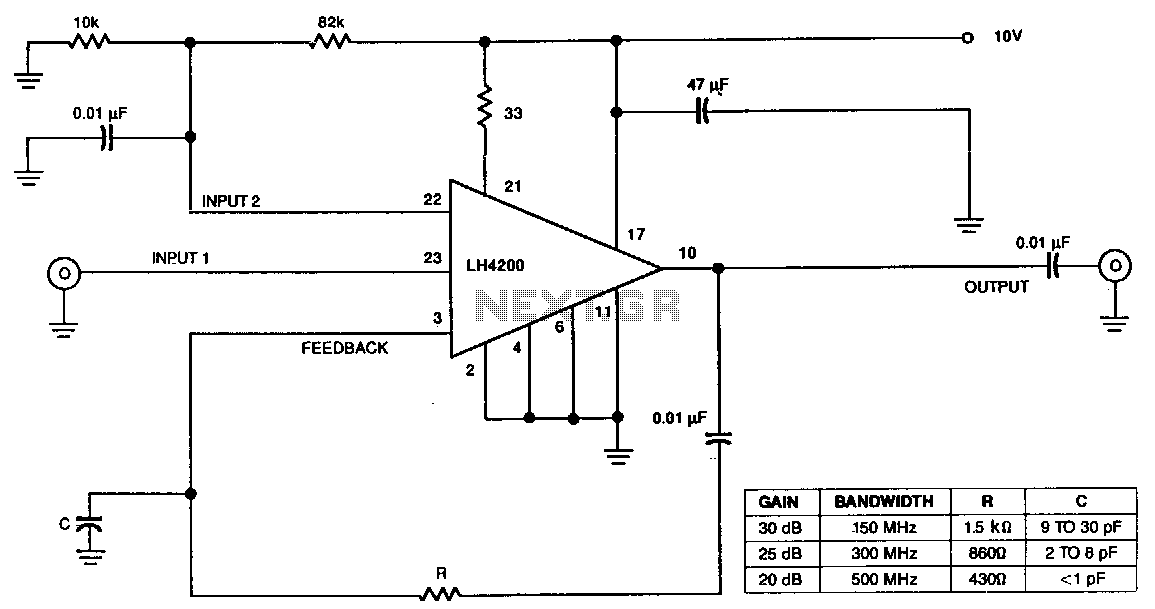
Wideband-500khz-1ghz-hybrid-amplifier
The amplifier's input stage features a dual-gate GaAs FET, which offers low input capacitance and high transconductance. The first input accepts the signal, while the second input regulates the amplifier's gain. Additionally, there is a third input for series feedback....
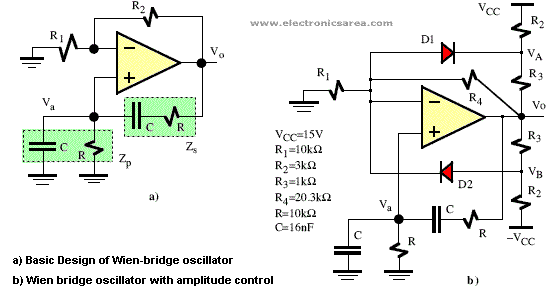
Opamp Wien-bridge oscillator
The Wien-bridge oscillator consists of an operational amplifier (OA) in a non-inverting configuration with a gain of 1 + R2/R1 and an RC feedback network.
The Wien-bridge oscillator is a type of electronic oscillator that generates sine waves. It employs a...
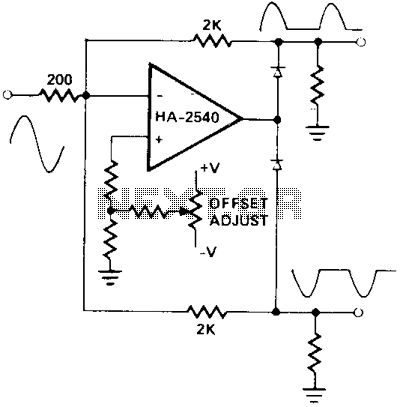
Wideband-signal-splitter
A circuit utilizing either the HA-2539 or HA-2540 in conjunction with two low-capacitance switching diodes can effectively separate signals exceeding 10 MHz. This configuration is particularly beneficial for applications such as full-wave rectification, AM detection, or synchronization generation.
The described circuit...
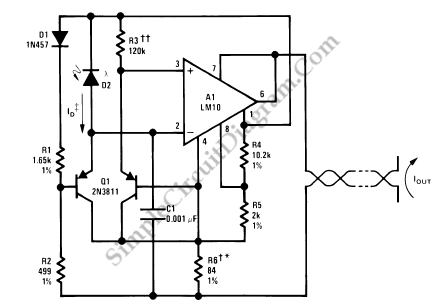
Logarithmic Light (Photodiode) Sensor Signal Conditioner
There are many measurement systems that would be more suitable if a logarithmic scale is used, especially when attempting to mimic human sensory responses. Most...
Logarithmic scales are particularly effective in representing a wide range of values in a compact format,...
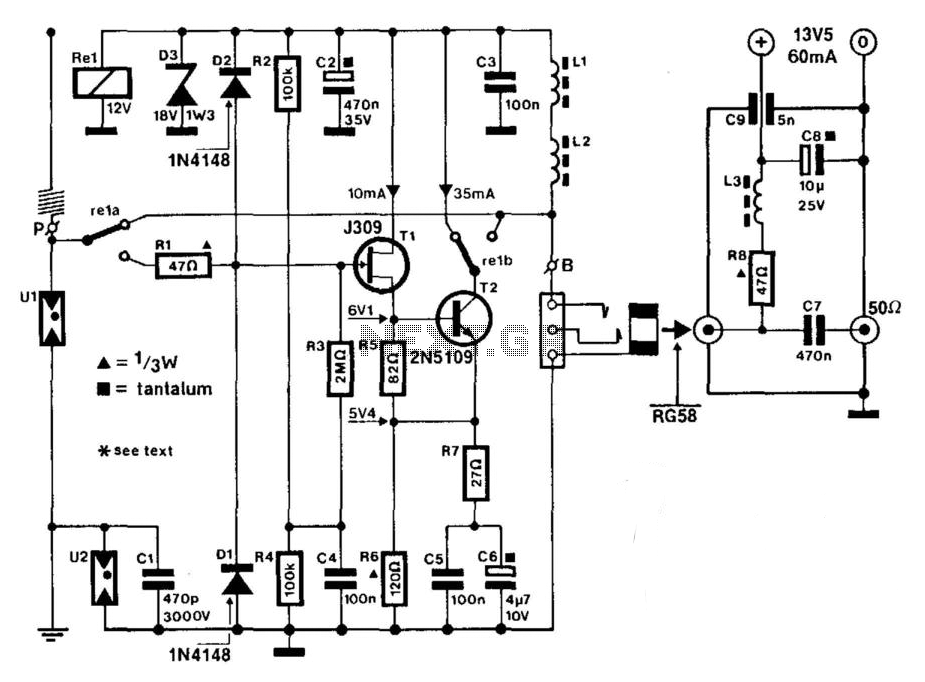
Wideband Active Rod Antenna
A J309 Siliconix FET is utilized to drive a 2N5109 in a wideband RF amplifier setup. A relay is incorporated to bypass the amplifier in transmit mode, if required. An active antenna element is a 2-meter 5/8-wave whip. The amplifier...
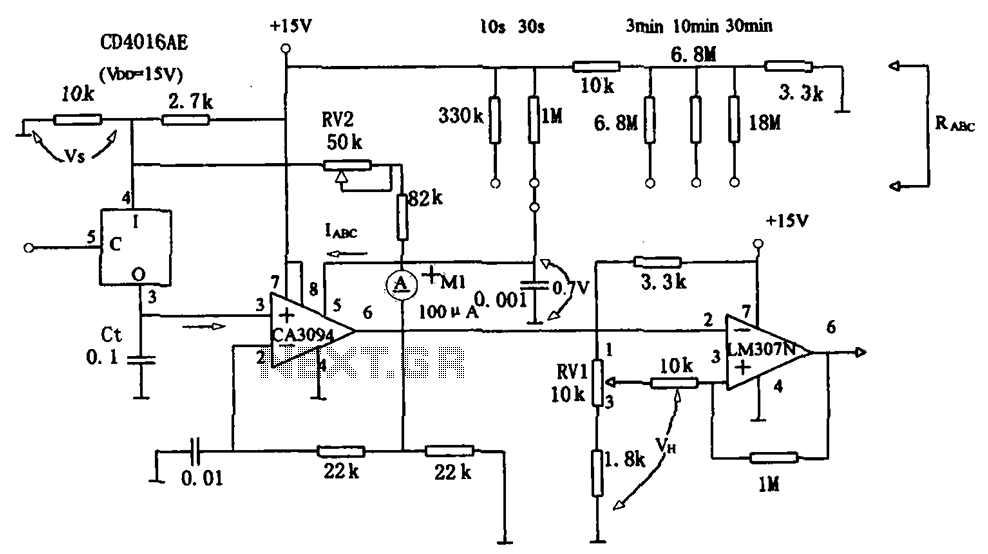
Long timed circuit diagram LM307N CA3094
The long timer circuit utilizes an operational amplifier, specifically the CA3094, to control the discharge formula for extended timing. This is typically achieved by adjusting the variable resistor RV1, which alters the timing duration to meet specific requirements.
The long timer...
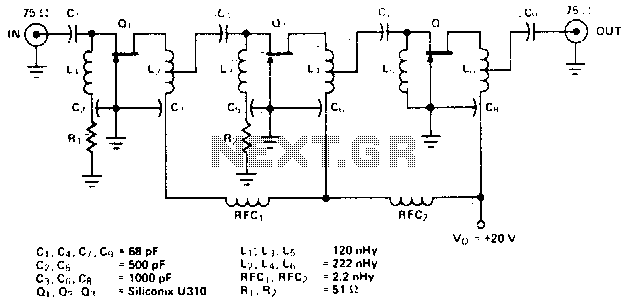
Wideband uhf amplifier with high-performance fets
The amplifier circuit is designed for a center frequency of 225 MHz, with a bandwidth of 50 MHz at 1 dB, low input voltage standing wave ratio (VSWR) in a 75-ohm system, and a gain of 24 dB. Three stages...
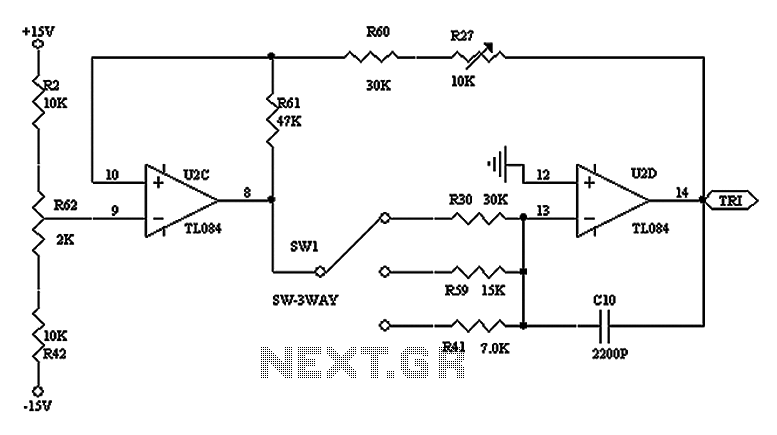
The triangular wave carrier generator circuit diagram
The triangular wave circuit consists of two operational amplifiers (OPs). R62 serves as the offset adjustment, while R27 is utilized for peak adjustment. A switch is included to select different resistances, allowing for the generation of triangular waves at varying...

Photodiode Alarm
This photodiode-based alarm system is designed to provide a warning signal when an individual passes through a designated protected area. The circuit remains in standby mode by utilizing a laser beam or infrared (IR) beam directed onto the photodiode. When...