


home telephone fm transmitter circuit
#FM transmitter
#telephone line
#FM band
#On Air LED
#switch
#signal transmission
#home phone
#wireless communication
#audio transmission
#RF circuit

Description: This circuit connects in series with a home phone line and transmits phone conversations through the FM band whenever the telephone handset is picked up. The transmitted signal can be tuned by any FM receiver. The circuit includes an "On Air" LED indicator and features a switch that can be used to turn off the transmitter. A notable characteristic of the circuit is that it does not require a battery for operation, as it draws electrical power from the phone line. The transmitter circuit utilizes a short wire aerial, approximately 4 inches (10 cm) long, to transmit the signal, and a portion of the RF signal can also be radiated through the phone line itself. The circuit may be used to share or record conversations but is not intended for illegal use.
This circuit operates by integrating with the existing telephone line infrastructure, allowing for real-time audio transmission over the FM band. The series connection ensures that the circuit does not interfere with the normal operation of the phone line. When the handset is lifted, the circuit activates, and the audio signal is modulated onto an FM carrier wave. The tuning capability of any standard FM receiver allows users to select the appropriate frequency to listen to the transmitted conversation.
The "On Air" LED indicator serves as a visual cue, informing the user when the transmitter is active. This feature is particularly important for ensuring that conversations are not inadvertently broadcasted to unintended receivers. The inclusion of a switch to deactivate the transmitter allows for user control, enhancing privacy and preventing unauthorized transmission.
Powering the circuit directly from the phone line eliminates the need for an external power source, making the design more convenient and compact. The short wire aerial is designed to be efficient in transmitting the modulated signal over a limited range, suitable for local reception. Additionally, the ability of the phone line to radiate a portion of the RF signal expands the effective transmission range without compromising the integrity of the phone line itself.
While this circuit can facilitate the sharing or recording of conversations, it is imperative to note that it must be used in compliance with legal regulations governing privacy and telecommunications. The design emphasizes ethical use, ensuring that users are aware of the implications of broadcasting private conversations.This circuit connects in series with your home phone line and delivers the phone conversation through the FM band any time you pick up the telephone handset. Transmitted signal could be tuned by any FM receiver. The circuit features an "On Air" LED indicator and also gives you a switch t hat can be utilized to turn off the transmitter. A special characteristic of the circuit is the fact that no battery is required to operate the circuit because electrical power is taken from your phone line. The transmitter circuit works by using only a short piece of wire aerial about 4" / 10 cm long to transmit the signal and a portion of the RF signal can also be radiated via the phone line itself.
The circuit may possibly be implemented to share or record conversations, but will not be meant for illegal use.
This circuit operates by integrating with the existing telephone line infrastructure, allowing for real-time audio transmission over the FM band. The series connection ensures that the circuit does not interfere with the normal operation of the phone line. When the handset is lifted, the circuit activates, and the audio signal is modulated onto an FM carrier wave. The tuning capability of any standard FM receiver allows users to select the appropriate frequency to listen to the transmitted conversation.
The "On Air" LED indicator serves as a visual cue, informing the user when the transmitter is active. This feature is particularly important for ensuring that conversations are not inadvertently broadcasted to unintended receivers. The inclusion of a switch to deactivate the transmitter allows for user control, enhancing privacy and preventing unauthorized transmission.
Powering the circuit directly from the phone line eliminates the need for an external power source, making the design more convenient and compact. The short wire aerial is designed to be efficient in transmitting the modulated signal over a limited range, suitable for local reception. Additionally, the ability of the phone line to radiate a portion of the RF signal expands the effective transmission range without compromising the integrity of the phone line itself.
While this circuit can facilitate the sharing or recording of conversations, it is imperative to note that it must be used in compliance with legal regulations governing privacy and telecommunications. The design emphasizes ethical use, ensuring that users are aware of the implications of broadcasting private conversations.This circuit connects in series with your home phone line and delivers the phone conversation through the FM band any time you pick up the telephone handset. Transmitted signal could be tuned by any FM receiver. The circuit features an "On Air" LED indicator and also gives you a switch t hat can be utilized to turn off the transmitter. A special characteristic of the circuit is the fact that no battery is required to operate the circuit because electrical power is taken from your phone line. The transmitter circuit works by using only a short piece of wire aerial about 4" / 10 cm long to transmit the signal and a portion of the RF signal can also be radiated via the phone line itself.
The circuit may possibly be implemented to share or record conversations, but will not be meant for illegal use.

FM adaptor circuit for car stereo
This compact FM adapter circuit, when connected to the audio output of a cassette player or iPod, enables the user to listen to their favorite music through a car stereo. It is particularly useful for vehicles that lack an auxiliary...

1.5 Watt FM Transmitter
P1 acts as the volume level for the condenser microphone. For the FM transmitter, the coil will be small. It is recommended to use thin gauge enamel magnet wire. The diameter of the coil should be a couple of millimeters;...

Long-range FM radio transmitter circuit
The circuit depicted utilizes a specialized launch tube T2 along with its associated components to create a high-frequency oscillator operating within the frequency range of 88 to 108 MHz. An electret microphone captures the audio signal, which is subsequently amplified...

40W FM transmitter with valve EL34
The catering better it does not become at straight line from the network 220V but via transformer 220V/220V of isolation and safety 1A. When does not exist the R3, the force of expense is bigger, but respectively is increased also...

Long range FM transmitter electronic project
This FM transmitter project is a simple yet effective circuit capable of transmitting signals over a distance of up to 1 kilometer in open air conditions. The circuit employs an RF transistor in the output stage, along with two BC547...

stereo fm circuit
This is a straightforward high-quality PLL FM transmitter with a typical output power of 5 W and a no-tune design. It features RDS/SCA input and audio/MPX input with optional pre-emphasis and can operate with or without a stereo encoder. Tuning...

mini fm radio transmitter circuit
This compact FM transmitter has a range of approximately 50 meters and is designed for hobbyists. With multiple mini-transmitters, users can create a diverse and engaging radio program. The device achieves high frequency stability due to its power supply via...

76MHz to 119MHz Fm transmitter
TR1 (BC547) is an inverted Hartley oscillator which based upon an inductor fabricated on the PCB. This makes it megga-stable, and setable anywhere in the VHF FM band (76MHz to 119MHz) and the BB105 varicap makes it voltage tuneable over...
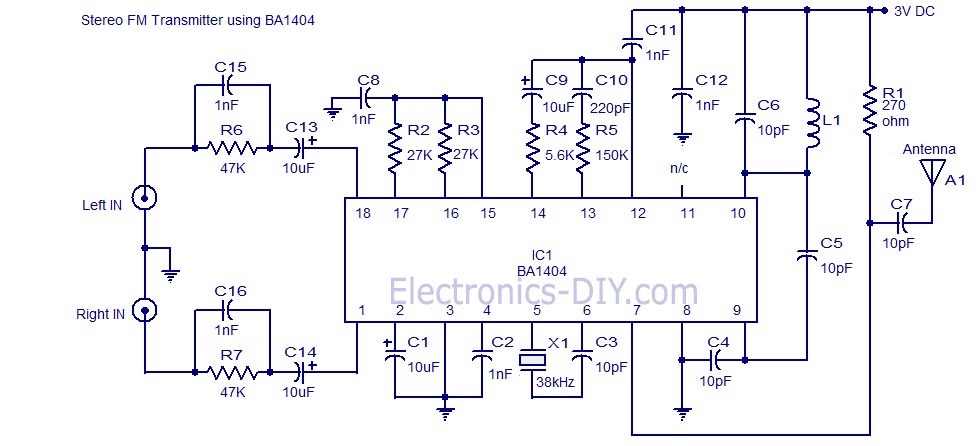
Stereo FM Transmitter with BA1404
A high-quality stereo FM transmitter circuit is presented. This circuit utilizes the BA1404 integrated circuit from ROHM Semiconductors. The BA1404 is a monolithic FM stereo modulator that includes a built-in stereo modulator, FM modulator, and RF amplifier. The FM modulator...