


lm723 variable power supply circuit
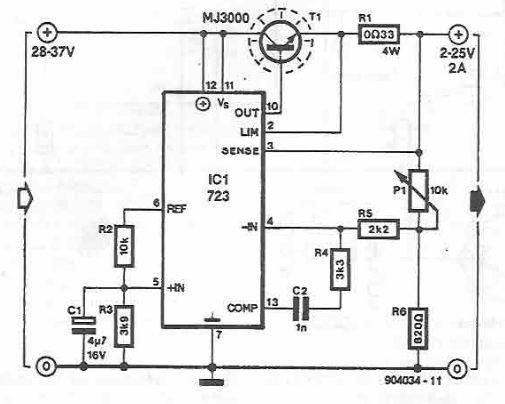
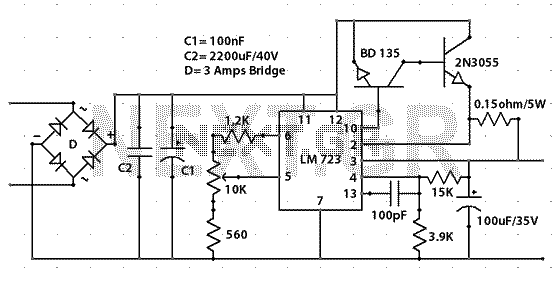
Description: A simple variable power supply circuit can be designed using the LM723 regulator, which provides a maximum current of up to 2A and a variable voltage range between 2 and 25 volts.
The LM723 voltage regulator is an integrated circuit capable of delivering a stable output voltage while allowing for adjustable settings. This makes it suitable for applications requiring a variable power supply. The circuit typically consists of the LM723, a few passive components, and additional circuitry to enhance performance.
To construct the variable power supply, the LM723 is connected in a configuration that allows for output voltage adjustment. The output voltage is determined by the feedback network, which usually consists of a potentiometer and resistors. By varying the resistance of the potentiometer, the output voltage can be adjusted within the specified range of 2 to 25 volts.
The maximum output current of 2A is achievable under optimal conditions, and it is essential to ensure that the LM723 is adequately heat-sinked to prevent thermal shutdown during operation. The circuit may also include additional capacitors at the input and output to stabilize voltage levels and reduce noise.
Furthermore, a diode can be placed in parallel with the load to protect the circuit from reverse voltage spikes. This configuration enhances the reliability of the power supply, making it suitable for various electronic applications.
Overall, the LM723-based variable power supply circuit is a versatile solution for providing adjustable voltage and current, making it an essential tool for electronics experimentation and prototyping.Using LM723 regulator can be designed a very simple variable power supply circuit which can provide a maximum current up to 2A and a variable voltage between 2 and 25 volts.
The LM723 voltage regulator is an integrated circuit capable of delivering a stable output voltage while allowing for adjustable settings. This makes it suitable for applications requiring a variable power supply. The circuit typically consists of the LM723, a few passive components, and additional circuitry to enhance performance.
To construct the variable power supply, the LM723 is connected in a configuration that allows for output voltage adjustment. The output voltage is determined by the feedback network, which usually consists of a potentiometer and resistors. By varying the resistance of the potentiometer, the output voltage can be adjusted within the specified range of 2 to 25 volts.
The maximum output current of 2A is achievable under optimal conditions, and it is essential to ensure that the LM723 is adequately heat-sinked to prevent thermal shutdown during operation. The circuit may also include additional capacitors at the input and output to stabilize voltage levels and reduce noise.
Furthermore, a diode can be placed in parallel with the load to protect the circuit from reverse voltage spikes. This configuration enhances the reliability of the power supply, making it suitable for various electronic applications.
Overall, the LM723-based variable power supply circuit is a versatile solution for providing adjustable voltage and current, making it an essential tool for electronics experimentation and prototyping.Using LM723 regulator can be designed a very simple variable power supply circuit which can provide a maximum current up to 2A and a variable voltage between 2 and 25 volts.
Three-rail-power-supply
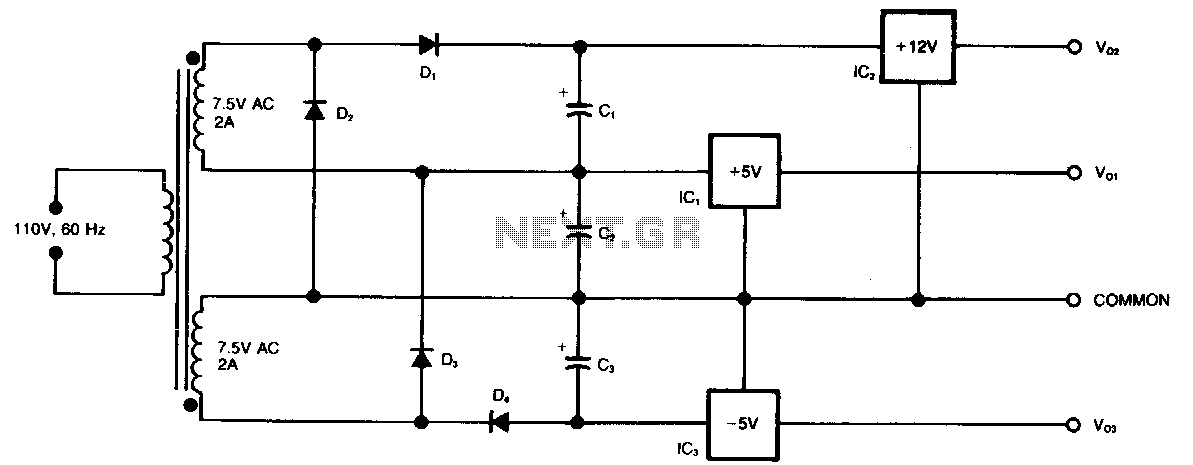
This circuit generates three supply voltages using a minimal number of components. Diodes D2 and D3 perform full-wave rectification, alternately charging capacitor C2 during both halves of the AC cycle. Meanwhile, diode D1 in conjunction with capacitor C1, and diode...
BMW R Series Motorcycle Regulator Schematic
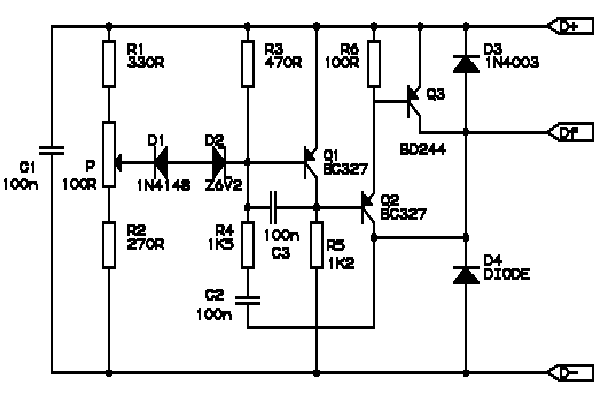
Correctly adjusted, the voltage on the pot wiper is slightly less than half D+ (appx. 0.47*D+) and Q1 will conduct if (D+)-(Vp) > 6.2 + 0.7 + 0.7, or 0.53*(D+) > 7.6V, (D+) > 14.3V. If D+ is lower than...
Variable 3 - 24 Volt / 3 Amp Power Supply circuit
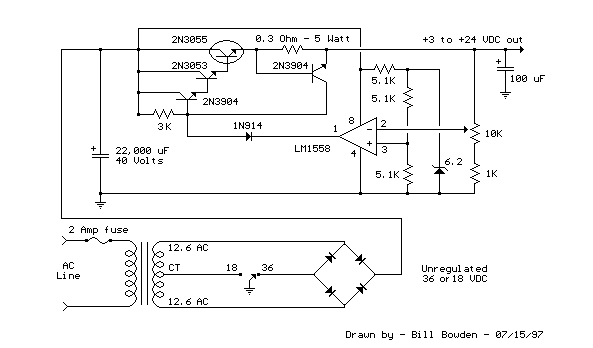
This regulated power supply can be adjusted from 3 to 25 volts and is current limited to 2 amps as shown, but may be increased to 3 amps or more by selecting a smaller current sense resistor (0.3 ohm). The...
0-30 Volts / 2,5A Variable Power Supply
This is a high quality power supply with a continuously variable stabilized output adjustable between 0 and 30VDC. The LM 723 is the heart of the power supply which drives the BD137 and then the 2N3055. The circuit provides short...
Switching Voltage Regulators-Step up Step down and polarity invert
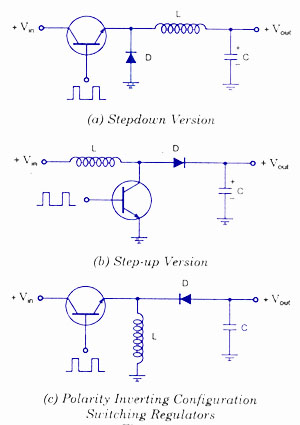
Switching voltage regulators include step-up, step-down, and polarity-inverting configurations, along with their working principles and circuit diagrams.
Switching voltage regulators are essential components in modern electronic circuits, providing efficient voltage conversion. These regulators can be categorized into three main types: step-up...
Combination Voltage And Current Regulator Circuit
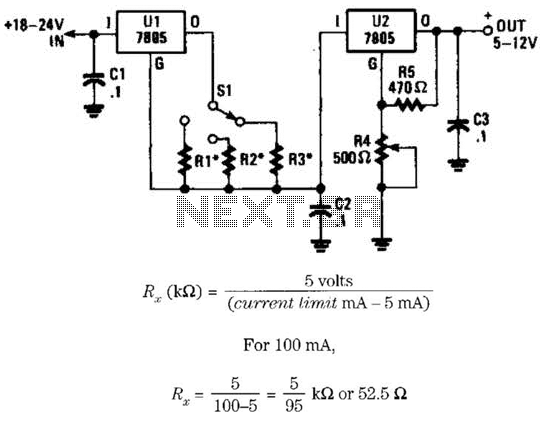
This voltage regulator and current limiter combination can be constructed using two 7805 regulators as illustrated. Resistors R1, R2, and R3 should be chosen to achieve a 5-V drop at the maximum allowable current limit. Switch S1 selects one of...
Positive-regulator-with-pnp-boost
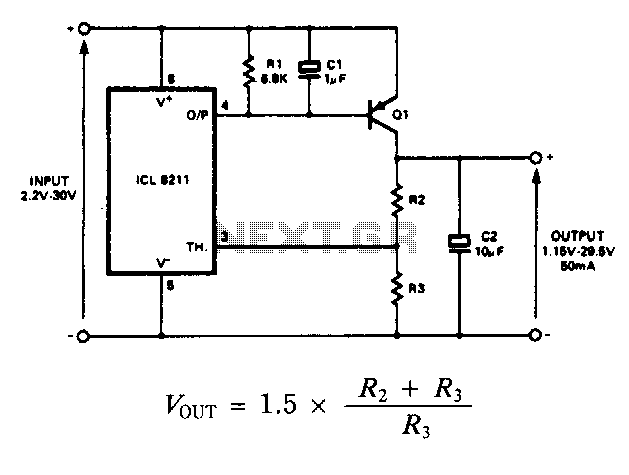
The IC8211 serves as the voltage reference and regulator amplifier, with Q1 functioning as the series pass transistor. Resistor R1 defines the output current of the IC8211, while capacitors C1 and C2 ensure loop stability and help suppress the feedthrough...
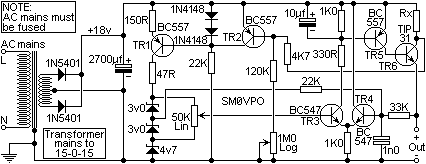
0-15 Volt 0-1A Power supply
TR1 provides a constant current to a bank of three zener diodes, thus maintaining a constant voltage independent of supply voltage variations. The resistor Rx is used to sense the PSU output current and to switch off the current to...
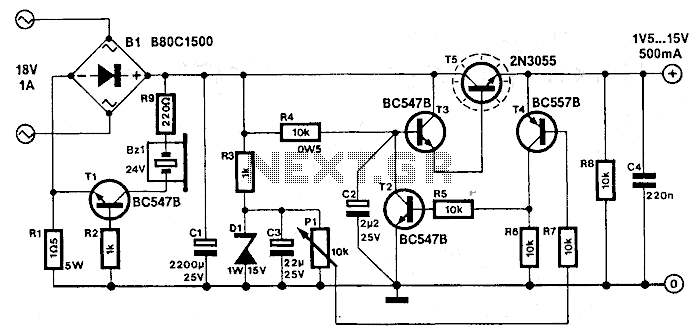
1,5-15V 500mA Power Supply
This simple variable power supply circuit has a low production cost and delivers an output voltage between 1.5 V and 15 V with a 500 mA maximum current. Its stabilization is better than 2% if the current consumption does not...