


Pultec EQP1A Equalizer
#equalizer
#Pultec EQP1A
#vintage audio
#audio processing
#filter caps
#component placement
#audio circuit
#sound engineering
#music production
#analog audio
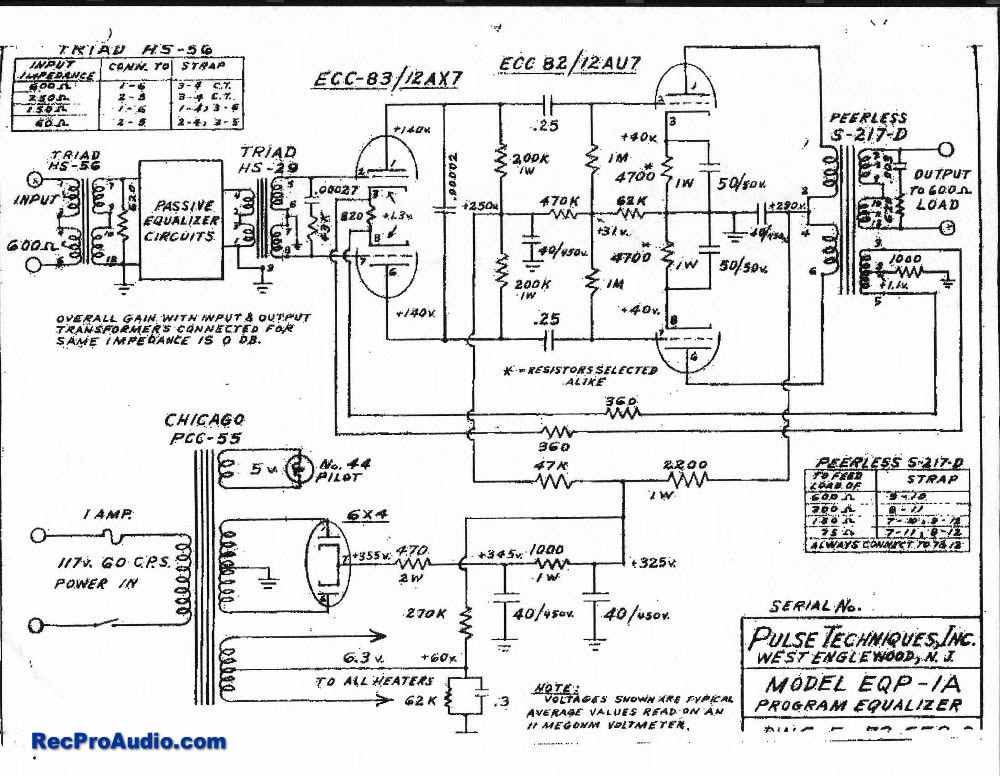
Description: This project closely replicates the vintage Pultec EQP-1a equalizer. It is constructed from the original Pulse Techniques Pultec schematic, with the layout adapted for modern replacement components such as filter capacitors and transformers. The total parts cost is approximately $1265 USD. A complete Pultec EQP-1a kit is also available for $1645, which includes upgraded filter section capacitors, a new master layout, and 500 high-resolution assembly photographs. While the original Triad HS-56, HS-29, and Peerless S-217-D transformers would have been ideal, sourcing these components is challenging due to the rarity of the Peerless S-217-D output transformer. Consequently, the focus shifted to modern equivalents from Sowter, which have a smaller footprint suitable for a 2U rack chassis while maintaining high-quality performance. The original Chicago PCC-55 power transformer is occasionally available on eBay at reasonable prices. For the inductor, the Cinemag Pultec replacement CML-150T was selected. Build notes indicate that the EQP-1a's amplifier section is separated from the passive filter circuit using two distinct turret boards, with the amplifier located on the rear panel. This design choice allows for effective routing of filament wires in the upper corner of the chassis, minimizing noise and keeping high-tension components away from the passive circuit. Notably, the 6x4 rectifier operates on the same 6.3V filament as the 12AX7 and 12AU7 tubes, while the power transformer’s rectifier 5V winding exclusively powers the lamp. The interstage and input transformers were relocated to the left of the bottom turret board, with the inductor positioned on the right. Grounding is achieved at three points: one at the output transformer lug, one at the input XLR, and one at the power transformer. The Pultec functions effectively and quietly, demonstrating a perfectly flat response when the equalizer is set flat, with accurate EQ curves across all configurations, including gain settings.
This electronic schematic describes a sophisticated audio equalizer based on the classic Pultec EQP-1a design, integrating modern components for enhanced performance and reliability. The chosen layout emphasizes effective lead dress practices, ensuring minimal interference and noise, which is crucial in audio applications. The separation of the amplifier section from the passive filter circuit using turret boards allows for optimized signal integrity and noise reduction.
The use of contemporary transformers from Sowter not only addresses sourcing challenges associated with vintage components but also provides a compact design suitable for modern rack systems. The selected Cinemag inductor is designed to replicate the original performance characteristics of the Pultec while fitting within the updated framework.
Grounding techniques are critical in audio equipment design, and the three grounding points help to prevent ground loops and maintain signal clarity. The careful routing of filament wires and the strategic placement of components contribute to the overall quiet operation of the unit, making it suitable for professional audio applications where fidelity is paramount.
In summary, this detailed schematic description outlines the construction and operational principles of a modern Pultec EQP-1a equalizer, highlighting the thoughtful integration of vintage design with contemporary engineering practices, resulting in a high-quality audio processing tool.This is about as close as you can get to a real vintage Pultec EQP-1a. Built from the original Pulse Techniques Pultec schematic with the layout designed around modern replacement parts (filter caps and trannys); and utilizing best practices regarding lead dress and component placement. Parts cost is around $1265 USD. I now offer a complete Pultec EQP-1a Kit for $1645 that includes upgraded filter section capacitors, a new master layout and 500 high-resolution assembly photos. The Pultec`s original Triad HS-56, HS-29 and Peerless S-217-D transformers would have been great, but sourcing them all is very difficult, primarily because of the rarity of the Peerless S-217-D output tranny.
As the Peerless is so exotic, I didn`t really care about sourcing the input and interstage trannys because without the S-217-D, the point seemed moot. On the plus side, modern EQP-1a equivalents from Sowter have a much smaller footprint which facilitates a 2u rack chassis if desired - and the quality is artisan.
For those inclined, the original Chicago PCC-55 power tranny does appear on eBay with some frequency and modest pricing. For the inductor, I chose Cinemag`s Pultec replacement CML-150T. Build notes: I separated the EQP-1a`s amplifier section from the Pultec passive filter circuit by way of two separate turret boards.
The amp section is on the rear panel. This provided a nice way to route the filament wires in the upper corner of the rear of the chassis to keep things quiet as well as keeping the HT stuff away from the passive. One particularly interesting thing is that the 6x4 rectifier runs off the same 6. 3V filament as the 12ax7 and 12au7 tubes, and the power transformer rectifier 5V winding only powers the lamp.
I ended up moving the interstage and input transformers to the left of the bottom turret board and the inductor to the right side. I think there are 3 grounds points: One at the OT lug. One at the input XLR, and one at the power tranny. The Pultec works great and is very quiet. I ran several sweeps and it`s perfectly flat with the eq in and set flat. The eq curves look very accurate as well in all configurations, including gain.
This electronic schematic describes a sophisticated audio equalizer based on the classic Pultec EQP-1a design, integrating modern components for enhanced performance and reliability. The chosen layout emphasizes effective lead dress practices, ensuring minimal interference and noise, which is crucial in audio applications. The separation of the amplifier section from the passive filter circuit using turret boards allows for optimized signal integrity and noise reduction.
The use of contemporary transformers from Sowter not only addresses sourcing challenges associated with vintage components but also provides a compact design suitable for modern rack systems. The selected Cinemag inductor is designed to replicate the original performance characteristics of the Pultec while fitting within the updated framework.
Grounding techniques are critical in audio equipment design, and the three grounding points help to prevent ground loops and maintain signal clarity. The careful routing of filament wires and the strategic placement of components contribute to the overall quiet operation of the unit, making it suitable for professional audio applications where fidelity is paramount.
In summary, this detailed schematic description outlines the construction and operational principles of a modern Pultec EQP-1a equalizer, highlighting the thoughtful integration of vintage design with contemporary engineering practices, resulting in a high-quality audio processing tool.This is about as close as you can get to a real vintage Pultec EQP-1a. Built from the original Pulse Techniques Pultec schematic with the layout designed around modern replacement parts (filter caps and trannys); and utilizing best practices regarding lead dress and component placement. Parts cost is around $1265 USD. I now offer a complete Pultec EQP-1a Kit for $1645 that includes upgraded filter section capacitors, a new master layout and 500 high-resolution assembly photos. The Pultec`s original Triad HS-56, HS-29 and Peerless S-217-D transformers would have been great, but sourcing them all is very difficult, primarily because of the rarity of the Peerless S-217-D output tranny.
As the Peerless is so exotic, I didn`t really care about sourcing the input and interstage trannys because without the S-217-D, the point seemed moot. On the plus side, modern EQP-1a equivalents from Sowter have a much smaller footprint which facilitates a 2u rack chassis if desired - and the quality is artisan.
For those inclined, the original Chicago PCC-55 power tranny does appear on eBay with some frequency and modest pricing. For the inductor, I chose Cinemag`s Pultec replacement CML-150T. Build notes: I separated the EQP-1a`s amplifier section from the Pultec passive filter circuit by way of two separate turret boards.
The amp section is on the rear panel. This provided a nice way to route the filament wires in the upper corner of the rear of the chassis to keep things quiet as well as keeping the HT stuff away from the passive. One particularly interesting thing is that the 6x4 rectifier runs off the same 6. 3V filament as the 12ax7 and 12au7 tubes, and the power transformer rectifier 5V winding only powers the lamp.
I ended up moving the interstage and input transformers to the left of the bottom turret board and the inductor to the right side. I think there are 3 grounds points: One at the OT lug. One at the input XLR, and one at the power tranny. The Pultec works great and is very quiet. I ran several sweeps and it`s perfectly flat with the eq in and set flat. The eq curves look very accurate as well in all configurations, including gain.
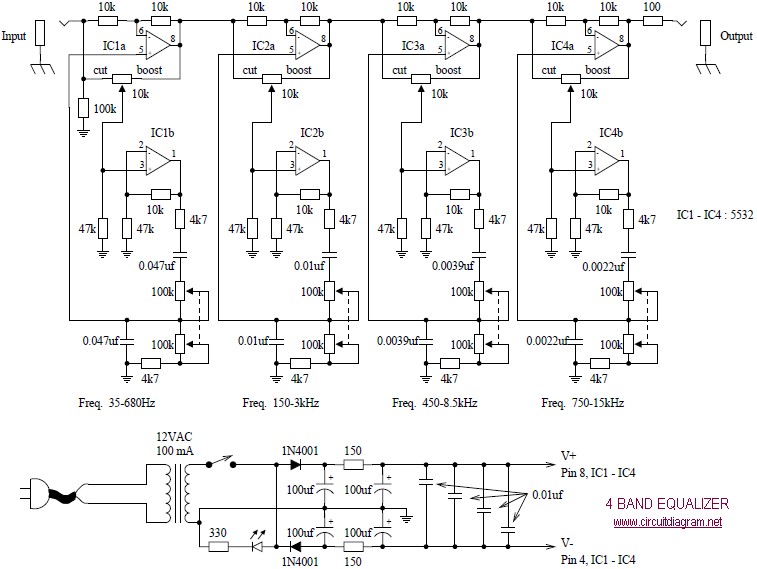
4 Band Equalizer schematic diagram
The following diagram illustrates a four-band blaster circuit. This blaster is utilized to enhance sound fidelity, emphasize specific instruments, eliminate unwanted noise, or create entirely new and distinct timbres.
The four-band blaster circuit is designed to manipulate audio signals across four...
Audio Equalizer Circuit
Designed for communications use, this equalizer circuit utilizes a Mitsubishi M5226P audio equalizer IC to modify frequency response. It operates with a supply voltage ranging from 9 to 20 V. Capacitors C6 through C16 are polyester film capacitors with a...
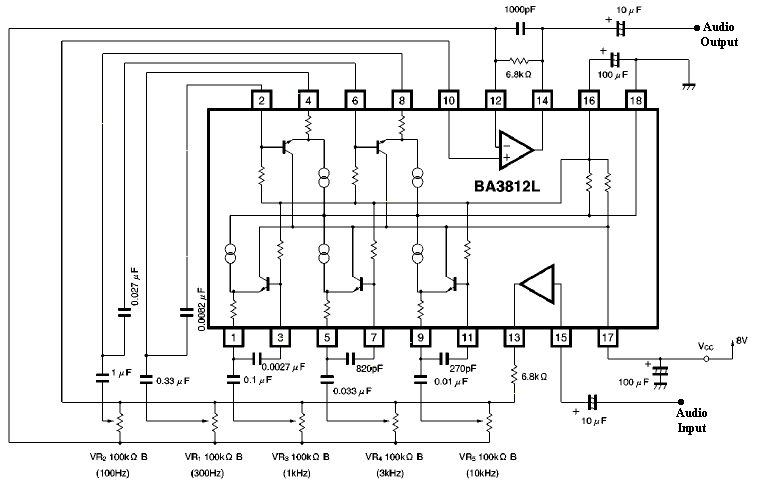
Audio 5 Band equalizer using IC BA3812L
This section discusses a series of 5-band equalizer circuits utilizing a single integrated circuit (IC) BA3812L, which is designed for high-fidelity (hi-fi) audio applications. The BA3812 IC features a 5-point equalizer with all functions integrated within the chip. The equalizer...
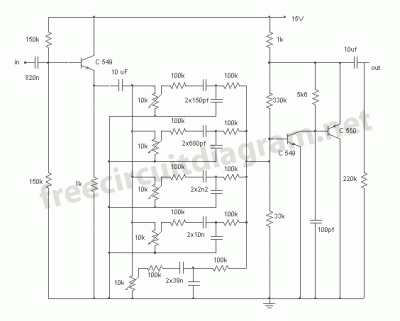
Simple 5 Band Equalizer Circuit
This circuit is a five-channel equalizer designed for a single line channel. The working principle of this series involves a series of frequency filters with a center frequency of 10 Hz.
The five-channel equalizer circuit is structured to manipulate audio signals...
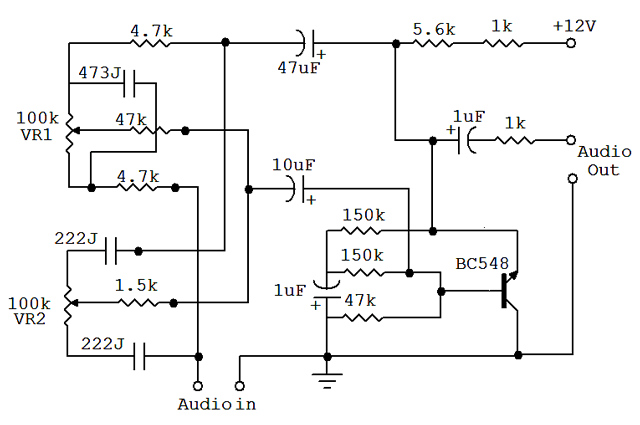
Bass and Treble Controller- Audio Equalizer Circuit
An audio equalizer circuit is utilized to modify the frequency response of an audio signal. This particular equalizer circuit is designed for adjusting the bass and treble (tone) levels of an audio amplifier. To integrate this equalizer circuit with an...
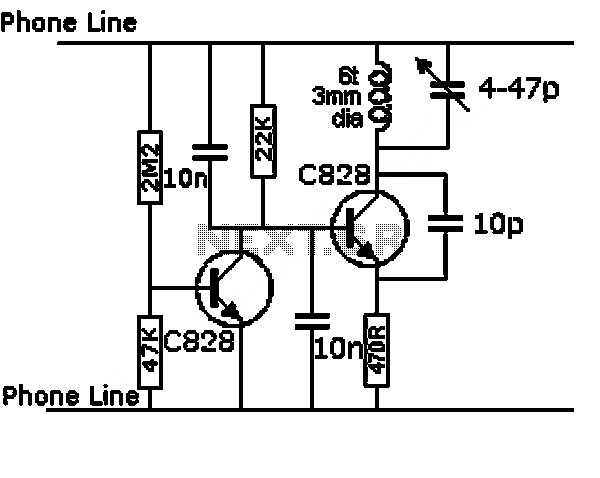
3 band equalizer circuit
This circuit is designed for tone control utilizing a three-band equalizer. It is based on the LF351 single-chip operational amplifiers. The circuit features three adjustable ranges: bass, mid, and treble controls. The equalizer allows for approximately +/-20 dB of boost...
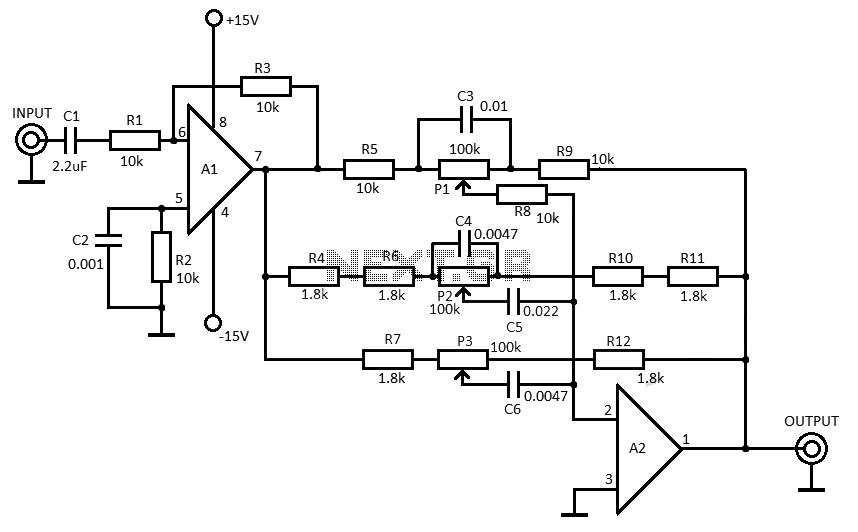
3 band equalizer circuit
This 3-band equalizer circuit is an active filter network designed to adjust bass, midrange, and treble audio frequencies. It utilizes the LM833 operational amplifier from National Semiconductors, which is known for its very low noise figure and wide frequency response.
The...
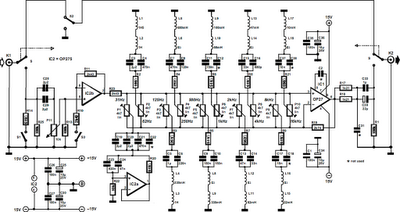
10 band equalizer
The equalizer described is designed for hi-fi installations, public address systems, mixers, and electronic musical instruments. Relay contacts at the inputs and outputs, in conjunction with switch S2, allow for the selection of the desired channel. The input can be...
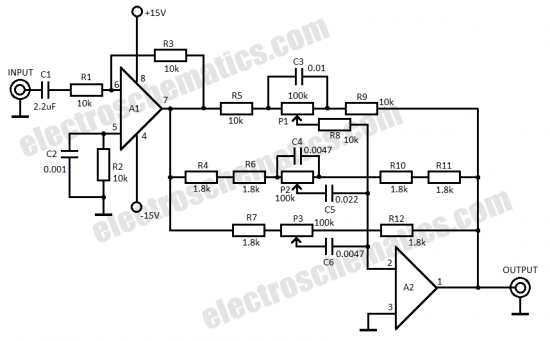
3 band equalizer circuit
This three-band equalizer circuit functions as an active filter network for bass, mid, and high audio frequencies. It is built around the LM833 operational amplifier from National Semiconductors. The output of this three-way graphic equalizer is configured to be DC...