


Check the circuit diagram of a three-phase motor with broken bars
#three-phase motor
#broken bars
#motor inspection
#circuit diagram
#fault detection
#electrical motor
#diagnostics
#industrial equipment
#maintenance
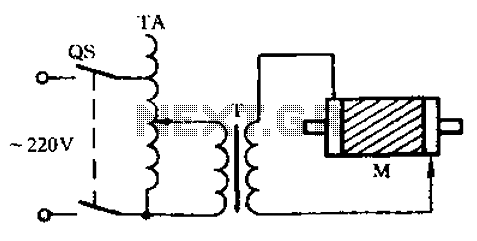
Description: Check the three-phase motor with broken bars as shown in the inspection circuit for the three-phase motor with broken bars.
The inspection circuit for a three-phase motor with broken bars is designed to diagnose and evaluate the condition of the motor's rotor. Broken bars in an induction motor can lead to significant performance issues, including reduced efficiency, increased heat generation, and potential motor failure. The schematic typically includes key components such as current transformers, voltage sensors, and a microcontroller to analyze the data collected.
The circuit begins with the three-phase supply connected to the motor. Each phase line is monitored by current transformers that provide real-time current measurements. These measurements are essential for identifying imbalances that may indicate broken rotor bars. The output from the current transformers is fed into an analog-to-digital converter (ADC) within the microcontroller.
The microcontroller processes the current data and compares it to predefined thresholds. If an anomaly is detected, such as significant current differences between phases, it triggers an alert signal. This alert can be visualized on an LCD display or sent to a remote monitoring system for further analysis.
In addition to current monitoring, voltage sensors are integrated into the circuit to assess the supply voltage levels. Maintaining proper voltage levels is crucial for the motor's operation, and deviations can further exacerbate issues related to broken bars.
The inspection circuit may also include protective elements such as fuses or circuit breakers to prevent damage from overcurrent situations. Overall, this inspection circuit serves as a vital tool for maintenance personnel to ensure the longevity and reliability of three-phase motors, enabling timely interventions before catastrophic failures occur. Check the three-phase motor with broken bars As shown in the three-phase motor with broken bars of inspection circuit:
The inspection circuit for a three-phase motor with broken bars is designed to diagnose and evaluate the condition of the motor's rotor. Broken bars in an induction motor can lead to significant performance issues, including reduced efficiency, increased heat generation, and potential motor failure. The schematic typically includes key components such as current transformers, voltage sensors, and a microcontroller to analyze the data collected.
The circuit begins with the three-phase supply connected to the motor. Each phase line is monitored by current transformers that provide real-time current measurements. These measurements are essential for identifying imbalances that may indicate broken rotor bars. The output from the current transformers is fed into an analog-to-digital converter (ADC) within the microcontroller.
The microcontroller processes the current data and compares it to predefined thresholds. If an anomaly is detected, such as significant current differences between phases, it triggers an alert signal. This alert can be visualized on an LCD display or sent to a remote monitoring system for further analysis.
In addition to current monitoring, voltage sensors are integrated into the circuit to assess the supply voltage levels. Maintaining proper voltage levels is crucial for the motor's operation, and deviations can further exacerbate issues related to broken bars.
The inspection circuit may also include protective elements such as fuses or circuit breakers to prevent damage from overcurrent situations. Overall, this inspection circuit serves as a vital tool for maintenance personnel to ensure the longevity and reliability of three-phase motors, enabling timely interventions before catastrophic failures occur. Check the three-phase motor with broken bars As shown in the three-phase motor with broken bars of inspection circuit:

Three-phase squirrel cage motor running single phase connection circuit
The circuit connection is illustrated in figures a and b. In figure a, a star-shaped winding is used with shunt capacitance, while figure b depicts a triangular winding with capacitance connected in parallel. The working capacitance (Cc) is calculated using...
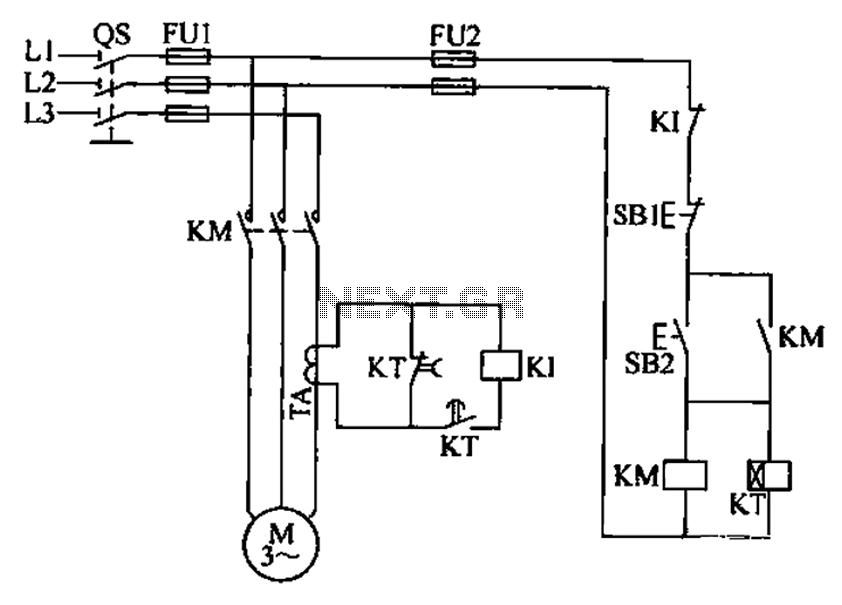
Three-phase motor overcurrent protection circuit
A three-phase electric motor overcurrent protection circuit. This example circuit utilizes a transformer to monitor the current, ensuring that the currents in the three-phase motor do not exceed normal operating levels. When the current exceeds the set threshold, the overcurrent...
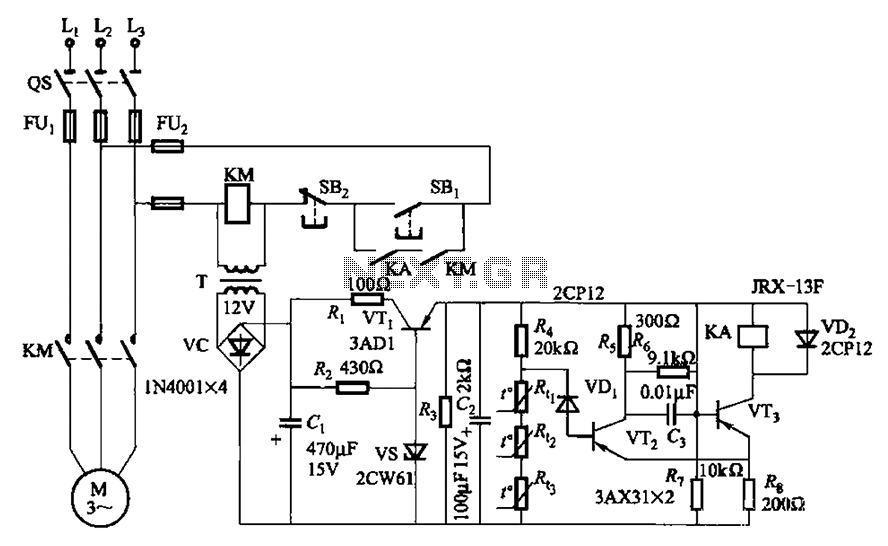
Three-phase asynchronous motor PTC protection circuits
A P-type transistor (VT2, VT3) and other components form a common emitter-coupled trigger, functioning as a Schmitt trigger device. This setup serves as a switching circuit to detect changes in the resistance of a PTC thermistor, thereby controlling the action...
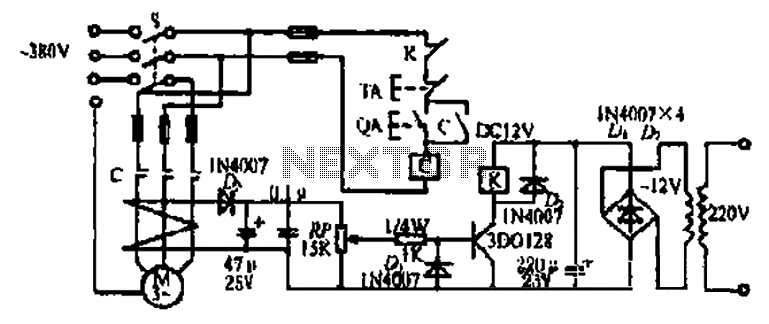
A three-phase motor phase automatic protection circuit
Connect a transformer to the motor phase line when the induced voltage is zero volts. In cases of serious imbalance in one, two, or three phases, the transformer’s induced voltage increases rapidly, which leads to an immediate rectification of the...
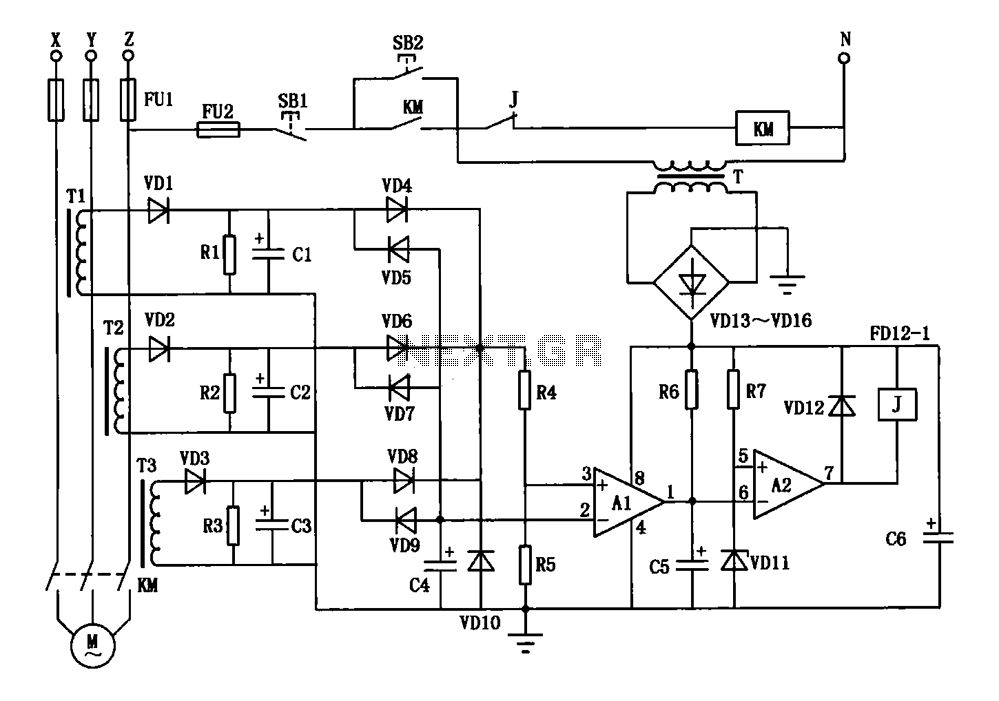
Current three-phase motor phase protection circuit diagram
A current three-phase motor phase protection circuit is designed to detect three-phase current using homemade small current transformers T1, T2, and T3. The current signals are collected by rectifiers VD1, VD2, and VD3, while capacitors C1, C2, and C3 serve...
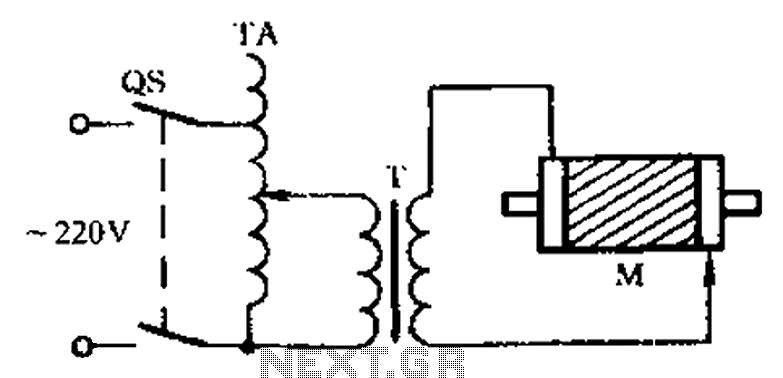
Check the three-phase motor with broken bars
The circuit diagram illustrates a three-phase motor equipped with an inspection circuit designed to detect broken bars.
The circuit for a three-phase motor with a broken bar inspection system typically consists of several key components that work together to monitor the...
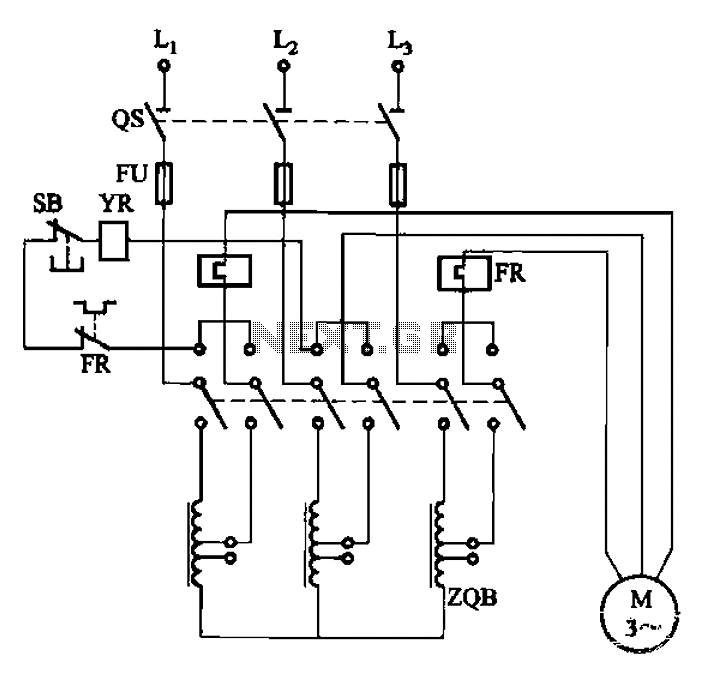
QJ3 series of manually operated auto-voltage start-up circuit
The circuit illustrated in Figure 3-47 involves a three-phase AC motor that is initially connected through a step-down autotransformer. To initiate operation, the power switch is closed, and the operating handle is pushed to the start position. Once the motor...
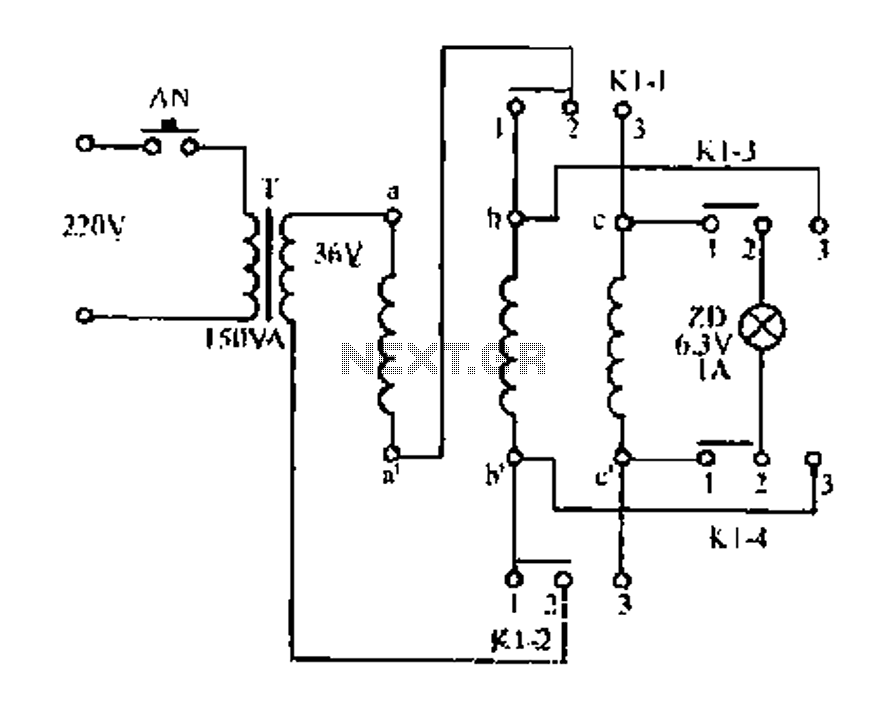
The beginning and end of a three-phase motor winding speed judgment circuit
Figure aa, bb, and ce represent three-phase windings. A double throw switch Kl-1 to Kl-4 is positioned on the left side, connecting phases 1 and 2. At this point, aa and bb are in series with the secondary of transformer...