


Motor Speed Control with Battery Eliminator Circuit
#motor speed control
#battery eliminator
#SMT
#hobbyist
#off-the-shelf components
#Milan Lulic
#elektroModell
#construction
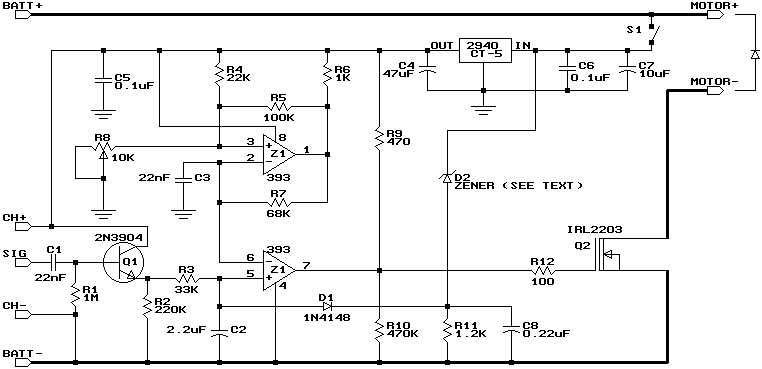
Description: This design is based on one published by Milan Lulic in the German magazine elektroModell. Mr. Lulic's design is for surface mount technology (SMT) construction, whereas mine uses standard off-the-shelf components, and is therefore better suited to construction by the hobbyist. More: This control has the following specifications: Size: 1.3"L x 1.1"W x 0.7"H (3.3cm x 2.8cm x 1.5cm). Weight: approximately 0.5 oz (14g) without motor and battery leads. Current: 12A continuous, 18A intermittent. Voltage Loss: 120mV @
This electronic control design, inspired by Milan Lulic's work, is tailored for hobbyists utilizing conventional components rather than surface mount technology (SMT). The compact dimensions of the control unit, measuring 1.3 inches in length, 1.1 inches in width, and 0.7 inches in height, make it suitable for various applications where space is a constraint. Weighing approximately 0.5 ounces (14 grams) without the motor and battery leads, the design is lightweight, facilitating easy integration into projects.
The control is engineered to handle a continuous current of 12A, with the capacity to manage intermittent loads of up to 18A. This capability makes it versatile for powering different types of motors or electronic devices that may require varying levels of current during operation. The voltage loss specification of 120mV indicates the efficiency of the control unit in maintaining power delivery, minimizing energy loss during operation.
To implement this design, the schematic should include standard components such as resistors, capacitors, diodes, and transistors, which can be easily sourced. The layout should ensure proper heat dissipation and include adequate filtering to reduce noise in the control signals. Additionally, the PCB (Printed Circuit Board) design should accommodate the specified dimensions while providing clear pathways for current flow and minimizing interference between components.
Overall, this control design offers a practical solution for hobbyists looking to create efficient and reliable electronic projects without the complexities associated with SMT construction. The specifications provided ensure that the control can be effectively utilized in various applications, contributing to its appeal among DIY electronics enthusiasts.This design is based on one published by Milan Lulic in the German magazine elektroModell. Mr. Lulic`s design is for surface mount technology (SMT) construction, whereas mine uses standard off-the-shelf components, and is therefore better suited to construction by the hobbyist. This control has the following specifications: Size: 1.3"L x 1.1"W x 0.7"H (3.3cm x 2.8cm x 1.5cm). Weight: approximately 0.5 oz (14g) without motor and battery leads. Current: 12A continuous, 18A intermittent. Voltage Loss: 120mV @
This electronic control design, inspired by Milan Lulic's work, is tailored for hobbyists utilizing conventional components rather than surface mount technology (SMT). The compact dimensions of the control unit, measuring 1.3 inches in length, 1.1 inches in width, and 0.7 inches in height, make it suitable for various applications where space is a constraint. Weighing approximately 0.5 ounces (14 grams) without the motor and battery leads, the design is lightweight, facilitating easy integration into projects.
The control is engineered to handle a continuous current of 12A, with the capacity to manage intermittent loads of up to 18A. This capability makes it versatile for powering different types of motors or electronic devices that may require varying levels of current during operation. The voltage loss specification of 120mV indicates the efficiency of the control unit in maintaining power delivery, minimizing energy loss during operation.
To implement this design, the schematic should include standard components such as resistors, capacitors, diodes, and transistors, which can be easily sourced. The layout should ensure proper heat dissipation and include adequate filtering to reduce noise in the control signals. Additionally, the PCB (Printed Circuit Board) design should accommodate the specified dimensions while providing clear pathways for current flow and minimizing interference between components.
Overall, this control design offers a practical solution for hobbyists looking to create efficient and reliable electronic projects without the complexities associated with SMT construction. The specifications provided ensure that the control can be effectively utilized in various applications, contributing to its appeal among DIY electronics enthusiasts.This design is based on one published by Milan Lulic in the German magazine elektroModell. Mr. Lulic`s design is for surface mount technology (SMT) construction, whereas mine uses standard off-the-shelf components, and is therefore better suited to construction by the hobbyist. This control has the following specifications: Size: 1.3"L x 1.1"W x 0.7"H (3.3cm x 2.8cm x 1.5cm). Weight: approximately 0.5 oz (14g) without motor and battery leads. Current: 12A continuous, 18A intermittent. Voltage Loss: 120mV @
Motor speed control
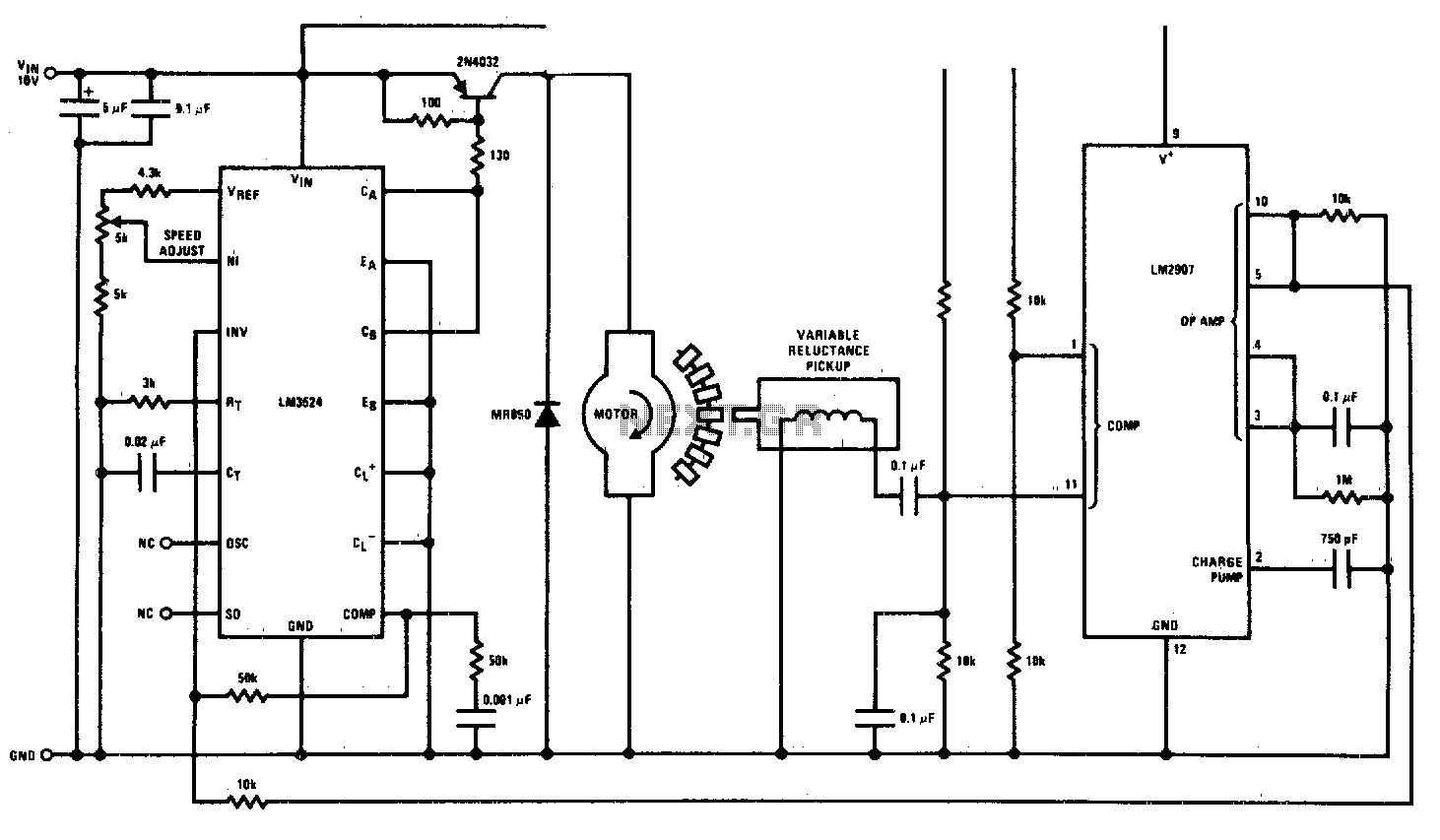
This circuit is a regulating series DC motor speed control using the LM3524 for the control and drive of the motor and the LM2907 as a speed sensor for the feedback network.
The circuit employs the LM3524 integrated circuit, which serves...
Tachless-motor-speed-controller
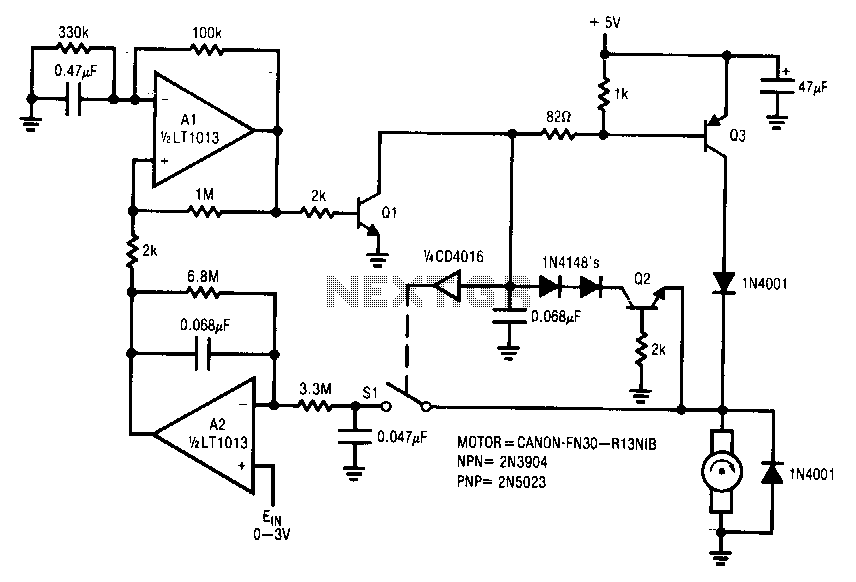
This circuit is particularly applicable to digitally controlled systems in robotic and X-Y positioning applications. By operating from a 5-V logic supply, it eliminates the need for additional motor drive supplies. The tachless feedback mechanism saves both space and cost....
battery eliminator circuit
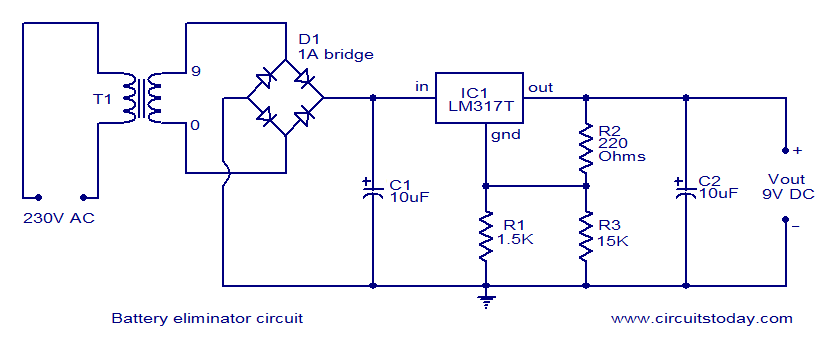
This document presents a circuit diagram of a battery eliminator circuit designed to replace 9V PP3 batteries. It can power any device that operates on a 9V battery. The transformer T1 reduces the mains voltage, while bridge rectifier D1 converts...
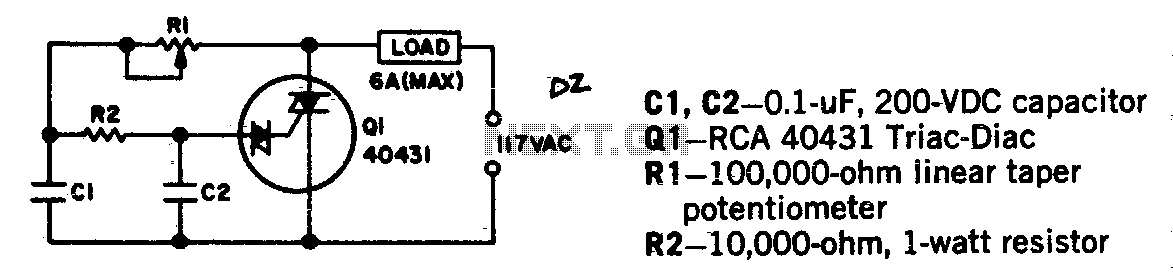
Motor speed control
Universal motors and shaded-pole induction motors can be effectively controlled using a full-wave Triac speed controller. Component Q1 integrates both the Triac and diac trigger diodes within a single package. The motor employed for the load should not exceed a...
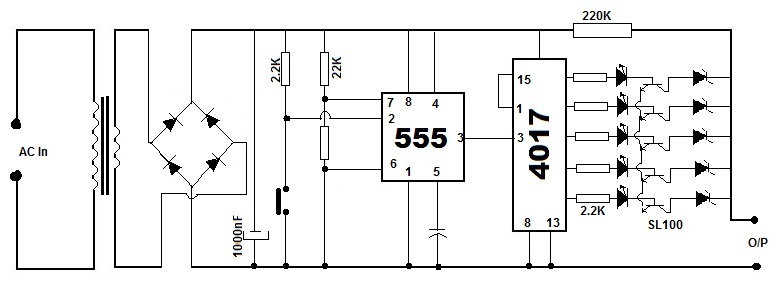
Multipurpose Battery Eliminator Circuit using 4017 Decade Counter
Battery eliminators are circuits that create a DC power supply from AC mains. Essentially, battery eliminator circuits consist of a step-down transformer, rectifier, and voltage regulator. A simple circuit of a multipurpose battery eliminator features various output voltage ranges controlled...
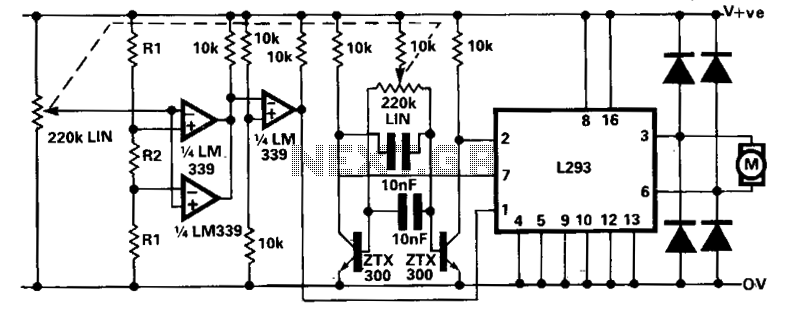
Motor speed control circuit
A limitation of the bi-directional proportional motor control circuit is that when the potentiometer is in its center position, the motor does not stop but continues to creep. This occurs due to the challenge of precisely adjusting the potentiometer to...

Motor speed control
The switching action of the 2N4990 enables the use of smaller capacitors while ensuring reliable triggering of thyristors.
The 2N4990 is a high-speed switching transistor that plays a crucial role in applications requiring efficient control of thyristors. The device's rapid switching...
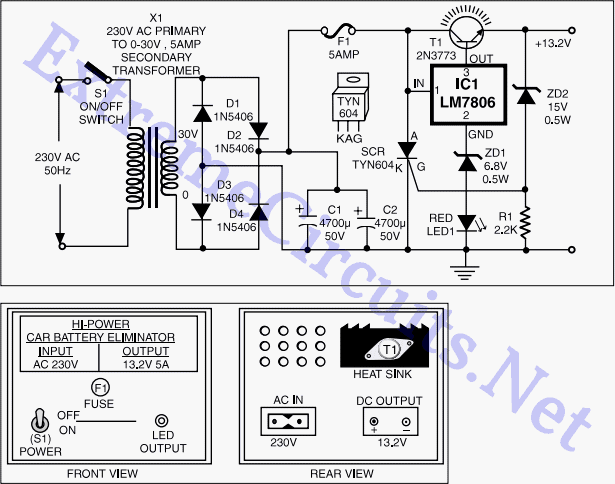
High-Power Car Battery Eliminator
To operate a car audio or video system from a household 230V AC mains supply, a DC adapter is required. DC adapters available in the market are generally costly.
A DC adapter serves as a crucial interface for converting alternating current...
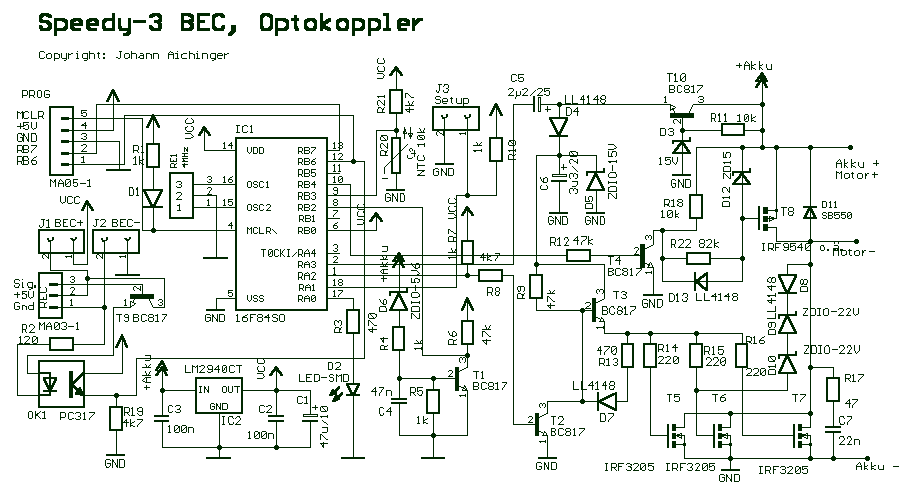
Motor Speed control with optocoupler
For normal use it is necessary to connect the battery when the jumper is connected. Please take care that the transmitter is on and the throttle is set to "power off". More: * switch on the transmitter, throttle to power...