


Common non-sinusoidal oscillator circuit waveform sawtooth oscillator use blocking oscillator
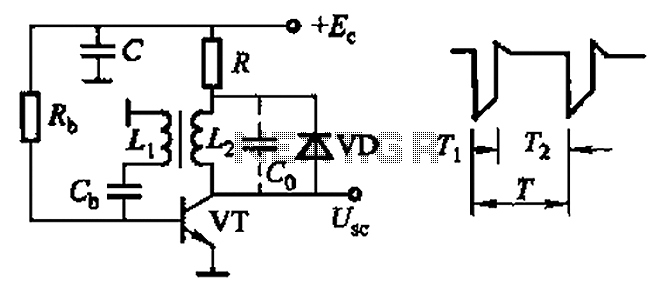
Description: Common non-sinusoidal oscillator circuit, waveform and frequency formula - sawtooth oscillator - use blocking oscillator
The sawtooth oscillator is a type of non-sinusoidal oscillator that generates a waveform characterized by a linear rise in voltage followed by a rapid drop. This waveform is commonly used in various applications, including signal generation, timing circuits, and audio synthesis. The sawtooth waveform is defined by its frequency and amplitude, which can be calculated using specific formulas.
In a typical sawtooth oscillator circuit, a blocking oscillator is employed to create the desired waveform. The blocking oscillator consists of a transistor or a similar active device, a feedback network, and timing components such as resistors and capacitors. The feedback network determines the charging and discharging time constants, which directly affect the frequency of the output waveform.
The frequency (f) of the sawtooth waveform can be calculated using the formula:
f = 1 / (T1 + T2)
where T1 is the time it takes for the voltage to rise, and T2 is the time for the voltage to drop. The amplitude of the waveform is primarily determined by the supply voltage and the configuration of the circuit.
In practical implementations, additional components such as diodes may be included to improve the performance and stability of the oscillator. The output of the sawtooth oscillator can be used to drive other circuits or devices, making it a versatile component in electronic design. Overall, the sawtooth oscillator is a fundamental circuit that serves as a building block for more complex electronic systems. Common non-sinusoidal oscillator circuit, waveform and frequency formula - sawtooth oscillator - use blocking oscillator
The sawtooth oscillator is a type of non-sinusoidal oscillator that generates a waveform characterized by a linear rise in voltage followed by a rapid drop. This waveform is commonly used in various applications, including signal generation, timing circuits, and audio synthesis. The sawtooth waveform is defined by its frequency and amplitude, which can be calculated using specific formulas.
In a typical sawtooth oscillator circuit, a blocking oscillator is employed to create the desired waveform. The blocking oscillator consists of a transistor or a similar active device, a feedback network, and timing components such as resistors and capacitors. The feedback network determines the charging and discharging time constants, which directly affect the frequency of the output waveform.
The frequency (f) of the sawtooth waveform can be calculated using the formula:
f = 1 / (T1 + T2)
where T1 is the time it takes for the voltage to rise, and T2 is the time for the voltage to drop. The amplitude of the waveform is primarily determined by the supply voltage and the configuration of the circuit.
In practical implementations, additional components such as diodes may be included to improve the performance and stability of the oscillator. The output of the sawtooth oscillator can be used to drive other circuits or devices, making it a versatile component in electronic design. Overall, the sawtooth oscillator is a fundamental circuit that serves as a building block for more complex electronic systems. Common non-sinusoidal oscillator circuit, waveform and frequency formula - sawtooth oscillator - use blocking oscillator
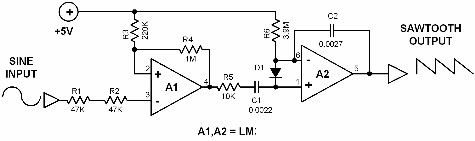
synchronized sawtooth
The sawtooth signal generated by this simple circuit is synchronized with the power line frequency. It is originally designed to control triac circuits but can be used for other special applications. The supply voltage is highly flexible and can be...
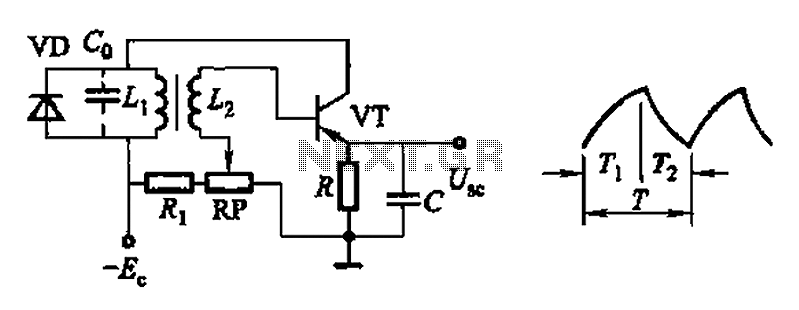
Non-sinusoidal oscillator circuit waveform pulse wave oscillator single-junction oscillator
Common non-sinusoidal oscillator circuit, waveform and frequency formula - pulse wave oscillator - single-junction transistor blocking oscillator.
The common non-sinusoidal oscillator circuit described is a pulse wave oscillator that utilizes a single-junction transistor in a blocking configuration. This type of oscillator...
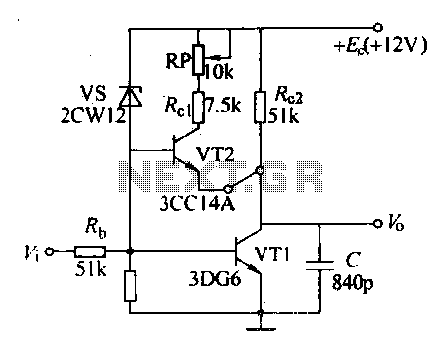
Sawtooth generator circuit II
Various sawtooth voltage generators utilize the principle of capacitor charging and discharging to produce sawtooth waveforms in both forward and reverse directions. A simple sawtooth voltage generator circuit is straightforward in design; however, it suffers from poor linearity in output...
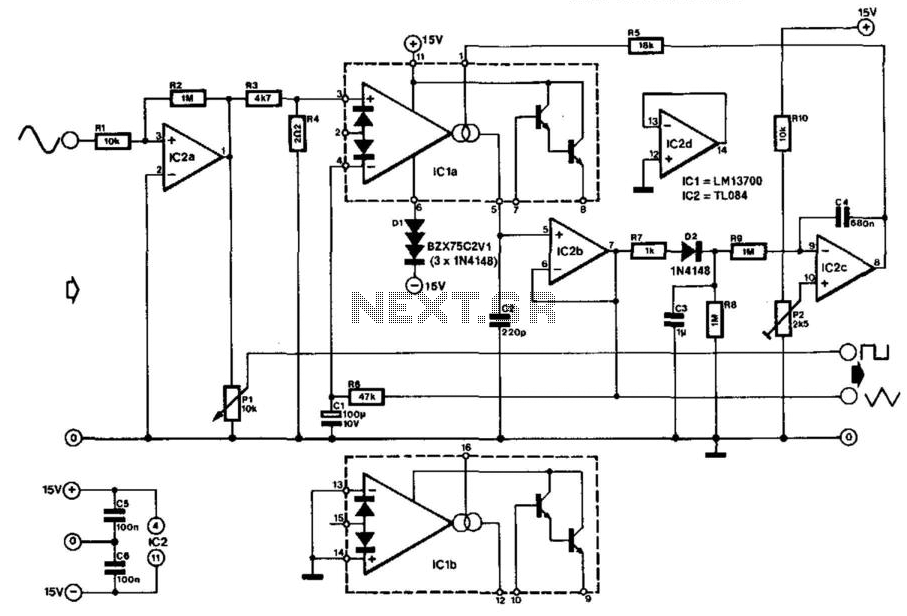
Rectangular/Triangular Waveform Converter
Many function generators utilize a rectangular waveform generator that comprises a Schmitt trigger and an integrator. The triangular signal generated by the integrator is subsequently transformed into a sinusoidal signal using a diode network. The converter described here operates inversely,...
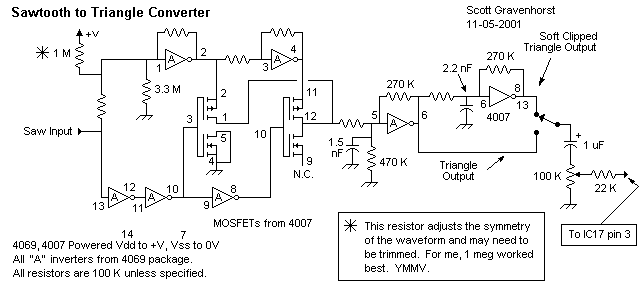
Sawtooth to triangle converter for oscillator
This wave shaper needs an input saw that goes from Vss to (ideally) Vdd. It works well with the 4069 VCO designed by Ren? Schmitz. Any saw will work as long as the wave is centered halfway between the rails....
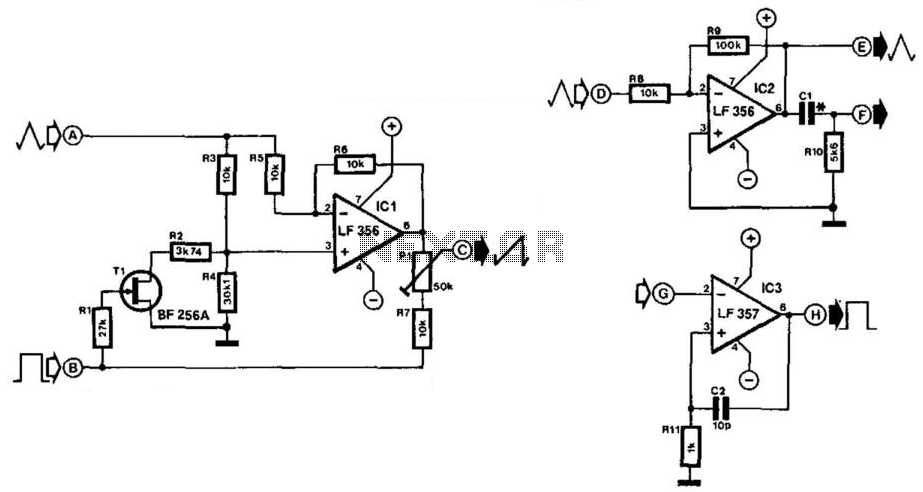
Sawtooth Converter
Simple function generators typically produce sinusoidal, rectangular, and triangular waveforms, but rarely generate sawtooth waveforms. The circuit depicted in Fig. 21-4(a) generates a sawtooth signal from rectangular and triangular signals. The quality of the sawtooth output is influenced by the...