Electronic Circuits Schematics Projects


Free energy collector circuit
Rating: 7.37/10 (19Votes cast)

Category: Inside Circuits
Views: 2167
Rank: 10

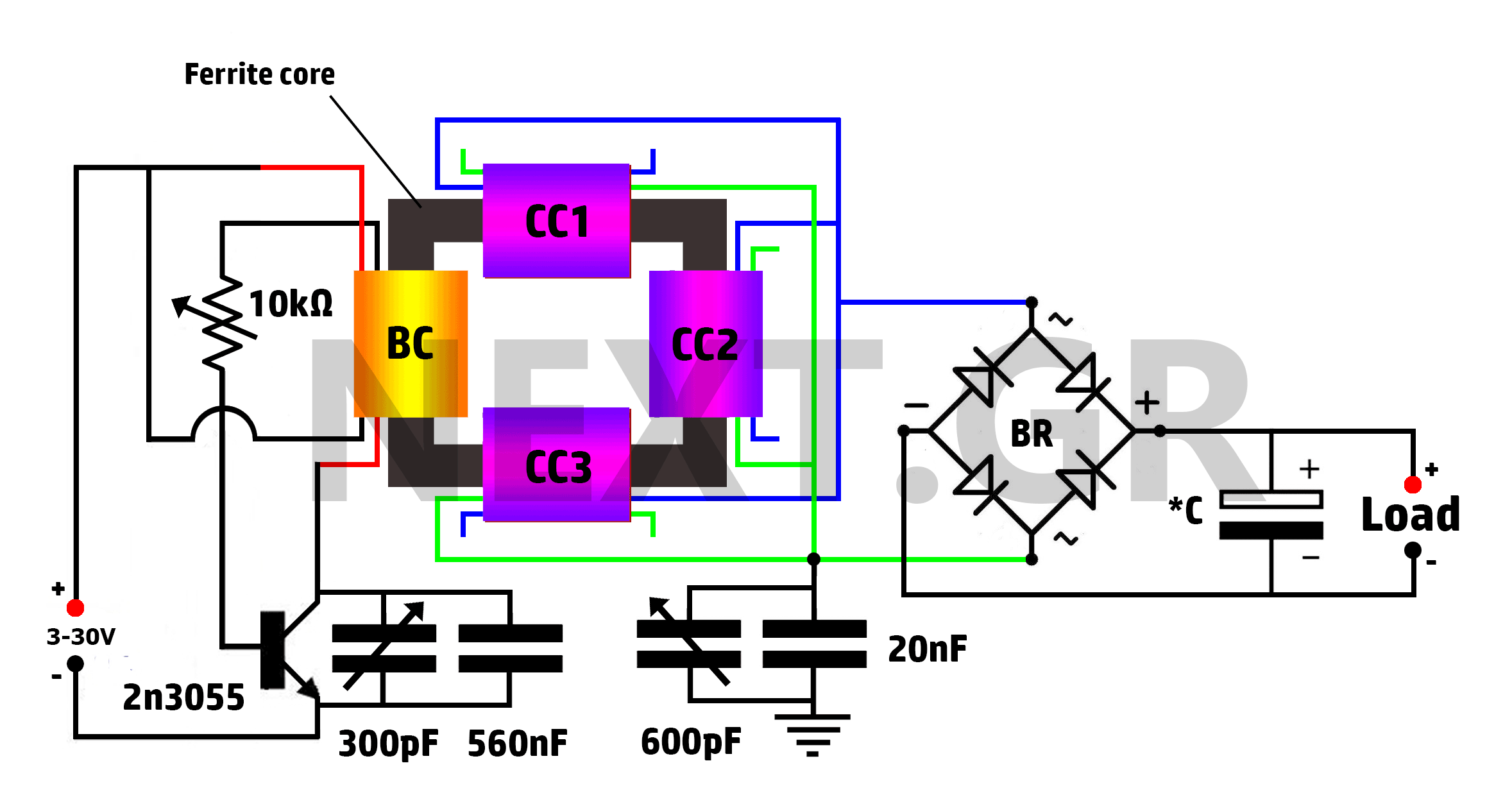
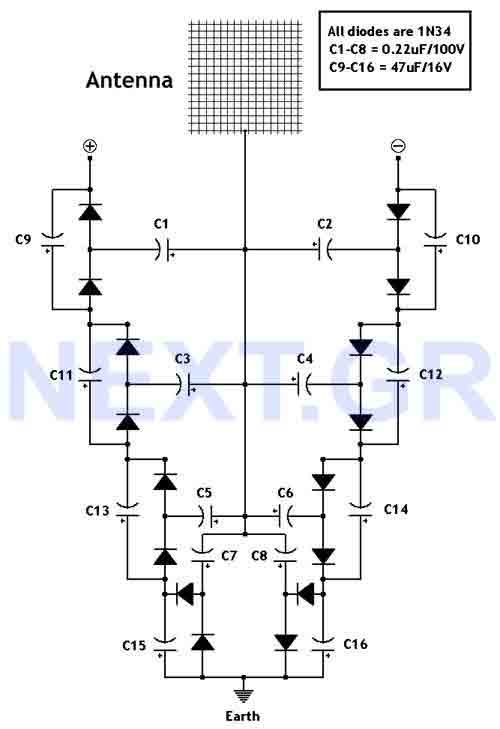
This circuit converts surrounding radio frequency waves to electric power. It can provide 40 Volts at 10 Watts indefinitely. The output power can be improved playing with the antenna. Placing the antenna near large metal objects gives more power. Antenna should be more than 150 feet long wire, placed horizontally as high as you can for best results. The pointing direction also is critical to the output. Keep the circuit as close to antenna as posible. You can also experiment with dishes etc. The circuit also acts as a passive detector. When large metal objects passes the power gets higher. Also its sensitivity can detect energy changes on earth and so it can used as early warning of seismic activity
Free energy collector circuit


It appears that antenna placement is critical to output. By constructing many of these circuits and connecting their outputs together, you could produce the energy to power a house. Remember each unit needs its own anntena. The best thing to do is to experiment with diferent lengths and sizes of anntenas. Every place on earth has diferent levels of RF power. Ofcource near large citys or near transmiters where RF is huge on air, the circuit works much better. To get an idea of making the best anntena, Imagine that this unit as an all frequency radio reciever. A very critical point to consider is the earth ground of the circuit which has to be properly conductive. An earth ground should consist of some type of metallic, conductive pipe or rod. Use the earth of your house or buy a new earth ground from the market hammer it as deep as you can for best results.
Related circuits

High quality tone control

The circuit is based on an inverting op amp using discrete transistors to overcome poor slew rate, fairly high distortion, and high noise problems. The output stage is driven by a constant current source, biased by a green LED to provide temperature compensation. With the controls flat, the unit...


Ttl-compatible crystal oscillator

Adjust Rl for about 2 volts at the output of the first gate


Data Acquisition System Ii

In this circuit, an HA-4900 series comparator is used in conjunction with a D/A converter to form a simple, vers


Phone-In-Use Indicator

The circuit receives its power from a 15-V wall adapter (not shown). The circuit takes advantage of the fact that th


Picture-fixer-inverter

The circuit will accept a video signal, separate the sync pulses, invert the video, and add new video to the old sync pulses. The video signal is brought in through Jl and applied to a clamping circuit consisting of Cl, Dl, D2,D3, Rl, and R2. The clamp circuit forces all of the sync pulses to...


555 Astable oscillator

This free-running multivibrator uses an external current sink to discharge the timing capacitor, C. Therefore, interval ^ may easily be 1000 the pulse duration, t1( which defines a positive output. Capacitor voltage, V^, is a negative going ramp with exponential rise during the pulse output...


Visible-red-continuous-laser-gun

Ql and Q2 switch the primary windings of transformer Tl via a square wave at a frequency determined by its magnetic properties. Diodes Dl and D2 provide base return paths for the feedback current of Ql and Q2. The output winding of T1 is connected to a multiple section voltage multiplier. That...


True rms detector

The circuit will provide a dc output equal to the rms value of the input. Accuracy is typically 2% for a 20 Vpp input signal from 50 Hz to 100 kHz, although it"s usable to about 500 kHz. The lower frequency is limited by the size of the filter capacitor


free energy selfrunning electronic circuit Kapanadze replication

Free energy From Air Circuit part 2/24


Comments

Dusan wrote on Sep 18, 2008
Is this thing working? I think that C9-C15 are reverse polarized.
Dk wrote on Oct 29, 2009
the use of capator ?
mike/Nov25,2008 wrote on Nov 28, 2008
Iam really amazed. what about ,if you can use something like Radio RF circuit for reception ,to avoid very high antena.
talu wrote on Dec 2, 2008
what kind of antenna? is it just a single straight wire placed horizontally?
Bob wrote on Sep 3, 2008
Wow.. I love that circuit! thanks!
Kagami wrote on Sep 18, 2008
That circuit is working just great. But you need to connect it ti real earth very well.
YasouM wrote on Nov 13, 2008
I'll give it a go...thanks
umair wrote on Nov 10, 2008
brother how it is worrking.
umair wrote on Nov 17, 2008
plz plz some body tell me that how this is working.plz
RANDY wrote on Nov 17, 2008
WHEN YOU SAY TO KEEP CIRCUIT CLOSE TO ANTENNA WHAT DO YOU MEAN,, ISNT THE CIRCUIT HOOKED UP TO ANTENNA. AND WHAT IS THE HIGHEST VOLTAGE YOU HAVE GOT
Zooba wrote on Nov 19, 2008
I think He means to elevate the circuit with antenna high close together.
Didik wrote on Dec 27, 2008
This circuit makes sense, because I already had previous attempts with a diode and a capacitor. This is very useful, as energy for booster antenna. This is very good and very useful.
rezvan wrote on Jun 28, 2009
plz any body tell me how it work . iam doing mini project on this and the out is not coming .plz help me out
sinergicus wrote on Jul 5, 2009
This circuit will work with another diodes model? For example 1n4007 ?Germanium diodes is very rare in my country ,and expensive...
spuffler wrote on Jul 13, 2009
Wow... the antenna is only 150 feet long? Oh, wait, there are 2 antennae. I wonder if the author lived near a clear channel fm transmitter.
spuffler wrote on Aug 11, 2009
C'mon folks.... how practical is this: "Antenna should be more than 150 feet long wire, placed horizontally as high as you can for best results."
mikeestrada wrote on Jul 22, 2009
As I see the diodes are arranged in a voltage multiplier mode. So for more voltage, you can add more diodes and caps.
Dk wrote on Oct 29, 2009
the use of capator?...I'm Vietnamese^^
Random kid wrote on Aug 27, 2009
Are you sure it works?
wrote on Sep 12, 2009
Yes Dusan,I've noticed that from C9 to C15 should be reverse also...Can someone check if we're right...or if he's done,does it works for any1 like in schematic?
wrote on Sep 13, 2009
Please Dusan, or other electronic-brothers in Serbia & other Country,answer or send me mail to: "milovanovic.ne@sbb.rs" My little block with only 4 Ga-diodes work & give me about 2v.(with antenna Cu-coil~long=1meter), but original with 16 diodes give me only 0,5-0,6v.???
nely wrote on Dec 6, 2009
is there any replacement for germaniium diodes?wan u used silicon 1n4148?pls rply asap
yousaf wrote on Dec 29, 2009
this is a wonderful circuit ............... a good energy source. It is helpful to reduce the atmospheric noise generated by comunication systems. the antenna must be compatible...... any body using adjustible antenna may get better results
mr hayman wrote on Jan 6, 2010
You cannot use silicon diodes, only crystal diodes, like from a crystal radio. Circuit converts the high frequency alternating radio waves captured by the antena into DC, like a radio. But uses a voltage multiplier to increase the voltage. Probably mostly 60 or 50 Hz energy from local grid.
yazid wrote on Feb 4, 2010
i have tried it.. but, the result current is very low.. how to amplify the current? any circuit to multiply the current? thx
alternative diode? wrote on Mar 10, 2010
about the germanium diode: they can be bought from http://www.futurlec.com/DiodesGen.shtml still, at 0,5$ not cheap. as an alternative Shottky 1N5819 or BAT85 MIGHT work. 2 possibles issue: high capacitance, higher leakage current than germanium (???) at 4ns its fast
newbee wrote on May 25, 2010
what about the capacitors c1-8, what type are they? tantalum or just some ceramic caps. tnx a lot pls reply
vfrr wrote on May 27, 2010
Hello! oa1180 germanium dioda steps up voltage 40 volt, one led may not be but diodat does not tool.
lwblack wrote on Jul 21, 2011
If you studied electricity, you know to increase amp is to decrease voltage. I suggest then to get your voltage up as high as you can get using this or a similar circuit. Then place a step-down transformer to say 12 VDC. The amperes will go up. Wattage will always remain the same(watts=volts*amps). Example: 175vdc*.01amp=1.75watts~1.75watts\12vdc=.1458amps OR 1.75watts\1.75vdc=1amp. Now consider that you want to charge a cell phone(using5vdc .35amp) with this circuit producing 1.75 watts: 1.75watts\5vdc=.35amps; more than enough to keep your cell phone charged. The reverse is also correct. When you witness a voltage stepped up you will also note that amps are stepped down.
OUT IN THE OPEN wrote on Jul 21, 2011
A STRONG SATILLITE SIGNAL AND DISH ,CONNECT THIS CIRCUIT BETWEEN THE LNB ( THATS FITTED ON THE DISH ) AND A GOOD EARTH , FREE ENERGY BEAMED TO YOUR DOOR STEP .... ENJOY
BAM wrote on Oct 23, 2011
ill try this thanks!
DéDé wrote on Feb 22, 2012
@yazidJust Use more diodes and caps then convert it to AC and transform it to a higher current with a transformer. You will get a lower voltage but that doesn't matter verry much.Dédé.
ugis wrote on Aug 28, 2012
I have a 40 m antenna, 5 m above the ground horizontally.With only 1 diode and capacitor I got 35-55V on a clear day, and even a pair of rainy 100V.I had no power, only voltage. I think this scheme is to try to have more power. Thank you!
mikerady wrote on May 2, 2012
You rock! I've been looking at that circiut for awhile but I didn't know the value of capacitors ,or understand let's say. Very helpful god bless you. Want to see more
John Robert Posey wrote on May 2, 2012
Contact me if you find this info useful;Im a 17 year old electronics experimenter, and I'll explain some of how this circuit works, and how to make it better.1) Use germanium diodes (or any high frequency diodes) and not rectifier diodes, to increase output from RadioFrequency.2) RF construction tip; The smaller-value capacitors will work best if they are antique "silver mica." They dont make them anymore, but they are well worth it, because of how well they work with radio energy. You could also try ceramic ones if you cant get old silver micas. Do NOT use polyester types. For the larger values, regular electrolytic ones are fine. They are polarized correctly.3) The purpose of the capacitors is to build up charge until it is powerful enough to discharge into the other capacitors, amplifying it. 4) If there werent diodes, there would be equal amounts of + & - potentials, but they would cancel eachother out. The diodes separate them into + and -, so you can use the electricity.
djbuggybee wrote on May 3, 2012
antenna: 30 meters in the air. the ground: copper tubing driven into the ground about 5 feet. the circuit in quite simple, just a rectifier bridge, with a capacitor in the center.I found that adding an inductor to the bottom (ground) helps pull in more power.I am exsperimenting with modifications of crystal radio schematics, meaning, i am adding an adjustable inductor and capacitor to it so adjustments can be made to optimize performance.the theory: utilizing the voltage potential between air (+) and ground (-). The resonant frequency of our planet is near 7.8 Hz, so specifically, we would want to tune into that. That 7.8Hz is 100's meters in amplitude, so tapping it is fairly impractical.you want the circuit to be in the center of the ground and antenna, and not be flexing wires about, because this produces inductive losses (wire that is curved creates an EM feild)Look up tesla patent and crystal radio to get stared. Use germanium diodes. Also lookup mosfet rectifier bridge.
djbuggybee wrote on May 3, 2012
The main problem is the antenna height. It is critical to the effectiveness of the circuit. Since we are utilizing voltage potential between ground and air, the closer the antenna is to ground, the lower the potential voltage. all of my tests have been done from about 3.5 meters above ground, and a spike of 5 nails as my ground tap. so, not following my own advice on that one, but by improving the ground and arial connection, improvements can be made.from my 10 foor hig antenna, and my rectifier bridge made with silicon diodes, i get about .001v in 30 seconds. the potential is pretty consistant on a sunny day, and the AC voltage from the ground and antenna is .238vac. so multiply the 10 foot antenna by 10, and all of the sudden, the circuit flourishes.My tests at home show that this works, and there is room for improvement.My ideas include a self tuning (digitally?) portion that help modulate the AC.a mosfet based rectifier bridge instead of diodes to save power.
Anonymous wrote on May 14, 2012
This is a terrible circuit, I found one that uses 4 caps and 4 resistors and does better than this. Also, you can't have a wire "as high as possible" when it's horizontal.


 characters left

Captcha

captchaPlease input letters you see on the image.
Click on image to redraw.


Facebook Comments

Most searched
 
Accounts area
Username:
Password:
Forgot password? Register
Circuits