


Multi-channel data acquisition ISO100 isolation circuit of a programmable gain amplifier
#data acquisition
#isolation circuit
#programmable gain amplifier
#optocoupler
#PGA100
#multichannel
#signal conditioning
#instrumentation amplifier
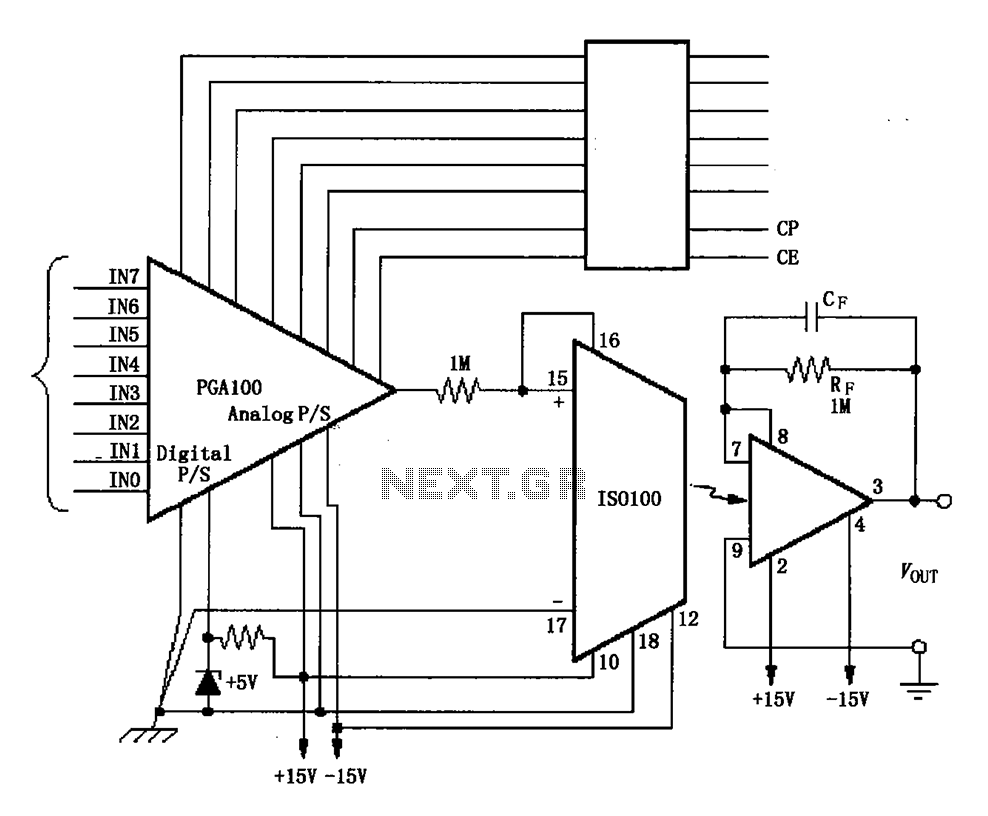
Description: The ISO100 multichannel data acquisition system comprises a programmable gain amplifier isolated by an optocoupler, a programmable amplifier (PGA100), and an isolation amplifier (ISO100). The optocoupler selects three channels and is coupled to the programmable gain amplifier, which can select from 23 different signals across three channels. The input signals from the 8-channel data acquisition system are amplified by the PGA100 before being sent to the isolation amplifiers. The output from the ISO100 isolation amplifier ensures effective signal isolation. This circuit design demonstrates excellent anti-jamming performance, making it suitable for noisy applications such as industrial field signal acquisition.
The ISO100 multichannel data acquisition system is designed to enhance signal integrity and isolation in environments with high electromagnetic interference (EMI). The system begins with a programmable gain amplifier (PGA100) that allows for adjustable gain settings, optimizing the signal level for further processing. The optocoupler serves a critical role in isolating the input signal from the output stage, ensuring that noise or voltage spikes from one part of the system do not affect others.
The optocoupler is configured to select among three channels, enabling the system to handle multiple input signals effectively. Each channel can process a selection of up to 23 different signals, providing flexibility in various applications. The output from the PGA100 is then fed into the isolation amplifiers, specifically the ISO100, which further isolates the amplified signal from the following stages of the circuit.
The ISO100 isolation amplifier is known for its high common-mode rejection ratio (CMRR), which minimizes the impact of noise and interference on the output signal. This characteristic is particularly advantageous in industrial environments where signals are often contaminated by electromagnetic noise. The design of the circuit ensures that the final output retains the integrity of the original signal, making it suitable for applications that require precise data acquisition.
In summary, the ISO100 multichannel data acquisition system is a robust solution for signal acquisition in noisy environments. Its combination of programmable gain amplification, channel selection via optocouplers, and effective isolation amplifiers allows for reliable and accurate data collection in challenging conditions. As shown in FIG grounds ISO100 multichannel data acquisition system consisting of a programmable gain amplifier isolation by optocoupler, programmable amplifier PGA100 and isol ation amplifier ISO100 composition. Optocoupler will select three channels and three-way choice coupled to the programmable gain amplifier, three channels select the optional 23 8 signals. 8-channel data acquisition system input signal after amplification by the PGA100 choose to output isolation amplifiers, after ISO100 isolation amplifier output.
As a result of a variety of isolation, the circuit shown in FIG excellent anti-jamming performance for noisy applications (such as industrial field signal acquisition).
The ISO100 multichannel data acquisition system is designed to enhance signal integrity and isolation in environments with high electromagnetic interference (EMI). The system begins with a programmable gain amplifier (PGA100) that allows for adjustable gain settings, optimizing the signal level for further processing. The optocoupler serves a critical role in isolating the input signal from the output stage, ensuring that noise or voltage spikes from one part of the system do not affect others.
The optocoupler is configured to select among three channels, enabling the system to handle multiple input signals effectively. Each channel can process a selection of up to 23 different signals, providing flexibility in various applications. The output from the PGA100 is then fed into the isolation amplifiers, specifically the ISO100, which further isolates the amplified signal from the following stages of the circuit.
The ISO100 isolation amplifier is known for its high common-mode rejection ratio (CMRR), which minimizes the impact of noise and interference on the output signal. This characteristic is particularly advantageous in industrial environments where signals are often contaminated by electromagnetic noise. The design of the circuit ensures that the final output retains the integrity of the original signal, making it suitable for applications that require precise data acquisition.
In summary, the ISO100 multichannel data acquisition system is a robust solution for signal acquisition in noisy environments. Its combination of programmable gain amplification, channel selection via optocouplers, and effective isolation amplifiers allows for reliable and accurate data collection in challenging conditions. As shown in FIG grounds ISO100 multichannel data acquisition system consisting of a programmable gain amplifier isolation by optocoupler, programmable amplifier PGA100 and isol ation amplifier ISO100 composition. Optocoupler will select three channels and three-way choice coupled to the programmable gain amplifier, three channels select the optional 23 8 signals. 8-channel data acquisition system input signal after amplification by the PGA100 choose to output isolation amplifiers, after ISO100 isolation amplifier output.
As a result of a variety of isolation, the circuit shown in FIG excellent anti-jamming performance for noisy applications (such as industrial field signal acquisition).

Signal Conditioning Analog Front-end for Microcontrollers
The I/O board incorporates 16-bit resolution voltage analog inputs and outputs, along with a 4-20mA current loop transmitter and receiver for microcontroller applications. The document discusses amplifier circuits and schematics, including a signal conditioning variable gain amplifier, analog filter, and...
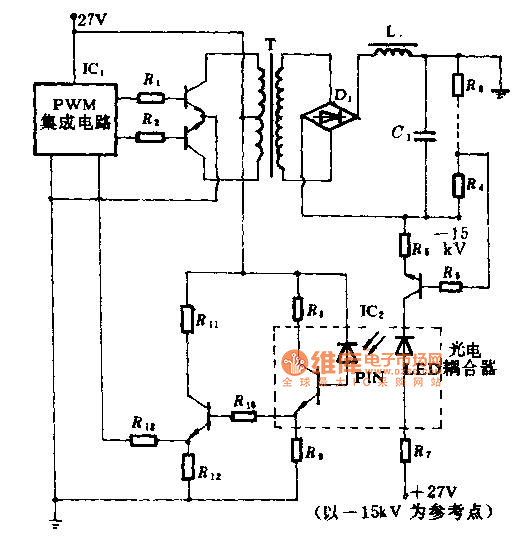
High voltage speed optocoupler and application circuit diagram
The technical parameters of high-speed optocouplers include a rise time (t1) of less than or equal to 300 ns, a circuit transfer ratio (CTR) of 50%, an isolation voltage (VSO) of at least 15,000 V, and an output transistor reverse...
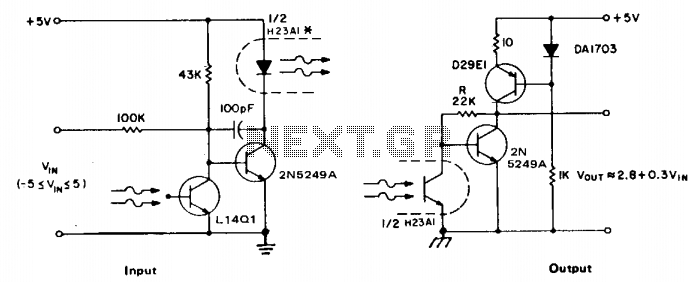
Dc linear coupler
The accuracy of direct linear coupling of analog current signals through an optocoupler is influenced by the linearity of the coupler and its temperature coefficient. Implementing an additional coupler for feedback can enhance linearity, but only if both couplers are...
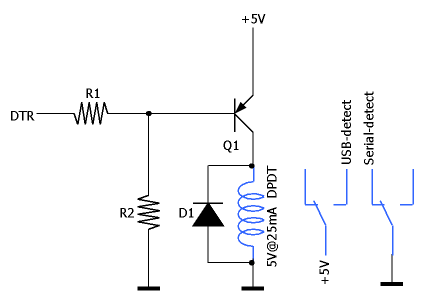
Dual cable (serial + USB) for Nikon coolpixes
To ensure that the USB and serial segments are electrically isolated, an optocoupler (U1) is employed. The LED section of U1 is directly driven by the Data Terminal Ready (DTR) signal, necessitating the selection of a highly sensitive optocoupler to...
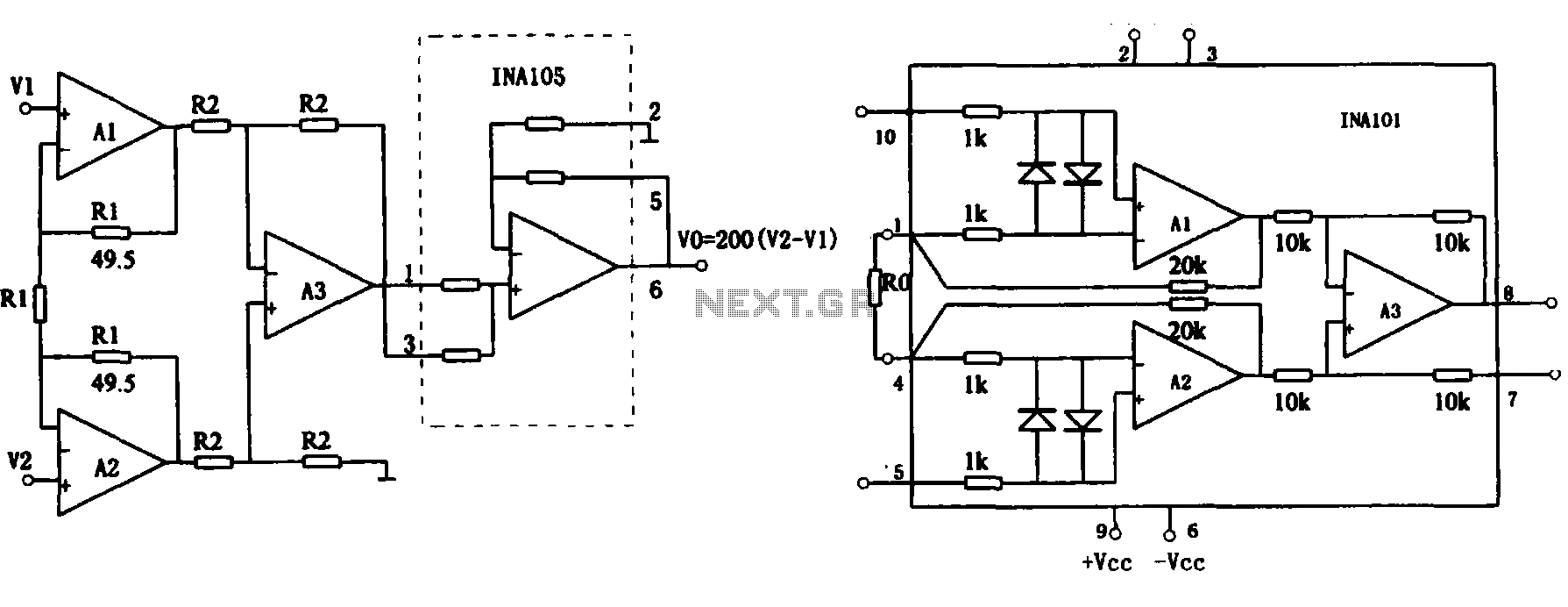
Extended common mode range of the instrumentation amplifier (INA101) circuit
This document describes the extended common mode input voltage range of an instrument amplifier circuit. The circuit consists of three precision instrument amplifiers, A1, A2, and A3, which can be INA101 or INA102 models. The figure illustrates that A1, A2,...
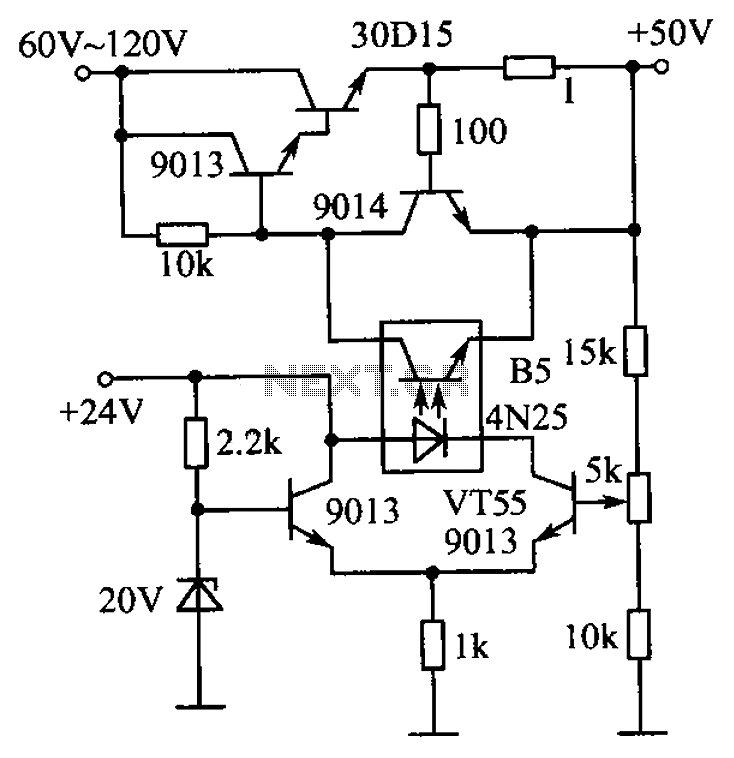
High voltage stabilizing circuit diagram composed of optocouplers
The circuit is illustrated. A standard driving transistor requires a higher breakdown voltage transistor (such as the FIG driving tube 9013). As the output voltage rises, the bias on VT55 increases, leading to an increase in the forward current of...
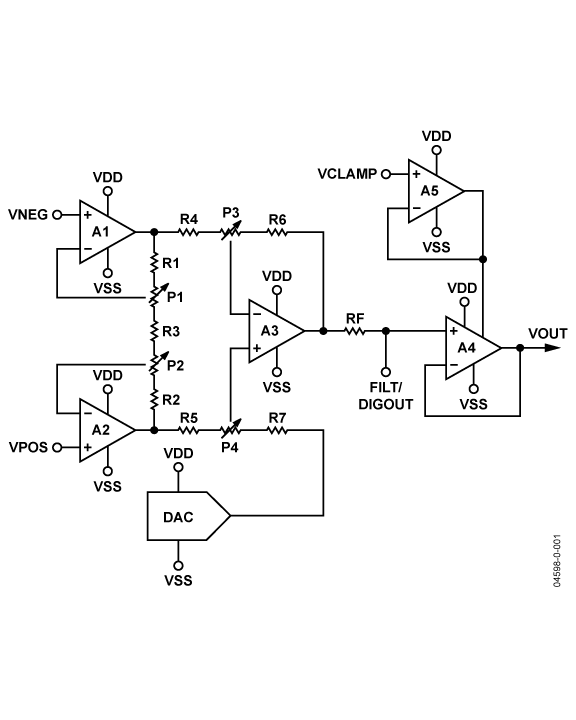
instrumentation amplifiers
The AD8555 is a zero-drift sensor signal amplifier featuring digitally programmable gain and output offset. It is designed to effectively and accurately convert variable pressure sensor and strain bridge outputs into a well-defined output voltage range. Additionally, the AD8555 can...
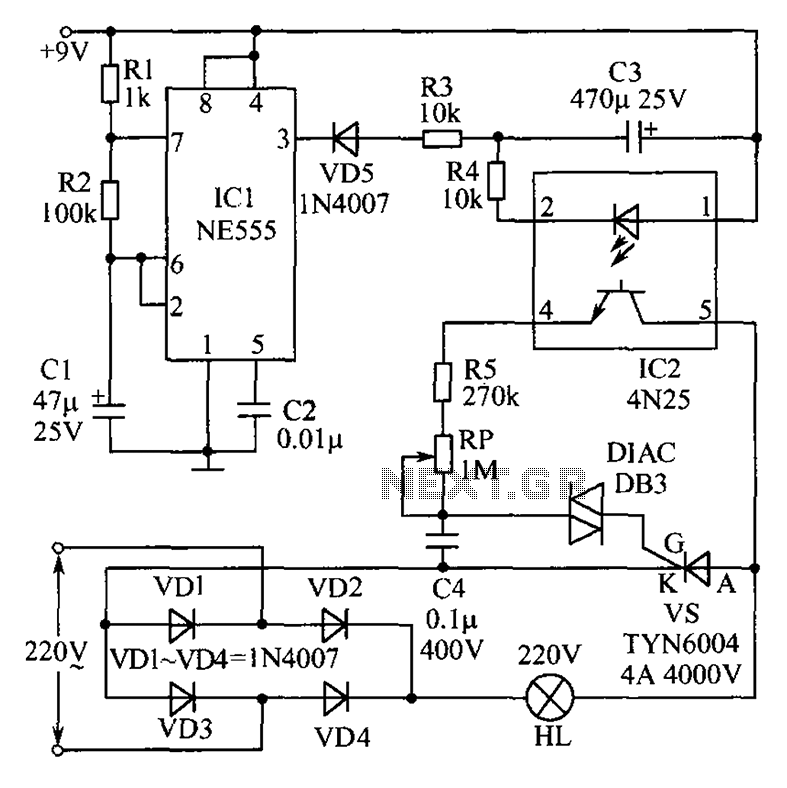
Christmas lights consisting of a circuit diagram of optocoupler
This circuit features an appealing Christmas lights setup. Upon activation, the lights (HL) gradually increase in brightness. Once they reach maximum brightness, they automatically dim, and upon reaching the lowest brightness, they gradually brighten again, creating a smooth transition throughout...
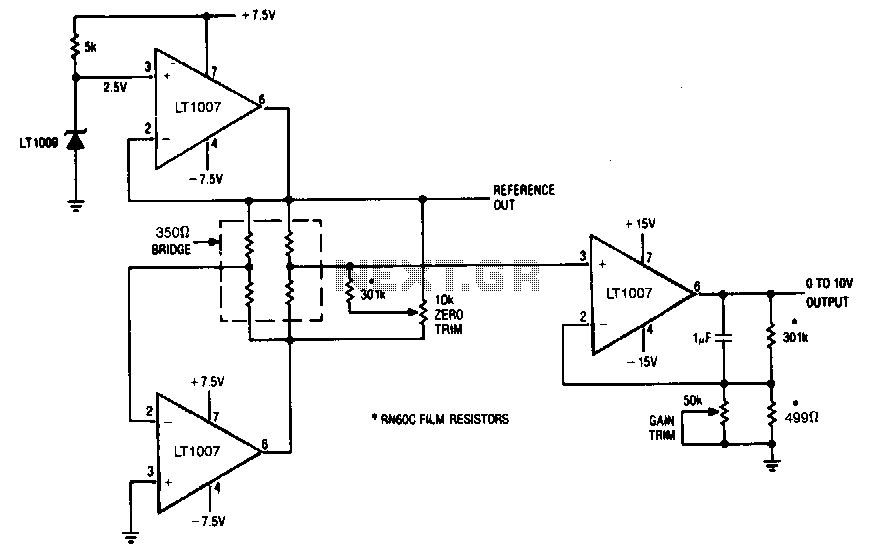
Signal-conditioner-with-bridge
The LT1007 is capable of providing excitation current directly to bias the 350-0 bridge at 5 V. With only 5 V across the bridge, as opposed to the usual 10 V, total power dissipation and bridge warm-up drift is reduced....