


how to design h bridge circuit for
#H-bridge
#transistors
#MOSFETs
#switching
#motor driver
#control circuit
#electronics
#DC motor
#PWM
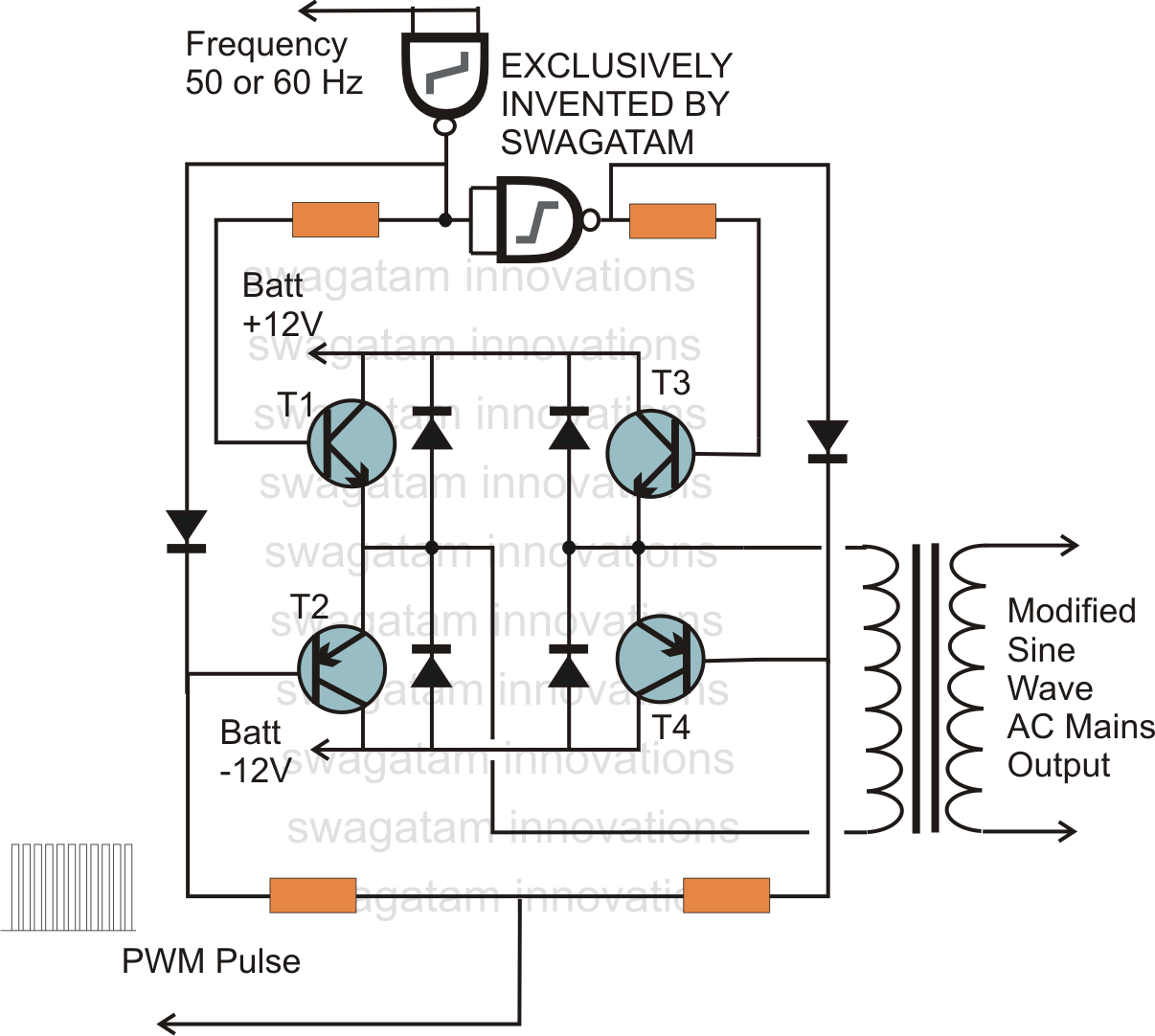
Description: In electronics, an H-bridge circuit refers to a configuration consisting of four individual switching devices, such as transistors or MOSFETs, which can be controlled by external discrete signals from the respective stages of the control circuit. During operation, the complementary pairs from each arm of the bridge switch together, meaning that the NPN device from the left arm and the PNP device from the right arm conduct simultaneously in response to an external applied signal. This arrangement generates a push-pull effect in the connected transformer winding of the inverter, which in turn produces a complete AC cycle at the output of the transformer. The unique arrangement of the devices allows for driving them through two individual signal sources: one determines the switching rate of the output, while the other controls the RMS value of the output from the transformer. Transistors T2 and T4 are fed with PWM pulses that switch ON together; however, when T1 is conducting, T2 remains OFF, and similarly, when T3 conducts, T4 stays OFF. The two diodes from the respective NAND gates manage this operation, allowing only the relevant transistors to perform the PWM switching. Consequently, the NPN transistors are responsible for generating regular 50 or 60 Hz pulses, while the PNP transistors break the square waves according to the PWM sections.
The H-bridge circuit is a crucial component in applications requiring bidirectional control of motors and other inductive loads. The four switches are typically arranged in a bridge topology, where two switches connect to the positive supply voltage and two connect to the ground. This configuration allows for the reversal of current through the load by selectively turning on the appropriate switches.
When designing an H-bridge, careful consideration must be given to the switching devices used, as they must handle the load current and voltage levels. MOSFETs are often preferred for their high efficiency and fast switching capabilities. Additionally, gate drivers may be employed to ensure that the transistors are turned on and off efficiently, minimizing switching losses and heat generation.
The control logic for the H-bridge can be implemented using microcontrollers or dedicated driver ICs, which provide the necessary PWM signals to modulate the output voltage and control the speed of the connected motor. The PWM frequency must be chosen based on the application requirements, balancing responsiveness and efficiency.
Protection features, such as diodes for flyback protection, should be incorporated to safeguard the circuit from voltage spikes generated by inductive loads. Furthermore, incorporating feedback mechanisms can enhance performance by allowing real-time adjustments to the PWM signals based on the load conditions.
In summary, the H-bridge circuit is a versatile and efficient solution for controlling the direction and speed of motors, making it an essential component in various electronic applications, including robotics, automotive systems, and industrial automation.In electronics H-bridge circuit refers to a configuration consisting of four individual switching devices like transistors or mosfets, such that these can be switched through external discrete signals from respective stages of the involved control circuit. While switching, the complementary pairs from each of the arms switch together, meaningthe NPN device from the left arm and the PNP
device from the right arm of the bridge conduct together in response to an external applied signal. The arrangement generates a push pull effect in the connected transformer winding of the inverter which in turn generates a required one full cycle of AC at the output of the transformer. The special arrangement of the devices make it possible for driving the devices through two individual signal sources, one which decides the switching rate of the output while the other decides the RMS value of the output from the transformer.
Transistors T2 and T4 ae fed with the PWM pulses which switch ON together, however when T1 is conducting, T2 should remain shut OFF and similarly when T3 conducts T4 should remain OFF, the two diodes from the respective NAND gates takes care of the issue and allow only the relevant transistors to carry out the PWM switching. Thus the NPN transistors are responsible for producing the regular 50 or 60 Hz pulses while the PNP transistors are responsible for breaking the square waves as per the PWM sections.
The H-bridge circuit is a crucial component in applications requiring bidirectional control of motors and other inductive loads. The four switches are typically arranged in a bridge topology, where two switches connect to the positive supply voltage and two connect to the ground. This configuration allows for the reversal of current through the load by selectively turning on the appropriate switches.
When designing an H-bridge, careful consideration must be given to the switching devices used, as they must handle the load current and voltage levels. MOSFETs are often preferred for their high efficiency and fast switching capabilities. Additionally, gate drivers may be employed to ensure that the transistors are turned on and off efficiently, minimizing switching losses and heat generation.
The control logic for the H-bridge can be implemented using microcontrollers or dedicated driver ICs, which provide the necessary PWM signals to modulate the output voltage and control the speed of the connected motor. The PWM frequency must be chosen based on the application requirements, balancing responsiveness and efficiency.
Protection features, such as diodes for flyback protection, should be incorporated to safeguard the circuit from voltage spikes generated by inductive loads. Furthermore, incorporating feedback mechanisms can enhance performance by allowing real-time adjustments to the PWM signals based on the load conditions.
In summary, the H-bridge circuit is a versatile and efficient solution for controlling the direction and speed of motors, making it an essential component in various electronic applications, including robotics, automotive systems, and industrial automation.In electronics H-bridge circuit refers to a configuration consisting of four individual switching devices like transistors or mosfets, such that these can be switched through external discrete signals from respective stages of the involved control circuit. While switching, the complementary pairs from each of the arms switch together, meaningthe NPN device from the left arm and the PNP
device from the right arm of the bridge conduct together in response to an external applied signal. The arrangement generates a push pull effect in the connected transformer winding of the inverter which in turn generates a required one full cycle of AC at the output of the transformer. The special arrangement of the devices make it possible for driving the devices through two individual signal sources, one which decides the switching rate of the output while the other decides the RMS value of the output from the transformer.
Transistors T2 and T4 ae fed with the PWM pulses which switch ON together, however when T1 is conducting, T2 should remain shut OFF and similarly when T3 conducts T4 should remain OFF, the two diodes from the respective NAND gates takes care of the issue and allow only the relevant transistors to carry out the PWM switching. Thus the NPN transistors are responsible for producing the regular 50 or 60 Hz pulses while the PNP transistors are responsible for breaking the square waves as per the PWM sections.
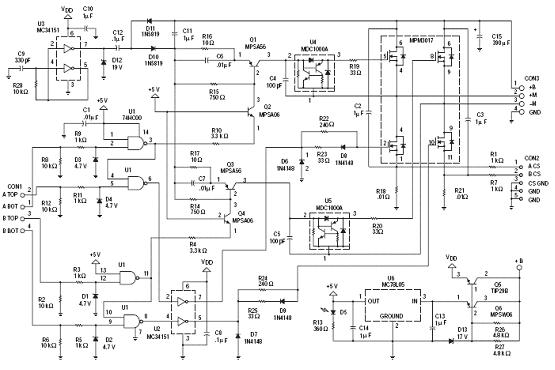
N-Channel H-bridge Motor Drive
The following circuit illustrates an N-Channel H-bridge motor drive circuit diagram. Features include low voltage motor drives utilizing N-channel MOSFETs.
The N-Channel H-bridge motor drive circuit is designed to control the direction and speed of a DC motor using low voltage....
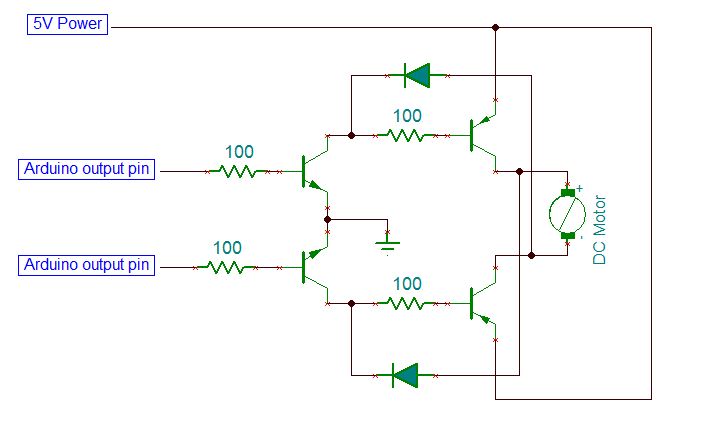
STHS Computer Technology
On the breadboard, construct two bi-directional motor control circuits, commonly referred to as "H-bridge" circuits. These circuits will manage the two DC motors that propel the wheels. Each circuit will have two wires connected to the Arduino (one for forward...
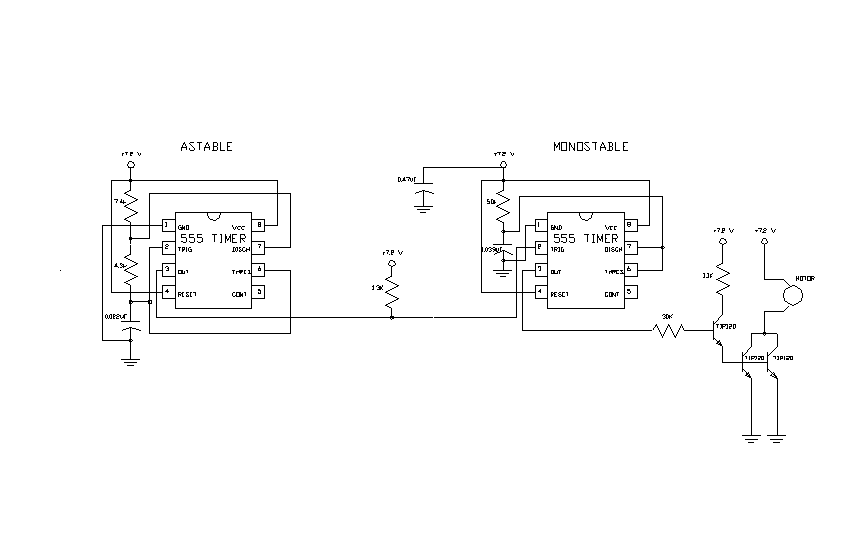
pulse width modulated (PWM) controller for high current
The second 555 timer was configured as a monostable circuit, commonly referred to as a one-shot since an output pulse only occurs if there is a trigger on the input. When this timer is triggered, the potentiometer in the RC...
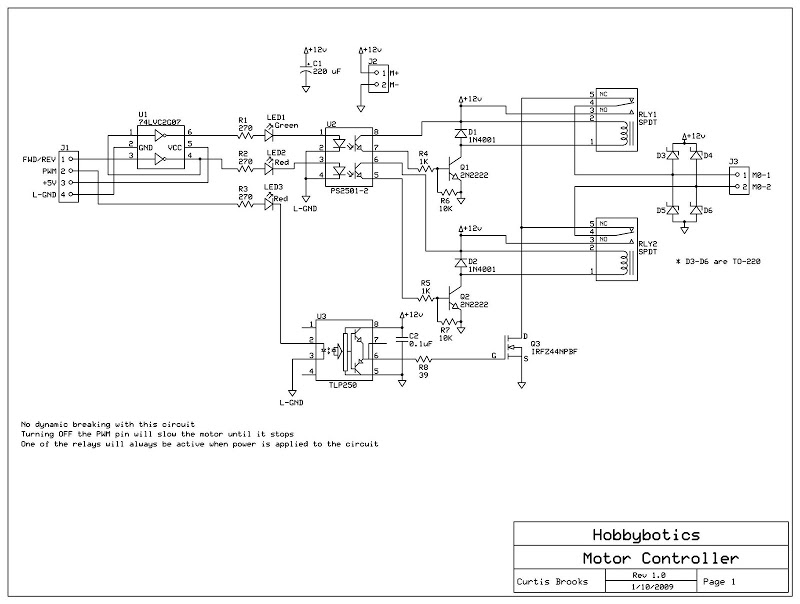
H-bridge circuit
Develop a cost-effective high-current circuit that utilizes PWM. The design includes flyback diodes to protect the MOSFET from the back EMF generated by the motor when the power is switched on and off via the PWM signal. This configuration is...
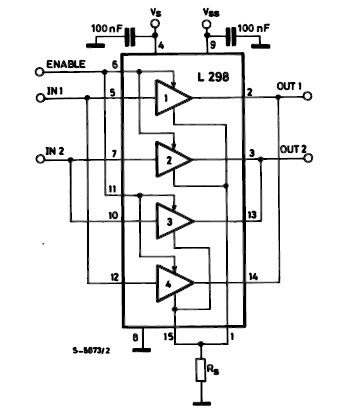
dc motor driver with h bridge ic l293d
The L298 IC H-Bridge DC motor driver features two H-Bridge circuits, allowing it to control two DC motors simultaneously. Each H-Bridge can deliver currents up to 2A, but when used in parallel, the L298 can provide a total current of...
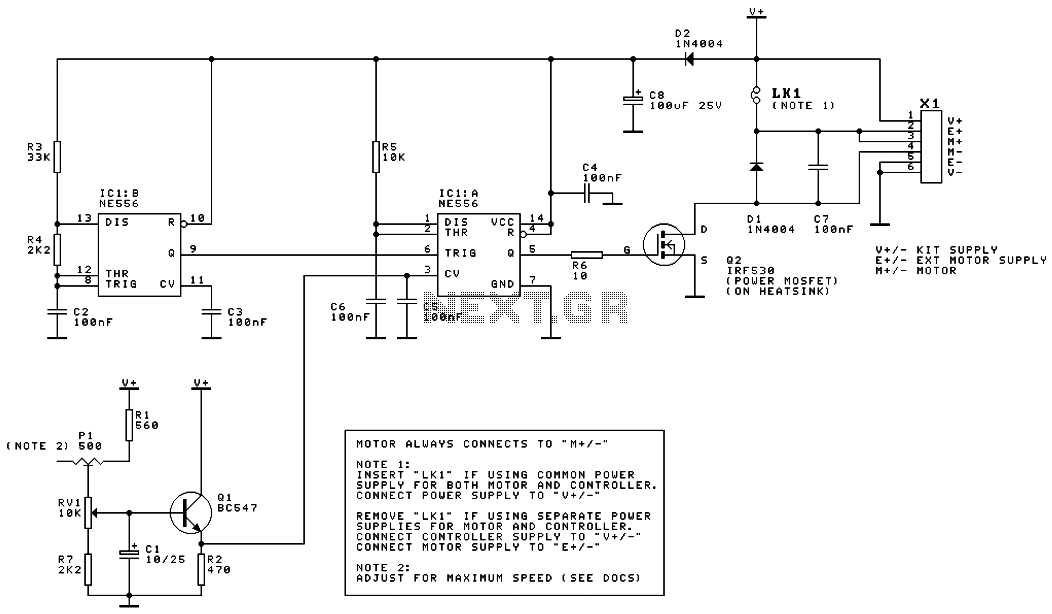
DC Motor Speed Controller
This is the schematic diagram of a DC motor speed controller circuit. The circuit utilizes two oscillators/timers that are configured as a Pulse Width Modulator (PWM). The timer chip used in this circuit is a dual NMOS timer/oscillator.
The DC motor...

Electrical drive III
For the DIY Motion Platform III, the electrical motion drive was expanded to three channels. The small signal concept remained unchanged, but the MOSFET half-bridge was modified to a full bridge (H-bridge). The DAC converter was upgraded to a four-channel...
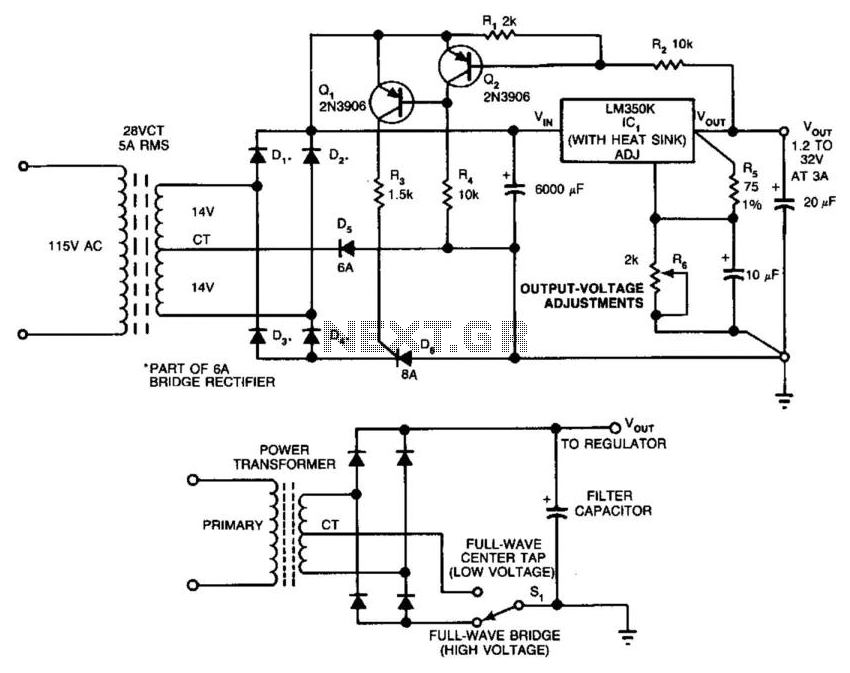
Switching Improves Regulator Efficiency
In this circuit, a full-wave bridge is switched to a full-wave center tap to reduce regulator dissipation. SCR D6 switches between configurations. When D6 is off, the circuit is an FWCT rectifier using D1, D2, and D5. It applies 17...
h bridge
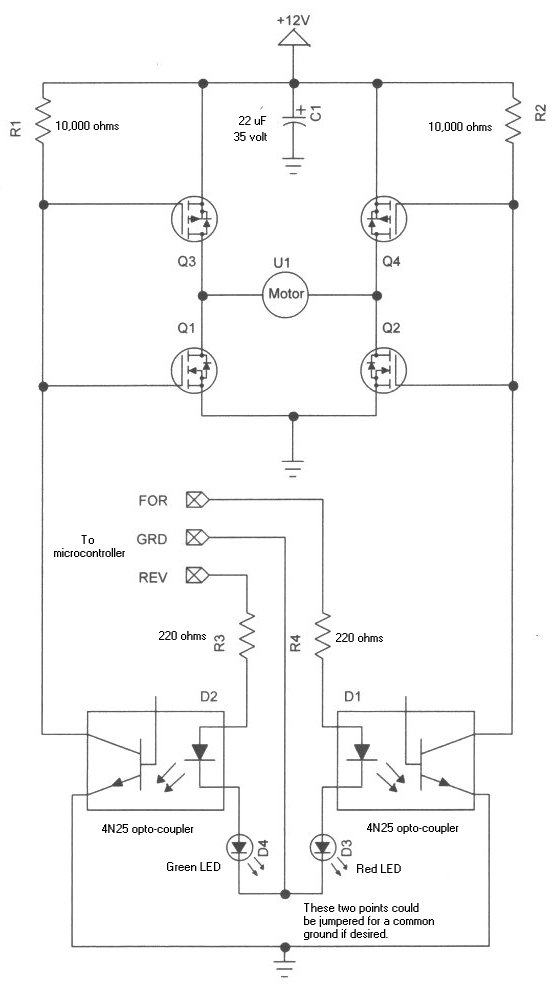
Learning how to use power MOSFETs by building an H-bridge motor control.
The H-bridge motor control circuit is an essential configuration for driving DC motors in both forward and reverse directions. It utilizes four power MOSFETs arranged in a bridge configuration,...