


SH-816 ASIC holiday lights
#holiday lights
#ASIC
#function selection
#LED control
#light patterns
#decoration
#button control
#lighting effects
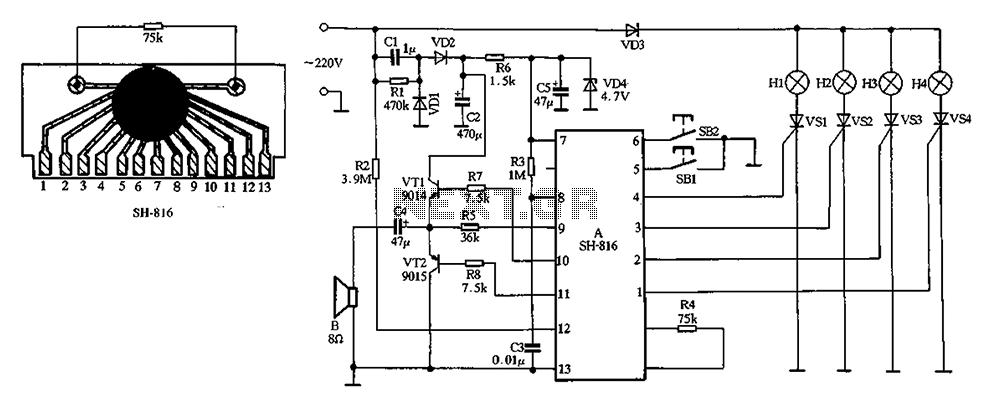
Description: The chip includes four built-in procedures for controlling double bond jumps, offering eight different jump patterns. Function selection is managed through button SB2, while button SB1 allows for additional features. The system can produce eight types of light-hop patterns, with SB2 enabling the following controls: 1. Volume control with large jump variations (there are four types of jumps: all four lights flash simultaneously with the music beat; two lights flash alternately with the music; a single lamp flashes in sync with the music; four lights illuminate sequentially with the music beat and extinguish in turn, automatically switching jump methods after each song). 2. Four types of jumps with volume increase; 3. Small volume jump variations with four different methods; 4. Eight light-hop fashion cycles; 5. All string lights illuminate simultaneously. Button SB1 locks the eight light-hop modes and is only active when SB2 is pressed. Specific light jump patterns include: 1. Sequential single lamp flashes; 2. Alternating water flow effects; 3. Twinkling star effects with self-moving changes; 4. Sequential illumination and extinguishing of four lamps; 5. A single light that slowly fades while changing automatically (similar to rolling waves); 6. Two adjacent lamps where one fades while the other illuminates slowly, moving forward; 7. Four lights that slowly fade; 8. Flashing star lights. The SH-816 operates at a voltage regulated by the CI Buck, with VD1, VD2 serving as rectifiers and VD4 functioning in the filter regulator, supplied by C5. To achieve higher volume, the audio amplifier VT1 and VT2 draw power from the left end of resistor R6. The amplification circuit employs complementary outputs of VT1 and VT2, with negative feedback provided by resistors R5, R7, and R8 for current limiting. The complementary circuits are utilized to adjust the static operating point.
The circuit design incorporates a microcontroller that manages the various light and sound outputs based on user inputs from the function selection buttons. The chip's architecture allows for the seamless execution of multiple jump patterns and sound variations, enhancing user experience during operation. The audio amplifier section is critical for sound output; it is designed to handle varying loads while maintaining sound fidelity. The use of complementary transistors in the amplification stage ensures efficient power handling and minimizes distortion.
The rectification and filtering components (VD1, VD2, and VD4) are essential for converting AC voltage into a stable DC supply, which is crucial for the reliable operation of the entire circuit. Capacitor C5 plays a vital role in smoothing out any voltage fluctuations, ensuring that the microcontroller and amplifier receive a consistent power supply. The resistors R5, R7, and R8 provide necessary feedback and current limiting, which stabilizes the operation of the amplification circuit and protects against overload conditions.
In summary, the described chip and its associated circuitry provide a comprehensive solution for controlling light and sound in a dynamic and engaging manner, suitable for various applications where visual and auditory effects are desired. Chip has four built +8 kinds of tricks jumps procedure for the control of the double bond. Connected to 6 feet of function selection buttons SB2 is key, then the key SB1 is 5 f eet 8 kinds of light-hop fashion lock key. Pressing the SB2 can achieve the following controls: 1 volume + big jumps species (four kinds of jumps: Four lights flash at the same time with the beat of the music Shuo, a group of two lights flashing alternately with the music beats, flow-through single lamp flashes with the music beat four lights lit one by one with the beat of the music, in turn, extinguished conversion method to automatically replace a jump method Zouwan every one song after); 2, +4 kinds of jumps in volume; 3, small volume jump species +4 law; 4,8 kinds of light-hop fashion cycle; 5, string lights all bright. SBI to eight kinds of light hop mode lock key, it is only in the fourth SB2, press SBI to function. Specific Lights jump ways: 1, followed by a single lamp flashes: 2, along the water, pour the water alternates; 3 stars twinkling, Happy Valley-type self- moving changes; 4, four-by-turn lamp is lit, then turn off one by one: 5 single light up slowly fades automatically change (like rolling waves): 6, two adjacent lamps, a light fades, another lights up slowly, followed by forward move {7, while four lights slowly fades: 8, star light flashes.
SH-816 operating voltage by the CI Buck, VD1, VD2 rectifier, VD4 filter regulator supplied with c5. To obtain a larger volume, audio amplifier VT1, VT2 operating power from the left end of the resistor R6. To improve the sound quality, an amplification circuit using VT1, VI2 complementary outputs. Its negative feedback resistor R5, R7, R8 as current limiting yang, complementary circuits used to adjust the static working point.
The circuit design incorporates a microcontroller that manages the various light and sound outputs based on user inputs from the function selection buttons. The chip's architecture allows for the seamless execution of multiple jump patterns and sound variations, enhancing user experience during operation. The audio amplifier section is critical for sound output; it is designed to handle varying loads while maintaining sound fidelity. The use of complementary transistors in the amplification stage ensures efficient power handling and minimizes distortion.
The rectification and filtering components (VD1, VD2, and VD4) are essential for converting AC voltage into a stable DC supply, which is crucial for the reliable operation of the entire circuit. Capacitor C5 plays a vital role in smoothing out any voltage fluctuations, ensuring that the microcontroller and amplifier receive a consistent power supply. The resistors R5, R7, and R8 provide necessary feedback and current limiting, which stabilizes the operation of the amplification circuit and protects against overload conditions.
In summary, the described chip and its associated circuitry provide a comprehensive solution for controlling light and sound in a dynamic and engaging manner, suitable for various applications where visual and auditory effects are desired. Chip has four built +8 kinds of tricks jumps procedure for the control of the double bond. Connected to 6 feet of function selection buttons SB2 is key, then the key SB1 is 5 f eet 8 kinds of light-hop fashion lock key. Pressing the SB2 can achieve the following controls: 1 volume + big jumps species (four kinds of jumps: Four lights flash at the same time with the beat of the music Shuo, a group of two lights flashing alternately with the music beats, flow-through single lamp flashes with the music beat four lights lit one by one with the beat of the music, in turn, extinguished conversion method to automatically replace a jump method Zouwan every one song after); 2, +4 kinds of jumps in volume; 3, small volume jump species +4 law; 4,8 kinds of light-hop fashion cycle; 5, string lights all bright. SBI to eight kinds of light hop mode lock key, it is only in the fourth SB2, press SBI to function. Specific Lights jump ways: 1, followed by a single lamp flashes: 2, along the water, pour the water alternates; 3 stars twinkling, Happy Valley-type self- moving changes; 4, four-by-turn lamp is lit, then turn off one by one: 5 single light up slowly fades automatically change (like rolling waves): 6, two adjacent lamps, a light fades, another lights up slowly, followed by forward move {7, while four lights slowly fades: 8, star light flashes.
SH-816 operating voltage by the CI Buck, VD1, VD2 rectifier, VD4 filter regulator supplied with c5. To obtain a larger volume, audio amplifier VT1, VT2 operating power from the left end of the resistor R6. To improve the sound quality, an amplification circuit using VT1, VI2 complementary outputs. Its negative feedback resistor R5, R7, R8 as current limiting yang, complementary circuits used to adjust the static working point.
CD71061 holiday lights ASIC
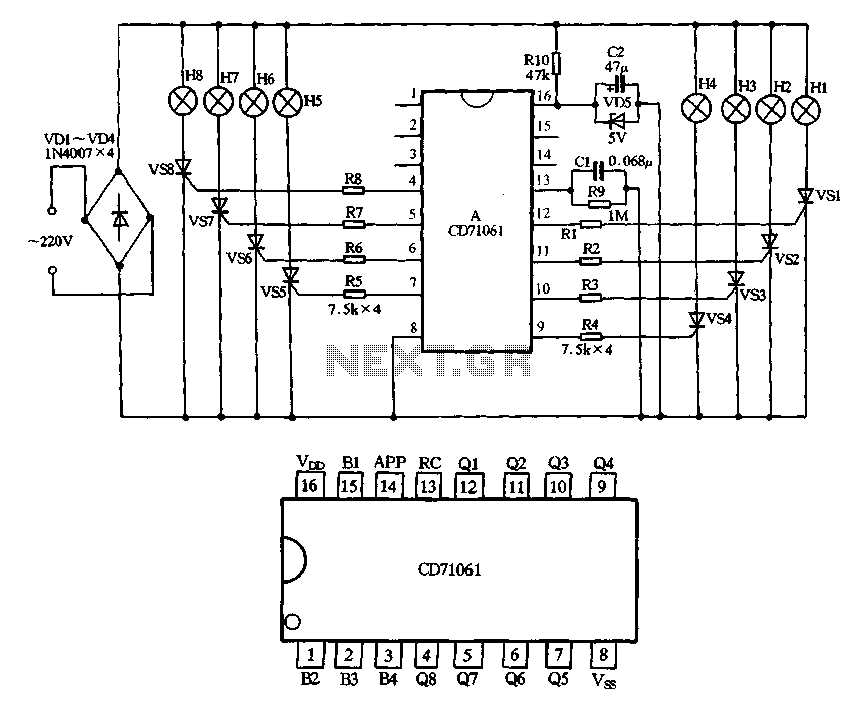
A 220V AC input is processed through a VD4 bridge rectifier, followed by a resistor R10 buck regulator, a VD5 regulator, and a capacitor C2. This setup filters the supply to power the manifold. The output trigger signal from the...
SR63 holiday lights ASIC
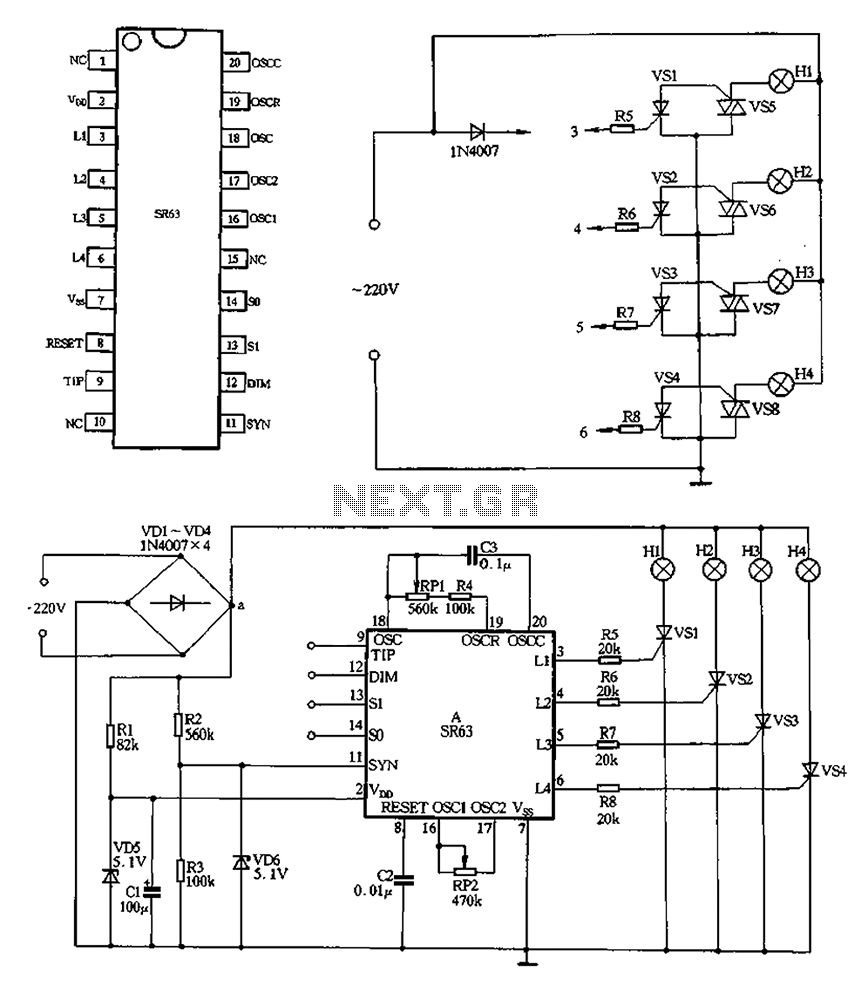
220V AC is converted to DC after passing through a VDI ~ VD4 bridge rectifier. The output from one point supplies power directly to lights H1 through H4. Another route passes through R1, a buck converter, and VD5, which regulates...
SH-868 ASIC holiday lights
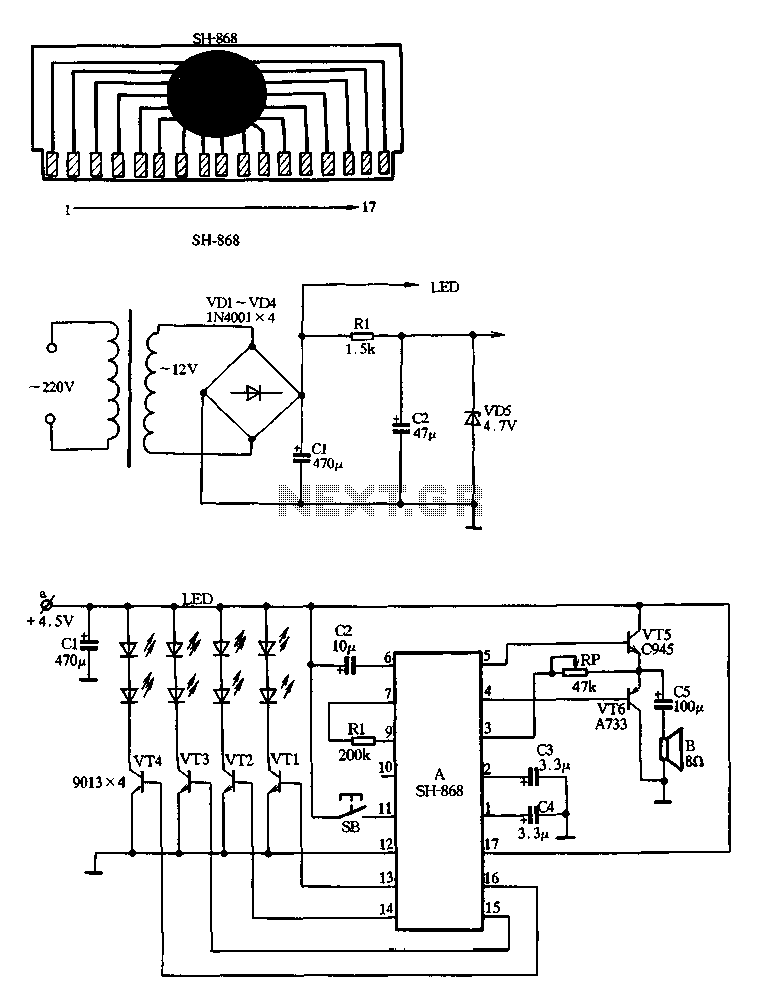
Figure 2-80 illustrates the SH-868, an integrated circuit designed for a music flash circuit powered by three batteries. It can drive a flashing light-emitting diode (LED) while simultaneously activating a sound speaker. The device features a function selection button (SB)...
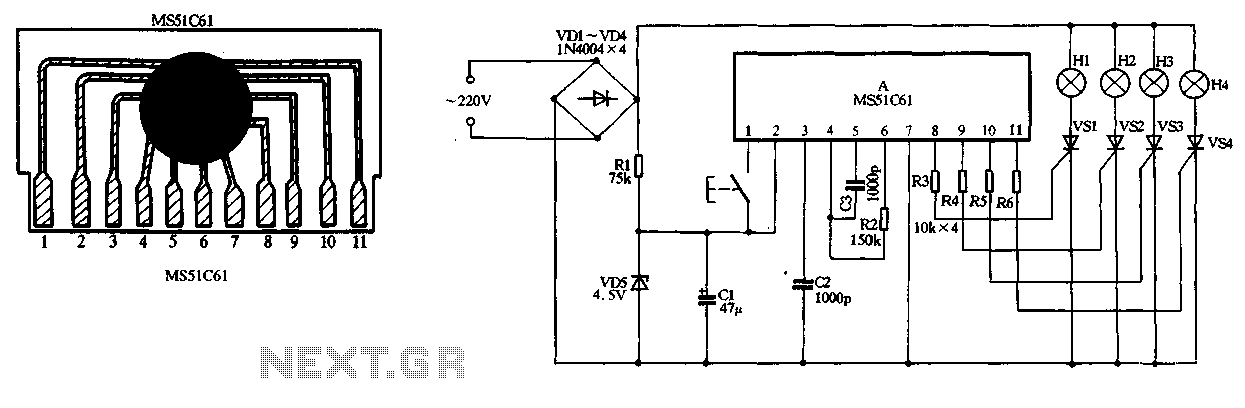
MS51C61 holiday lights ASIC circuit
The circuit utilizes a 220V AC input, which is converted to DC using a VD1-VD4 bridge rectifier. This rectified voltage is used to power four lights (H1 to H4). The circuit also includes a resistor (R1) for voltage limiting and...
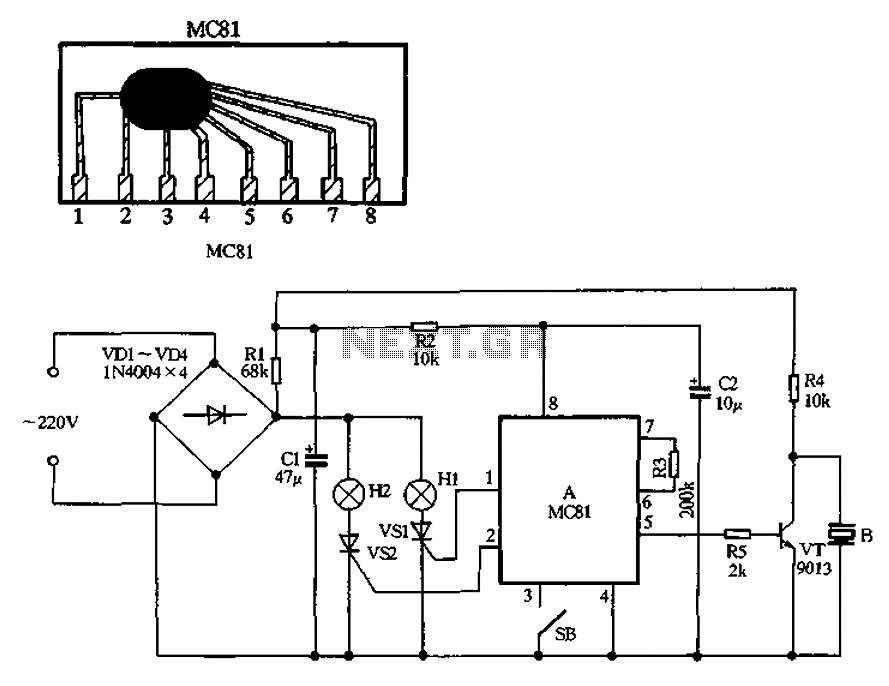
MC81 holiday lights ASIC
A 220V AC power supply is utilized with a VDI ~ VD4 bridge rectifier, which provides electricity to the lights Hl and H2. The circuit includes two resistors, Rl and R2, that act as current-limiting components for the capacitors C1...
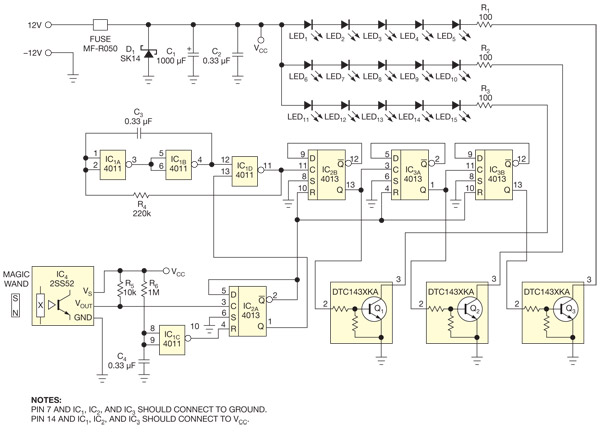
Control your Holiday Lights with a Magic Wand
This circuit enables the activation of holiday bulbs with a wave of a magic wand. The strings of lights flash in a sequential manner. The core concept relies on a magnet.
The circuit operates by utilizing a magnet as the primary...
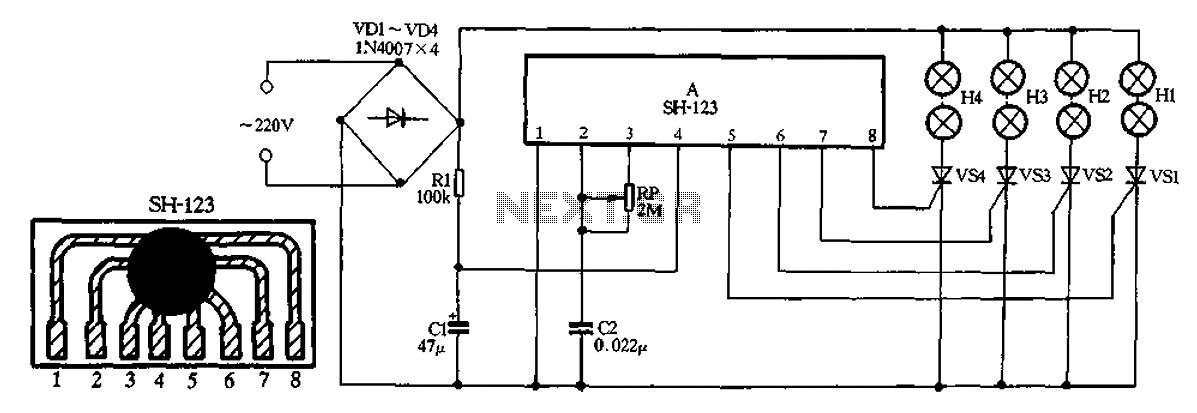
SH-123 ASIC holiday lights
A 220V AC input is processed by a bridge rectifier consisting of diodes VD1 to VD4, which supplies electricity to four lights labeled H1 to H4. The circuit includes a limiting resistor R1 and a filter capacitor C1 to stabilize...
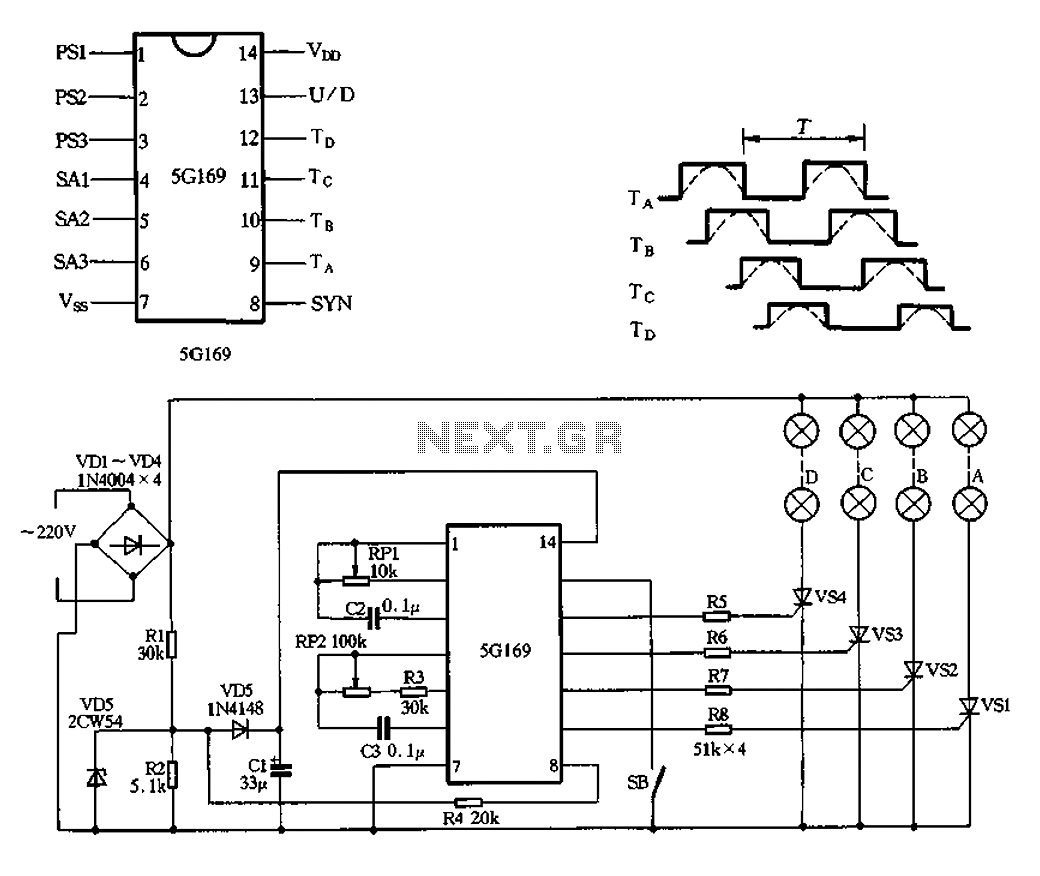
5G169 holiday lights integrated circuit
The circuit features an AC input from VDI, which is converted to pulsating DC power using a VD4 full-wave bridge rectifier to power four lights. Resistors R1 and R2, along with diode VD5, form a simple circuit, while VD6 serves...
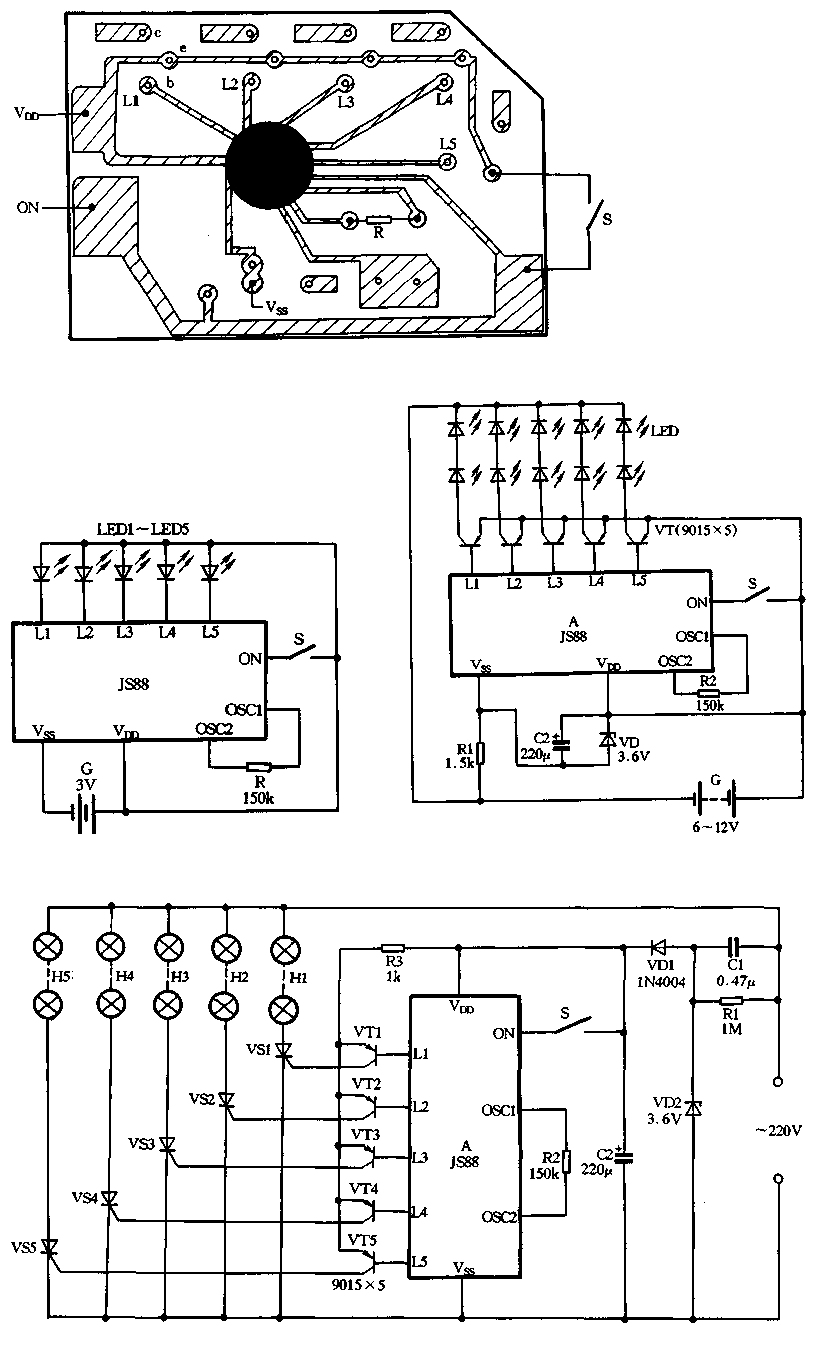
JS88 holiday lights IC circuit
Figure 2-39 illustrates a typical application circuit for the JS88 manifold, which includes an oscillation resistor (R) that allows for fine-tuning of the water flicker frequency. When switch (S) is closed, components L1 to L5 sequentially output low signals from...